Introduction
For the first five decades of Utah telephone service, a single three-digit prefix covered the entire state, and the 801 area code is that original code, still anchoring the busiest corner of the Wasatch Front today. When a call lights up your phone from this prefix, it almost certainly traces back to the Salt Lake City metro. Most guides gloss over the exact overlay timeline, still repeating a 2001 date that is off by seven years. This guide unpacks where the code reaches, how it earned its status as the state's founding prefix, and how to put one to work even if your desk sits a thousand miles away. By the end, you will know precisely why a Wasatch Front phone number still carries real weight with buyers across the metro.
Key Takeaways:
- The 801 area code was one of the original 86 area codes assigned across North America in 1947.
- Its overlay partner, 385, actually joined the metro on June 1, 2008, not 2001 as several older guides claim.
- A local number still boosts answer rates, since most shoppers favor businesses that look local.
- Cloud phone platforms let any business activate a matching number without an office in Utah.
The Story Behind the 801 Area Code
The 801 area code is one of the original 86 area codes assigned to North America in 1947, when the continent's telephone network was first carved into numbering zones. For fifty years it stood alone as Utah's only code, covering every city, town, and ranch from border to border. That changed on September 21, 1997, when rural Utah was split off into its own prefix, leaving this code to serve the densely populated Wasatch Front corridor it still covers today, a founding status that gives it a quiet sense of establishment newer prefixes have not had time to earn.
One of America's First 86 Area Codes
Few callers realize that a number's middle digit once told you exactly how much territory a code covered. Every original 1947 area code with a middle digit of 0, including 801, was designed to serve an entire state, while a middle digit of 1 marked a state split across multiple codes. That naming convention was retired in 1953 once the country ran out of easy zero-and-one combinations to assign, but it explains precisely why this prefix once stretched across all of Utah rather than a single region.
Why That History Still Matters Today
Understanding that original design makes the later 1997 split easier to follow: Utah simply outgrew the single-code model that convention assumed every state would keep. The same growth pressure would eventually force a second overlay onto the metro just over a decade later, a pattern that has repeated across several other fast-growing American states as their original single-code systems ran out of room.
Which Cities Does the 801 Area Code Cover?
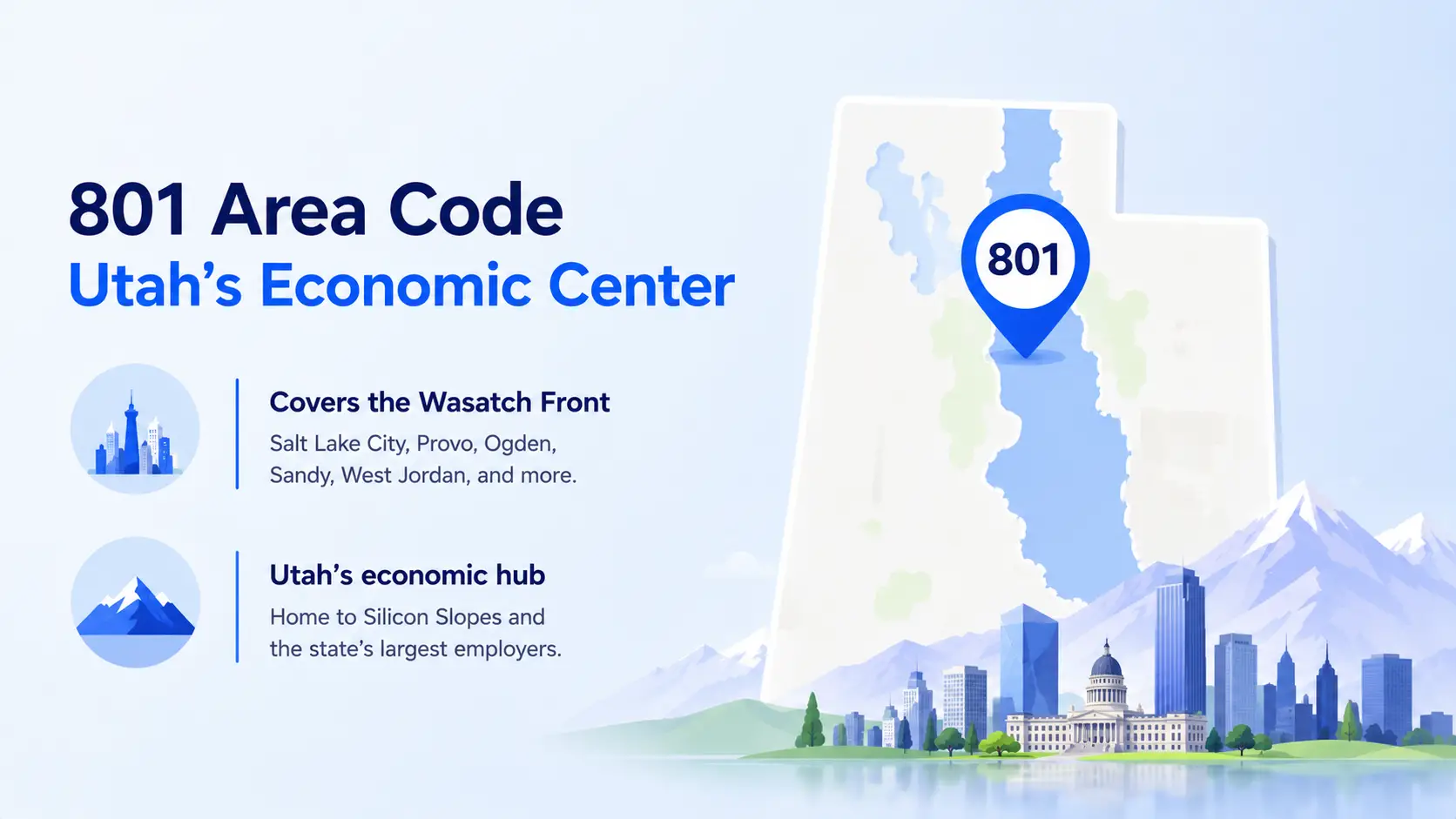
Today the 801 area code blankets the Wasatch Front, the roughly 120-mile urban corridor running along the western base of the Wasatch Range. Cities served include Salt Lake City, West Valley City, Provo, Orem, Ogden, Sandy, West Jordan, Layton, and Lehi, a corridor that concentrates so much of the state's tech, finance, and healthcare industry that it is often branded Silicon Slopes. A matching number in this range signals a presence in Utah's economic center rather than its rural outskirts, and a Wasatch Front phone number reads as local to nearly every major employer in the state.
How 801 and 385 Share the Same Map
Unlike a clean geographic split, the metro now runs on an overlay: the 801 area code and the newer 385 prefix cover the exact same cities, stacked directly on top of one another. Regulators activated 385 on June 1, 2008, once the original numbering pool approached exhaustion, layering the new code over the identical territory rather than redraw any boundaries. Ten-digit dialing did not become mandatory that same day; callers could still dial locally with seven digits until June 1, 2009, giving residents a full year to adjust. Two neighbors on the same street can hold different codes while sharing everything else about their address, right down to the same block, the same zip code, and often the same shared driveway.
Why an 801 Area Code Number Still Builds Trust
Local numbers continue to shape whether people decide to pick up. Most consumers are more likely to answer a call that shares their own regional prefix, and roughly 60% of shoppers prefer doing business with a company that appears local, an edge that helps any business courting the Salt Lake City metro. Sales teams dialing from a local 801 number tend to see higher pickup rates, and given the code's long history, it signals staying power on top of that. A Wasatch Front phone number carries that credibility well before a customer ever hears a human voice.
Which Industries Benefit Most
Professional services firms, healthcare clinics, and financial advisors see some of the clearest gains, since clients in the Salt Lake City metro actively screen calls from unfamiliar out-of-state numbers. Real estate agents and contractors report similar patterns, particularly for showing confirmations and appointment reminders that need a real response rather than a canned voicemail greeting. Even a fully remote team selling into Provo or Ogden can borrow this local credibility without leasing a single square foot of downtown office space. Insurance agencies and property managers report a similar lift, since renewal calls and maintenance follow-ups both depend on a customer actually answering the phone on the first attempt.
How to Get a Business Phone Number from Rozper
Rozper provisions local, international, and toll-free numbers across 150+ countries, backed by 99.999% uptime and CRM-ready integrations with Salesforce, HubSpot, and Zoho. Support comes from a real 24/7 team rather than a bot tree, which matters most on the day a routing rule needs fixing fast. Getting a matching number set up takes only a handful of steps.
- Visit the website and start a no-pressure conversation about your goals.
- Share your business email and a bit about your call volume and markets.
- Get a custom quote — the plan is not fixed, so you only pay for what you use.
- Choose your number type: local, international, toll-free, or a second number for privacy.
- Pick your country or area code from the 150+ countries in coverage, including 801.
- Set up call forwarding, call recording, and CRM integration with the onboarding team.
- Port your existing number over with minimal disruption and start taking calls.
A Second Number Instead of a New Line
Not every business needs a full second phone system just to test a market. A second number tied to the same device keeps a personal line separate from a business one, or lets a company trial a Wasatch Front phone number before committing to a bigger local push. This approach works particularly well for consultants and small teams who want an 801 presence without provisioning a whole new desk phone setup. It is a smaller step than a full number change, and it can always scale into a larger deployment once call volume justifies it.
Setting Up Call Routing for a Growing Salt Lake City Team
A single 801 number rarely stays a single line for long once a business starts booking real volume. Modern cloud systems let one number ring several devices at once, or hand off to a different team member automatically after a set number of rings. Sales teams calling into the same overlay complex, whether the prospect holds an 801 number or a 385 area code number, can route every inbound call through one shared queue instead of juggling separate lines. That setup also makes it far easier to track which marketing channel actually drove the call, since every inbound number can carry its own tag inside a CRM dashboard. Teams expanding beyond the metro can apply the same routing logic to a rural prospect list as well, without standing up a second phone system just to cover a different part of the state.
What People Get Wrong About This Prefix
A common assumption is that the 801 area code belongs only to Salt Lake City proper, when it actually spans dozens of municipalities across several counties. Others assume that because 385 exists, this original code is being phased out; it is not, and both codes remain fully active with existing numbers staying right where they are. According to Wikipedia's overlay history, 385 entered service on June 1, 2008, not 2001 as several older guides still repeat, with mandatory ten-digit dialing following a year later. Porting trips people up too: most modern carriers let a business keep its existing digits while switching providers, so confirming porting support before signing anything avoids a needless renumbering headache.
801 vs. Nearby Utah Area Codes
Utah's numbering map is short but layered. This metro code and 385 share the Wasatch Front as an overlay, while the 435 area code covers the rural remainder of the state as a separate geographic region instead. None of the three signals a better or newer part of Utah; they simply mark different chapters in the state's growth, from the founding 1947 code to the 1997 rural split to the 2008 metro overlay.
Conclusion
More than a routing detail, this prefix is a piece of Utah history: the state's original telephone code, still beating at the center of its largest cities more than three-quarters of a century after it was assigned. Whether you are tracing an unknown call or planning a local presence, knowing the code's real origins and reach puts you well ahead of the average caller. As the Wasatch Front keeps growing, expect these digits to stay woven into everyday Utah communication for a long time to come. That founding history is exactly what makes this prefix such a dependable anchor for a Salt Lake City business identity.
A Wasatch Front phone number is one of the simplest ways to signal that reach before a customer even picks up. Rozper can activate a matching number in minutes, without requiring a single square foot of Utah office space. Start the conversation whenever the timing works for your team. Put the state's founding area code to work for your business, and let that decades-long reputation do some of the trust-building for you.
FAQs
Which cities does the 801 area code cover?
It covers the Wasatch Front metro, including Salt Lake City, Provo, Ogden, Sandy, Orem, and West Valley City. These cities sit along Utah's densely populated urban corridor near the mountains.
Is 801 being replaced by 385?
No, both codes run as an overlay across the same metro, and existing numbers stay fully active. 385 was simply added in 2008 to expand the available number supply.
Can I get an 801 area code number if I live outside Utah?
Yes, cloud phone providers let you request and route a number tied to the metro. Setup takes minutes regardless of where you physically live or work.
Why do I have to dial ten digits for local calls?
Because the metro uses an overlay, every local call needs the full ten-digit number. This applies even between close neighbors sharing the exact same street.
What time zone does the 801 area code use?
The entire 801 region sits in the U.S. Mountain Time Zone year-round. It observes daylight saving time from March through November, same as the rest of Utah.
Is an 801 area code number safe to answer or call back?
Yes, it is a standard geographic prefix, not a premium-rate or international scam code. As with any area code, individual callers can still attempt scams, so normal caller-ID caution still applies.
Why was 801 one of the first area codes in the country?
It was assigned in 1947 during the original rollout of the North American Numbering Plan. Only 86 codes existed at that launch, and 801 was one of the very first.
How do I get a business phone number from Rozper for this area code?
Visit rozper.com, share your business email and call volume, and get a custom quote for your number. The team provisions the number, sets up CRM integration, and ports your existing digits if needed.