Introduction
Greater New Orleans has used the 504 area code since 1947. Few prefixes carry as much local pride, showing up on shirts, songs, and storefronts across the city. Maybe a call from this code just landed on your phone. Maybe you run a business and want a local number in New Orleans or Metairie. Either way, this guide explains what the 504 area code covers and where it came from. You'll learn its geography, its history, the cities it reaches, and the dialing rules that come with it.
Key Takeaways:
- The 504 area code covers Greater New Orleans, including Orleans, Jefferson, St. Bernard, and Plaquemines parishes.
- It has covered the entire state of Louisiana since 1947, shrinking through splits in 1957, 1998, and 2001.
- The code has no overlay, yet 10-digit dialing became mandatory statewide in 2021.
- "504" doubles as a badge of New Orleans identity beyond just a phone prefix.
Where Is the 504 Area Code Located?
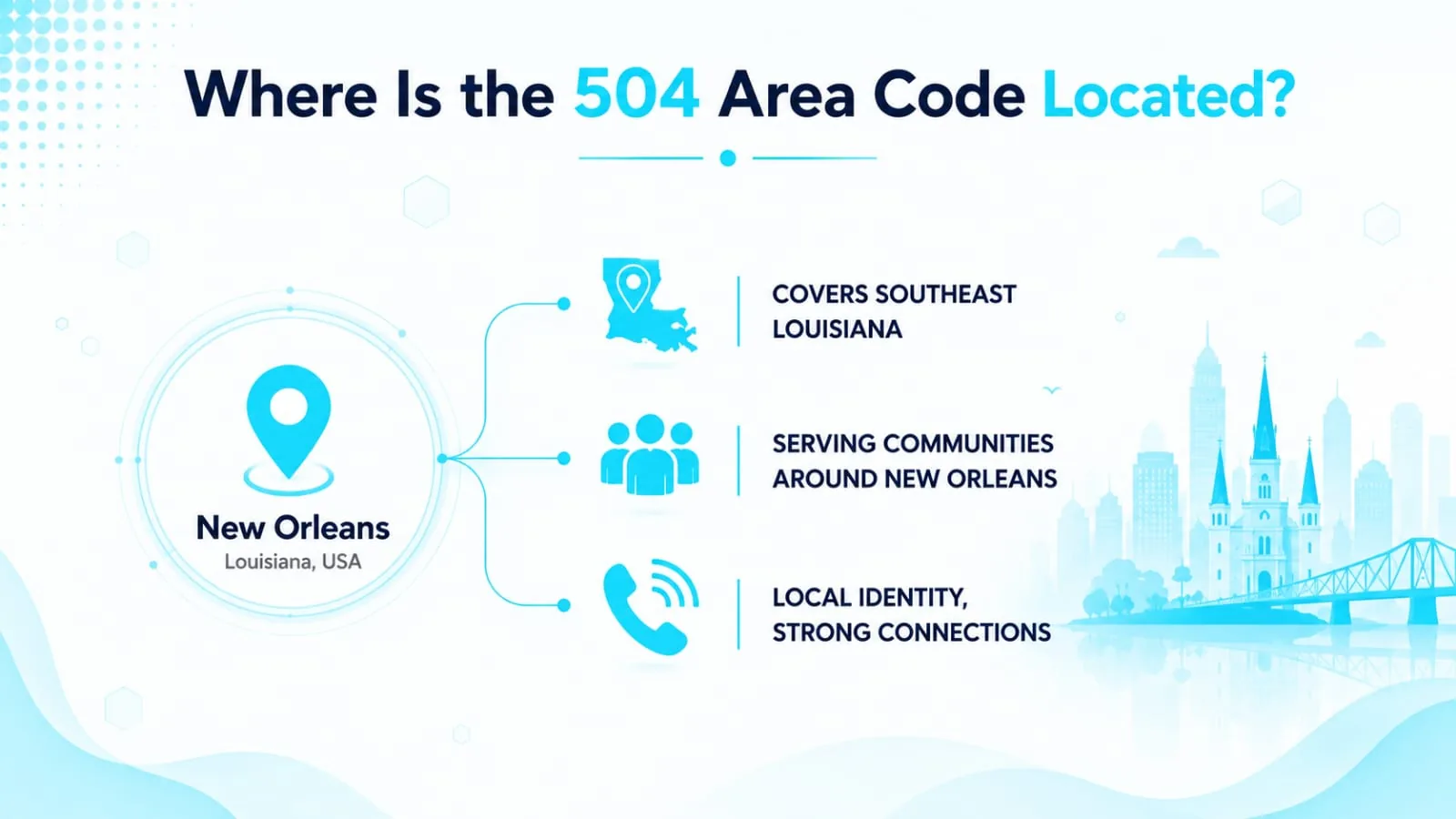
This area code covers the Greater New Orleans metro, tucked along the Gulf Coast where the Mississippi River meets the sea. It once spanned a much larger territory. Today it wraps tightly around the city and its closest parishes, a compact urban footprint rather than a sprawling rural one. It sits apart from the rest of the state, which uses different codes. More than a phone prefix, "504" has become shorthand for the Crescent City itself.
- 504 covers Orleans, Jefferson, St. Bernard, and Plaquemines parishes.
- New Orleans sits at its heart, on the Mississippi River.
- The footprint is compact and heavily urban.
- The code doubles as a badge of city identity and pride.
History and Origin of the 504 Area Code
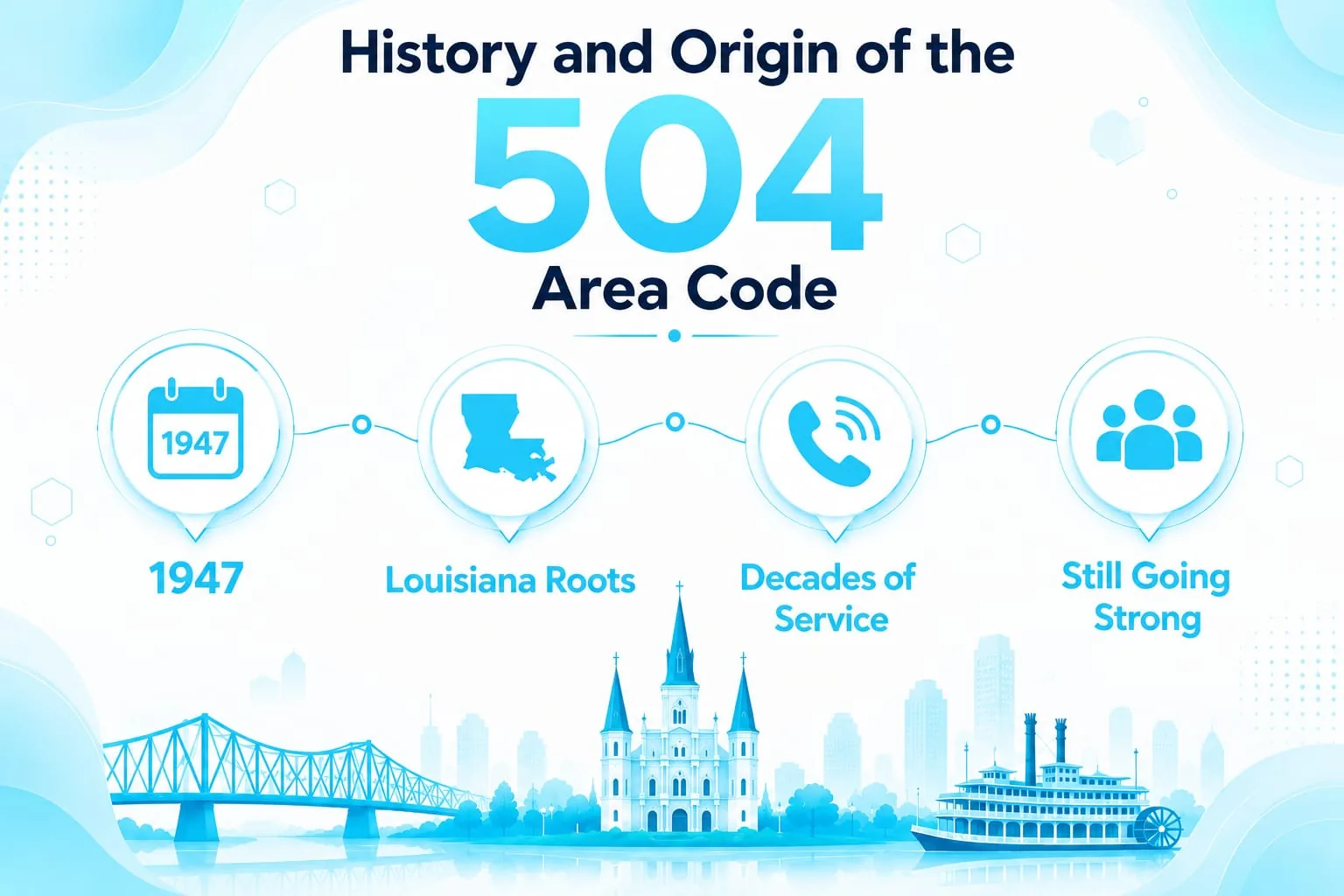
The 504 area code is one of the original codes in the country. It went live in 1947 as one of the first 86 area codes ever assigned. At first it covered the entire state of Louisiana. That did not last. In 1957, everything west of the Mississippi River moved to area code 318. Decades later, growth around the city forced two more changes. In 1998, Baton Rouge moved to area code 225, and in 2001, the North Shore and bayou parishes moved to 985. Each split left 504 smaller, until it settled around the New Orleans metro it defines today.
Area Code 504 Compared to Nearby Louisiana Codes
The state runs on several area codes, and 504 anchors the southeastern corner around New Orleans. To the northwest, area code 225 covers Baton Rouge, while 985 covers the North Shore and the bayou parishes just outside the city. Further west, the 337 area code covers Acadiana and the Lake Charles region. What sets 504 apart is how compact and iconic it is.
A small, dense footprint
Unlike the wide rural codes elsewhere in the state, 504 packs a whole metro into a tight cluster of parishes. That density is part of why the code feels so tied to one place.
A code with no overlay
The 504 area code has no second code layered on top of it. Every line in the metro, from a corner store to a mobile phone, shares the same prefix.
Cities and Communities Served by the 504 Area Code
This area code reaches a dense mix of city neighborhoods and suburbs. New Orleans anchors it, from the French Quarter to the Garden District and beyond. Metairie and Kenner spread west through Jefferson Parish as major suburban centers. Downriver, Chalmette and the St. Bernard communities carry deep working-class and fishing roots.
Across the river sit Gretna, Marrero, and Harahan, part of the West Bank that grew alongside the city. Belle Chasse and the Plaquemines communities stretch toward the Gulf. Choosing which of these markets to target is its own decision, and our area code guide helps weigh the options.
Time Zone and Dialing Rules for the 504 Area Code
Every community in this area code runs on Central Time. That means Central Standard Time in winter and Central Daylight Time in summer, matching the rest of the state. The dialing rule holds a surprise. Even though 504 has no overlay, 10-digit dialing is now required for every local call. That rule took effect in 2021, when Louisiana went all-digit to make room for the 988 crisis line. So callers must include the area code, even for a neighbor next door. The Wikipedia entry on area code 504 lays out the full timeline.
Why Businesses Choose a 504 Area Code Number
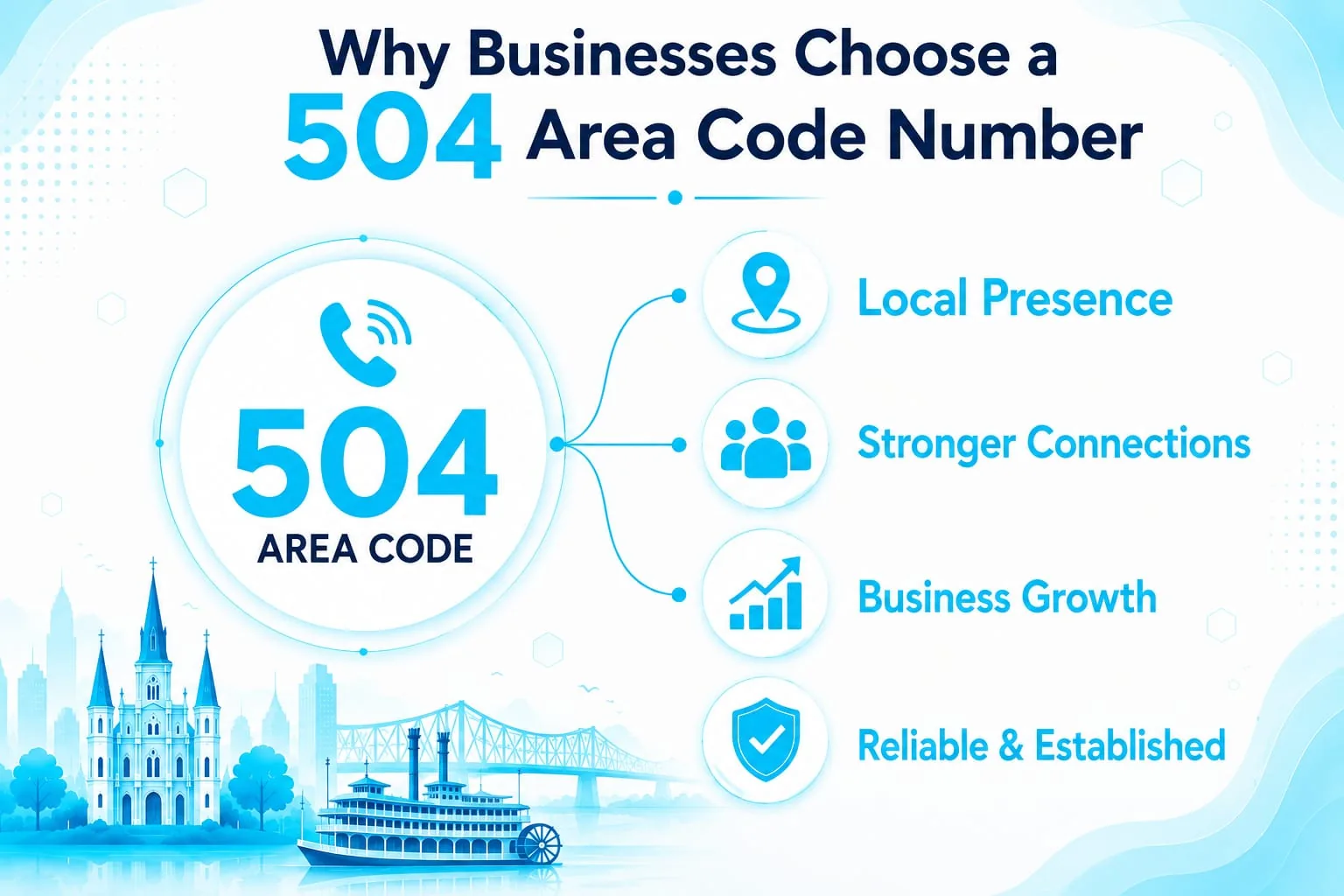
A local number in this area code sends a powerful signal. Few codes carry as much hometown weight as 504, so a matching number instantly reads as authentically New Orleans. That local pride still drives trust and referrals here. Businesses expanding into New Orleans or Metairie often pick up a 504 number so their caller ID fits right in.
This is where a cloud phone provider like Rozper fits in. A business doesn't need a physical office in the city. Rozper lets it set up a local 504 number through a VoIP platform instead. The local presence stays intact, and calls can route anywhere the team actually works. Rozper backs that setup with 99.999% uptime and coverage across 150+ countries. A company can claim a New Orleans number while its support or sales team works from anywhere else. It's a practical way to plant a flag in the Crescent City without signing a lease.
How to Get a 504 Area Code Number
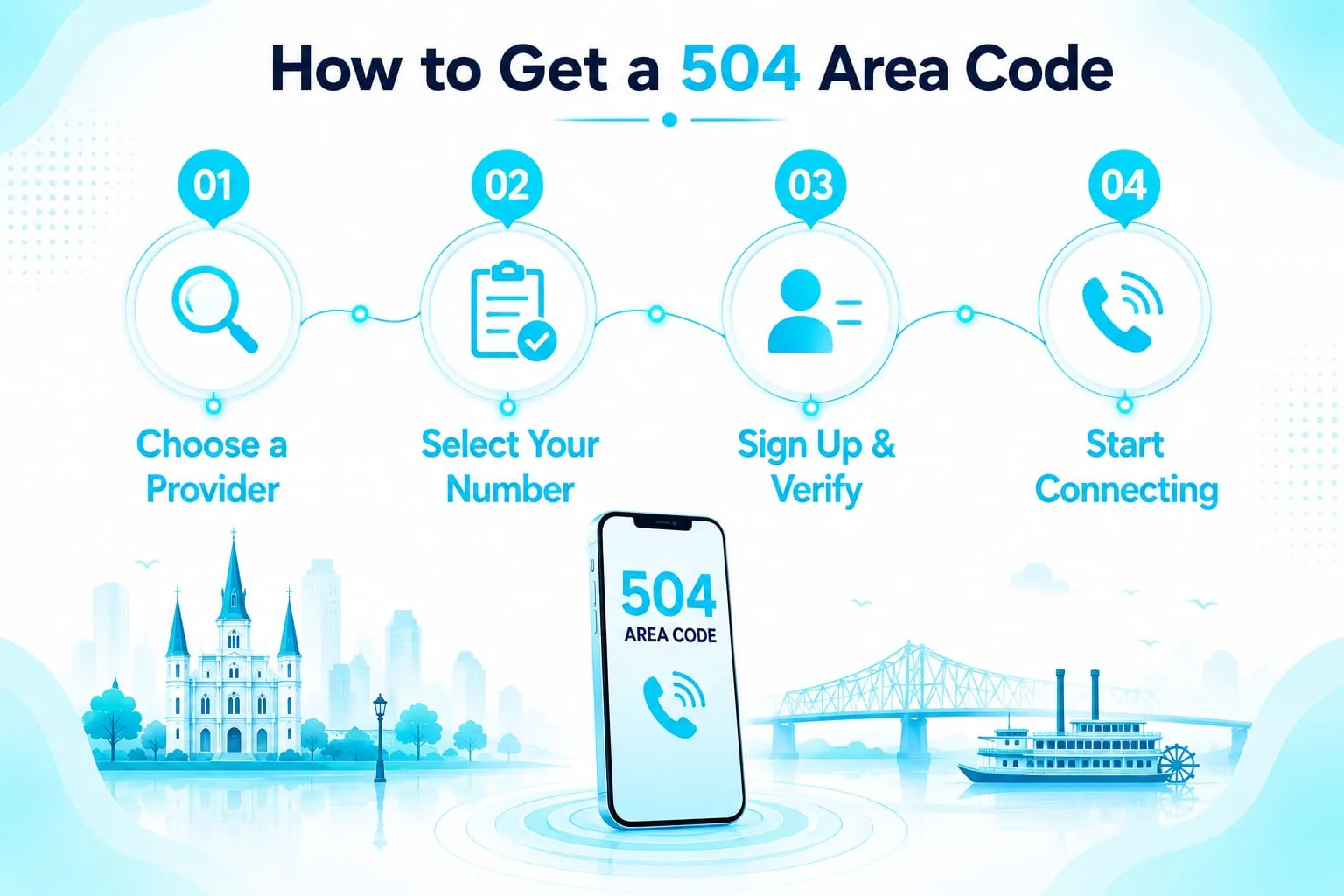
Getting a new number in this area code usually means going through a phone provider. That's different from the phone company that first assigned the block decades ago. VoIP providers can issue one in minutes. The process looks the same almost everywhere:
- Pick a cloud or VoIP provider that offers coverage in the metro.
- Search available numbers in the 504 area code and choose one that fits.
- Confirm the number and point it at your existing phones or app.
- Route incoming calls to any team, wherever they actually sit.
Businesses moving a number from an old provider need one extra step. They file a standard porting request, which usually takes a few business days. It's worth confirming the old number keeps working normally during the transfer.
Conclusion
Area code 504 began in 1947 as a statewide code and shrank over the decades to the Greater New Orleans metro it defines today. It covers New Orleans, Metairie, Kenner, and the parishes that ring the city. Its Central Time zone and mandatory 10-digit dialing shape how every local call connects. For residents, the 504 area code is far more than a prefix; it's a badge of Crescent City pride. For businesses eyeing New Orleans, it's a small but powerful signal of local presence.
FAQs
When was area code 504 created?
It went into service in 1947 as one of the first 86 area codes in the country. At first it covered the entire state before shrinking over the decades.
What cities does the 504 area code cover?
It covers Greater New Orleans, including New Orleans, Metairie, Kenner, Chalmette, Gretna, and Marrero. These sit inside Orleans, Jefferson, St. Bernard, and Plaquemines parishes.
Do I need to dial 10 digits for local calls in this area code?
Yes. Even though the 504 area code has no overlay, the state switched to mandatory 10-digit dialing in 2021. Every local call now needs the area code included.
Is area code 504 the same as area code 985?
No. Area code 985 split away in 2001 to cover the North Shore and bayou parishes. Today 504 covers only the core New Orleans metro.
What time zone does the 504 area code use?
The entire region runs on Central Time. It follows the same standard and daylight schedule as the rest of the state.
Is a call from the 504 area code safe to answer?
Yes, it's a standard code used by New Orleans residents and businesses alike. As with any call, stay cautious about sharing personal details with an unfamiliar number.
Can a business outside Louisiana get a 504 area code number?
Yes. VoIP providers can issue a number in this area code to any business, wherever it's based. Rozper, for example, can set one up with call routing and support for remote teams.
Why does the 504 area code require 10-digit dialing without an overlay?
The state went all-digit statewide in 2021 to free up numbers for the 988 crisis line. That made 10-digit dialing standard even in single-code regions like the 504 area code.