Introduction
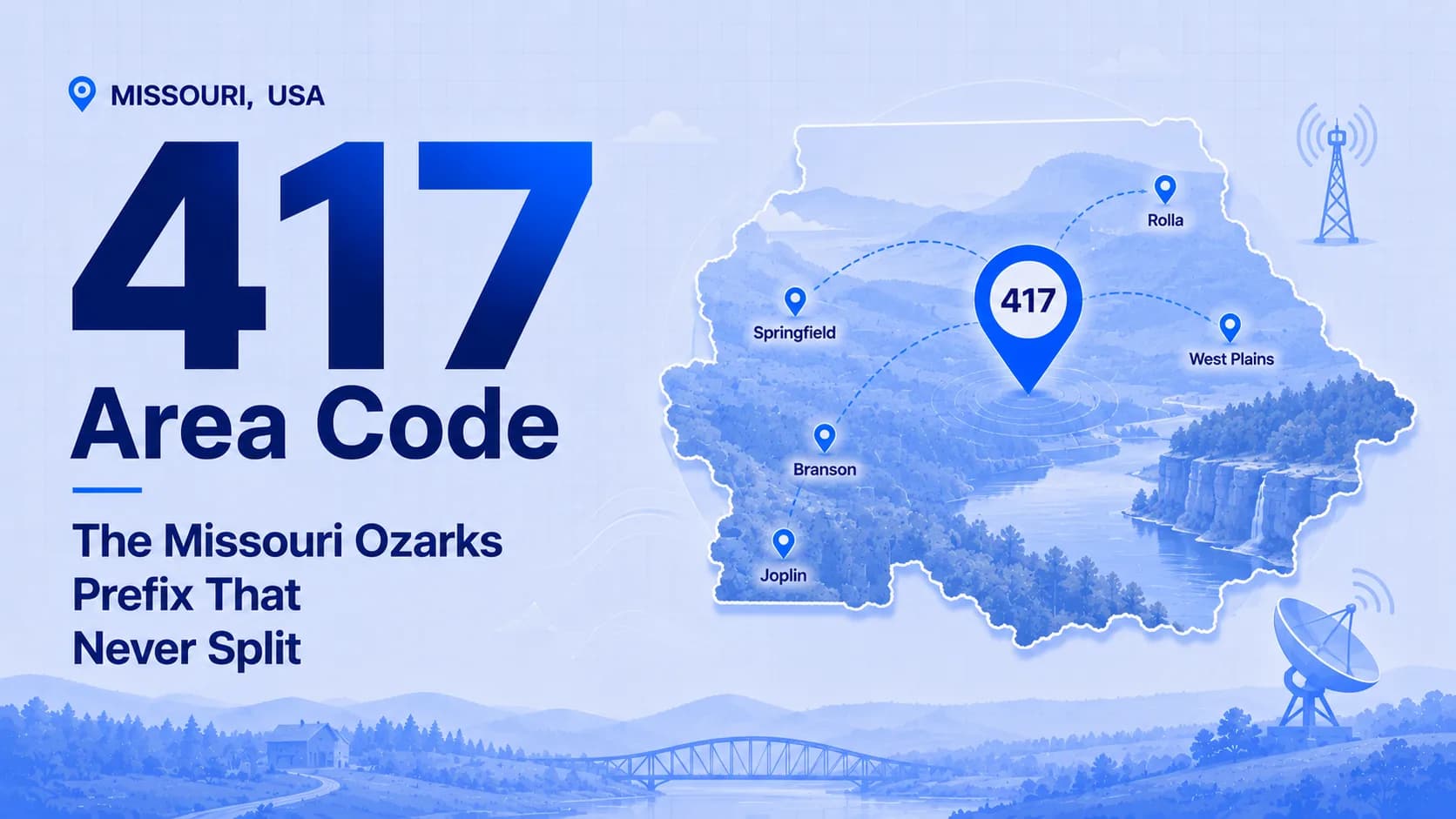
The 417 area code covers southwest Missouri, and this guide maps out exactly which Ozarks communities it reaches and why it still runs on a single prefix after 75 years. That staying power matters because it sets this region apart from nearly every other major Missouri market, where splits and overlays have become routine. You'll learn where the 417 area code came from, which cities share it, and why its number supply has held up while St. Louis needed help twice. By the end, you'll understand exactly why this corner of Missouri never had to relearn how to dial a phone.
Key Takeaways:
- The 417 area code covers roughly 40 counties across southwest Missouri, including Springfield, Branson, and Joplin.
- It was created on January 1, 1950, carved out of the original 816 area code as Missouri's third prefix.
- Unlike 314 in St. Louis, the 417 area code has never split or received an overlay in 75 years of service.
- Businesses can activate a genuine 417 number through Rozper without opening an office anywhere in the Ozarks.
Springfield to Branson: The Reach of the 417 Area Code
The 417 area code spans roughly 40 counties across the entire southwest corner of Missouri, tying together the region's biggest city with its most visited tourist destination under one shared prefix. That single-code footprint stretches from the edge of the Kansas border all the way to the Arkansas state line without ever splitting into a second numbering region.
- Springfield — Greene County, the region's largest city and home to Missouri State University
- Branson — Taney County, one of the Midwest's biggest live-entertainment tourist destinations
- Joplin — Jasper County, an industrial and logistics hub near the Kansas and Oklahoma borders
- Nixa and Ozark — fast-growing Christian County suburbs just south of Springfield
- Lebanon and Carthage — smaller hubs anchoring the eastern and western edges of the region
Why 417 Was Missouri's Third Area Code, Not Its First
When AT&T rolled out the country's first area codes in 1947, Missouri only got two: 314 for the eastern third of the state, including St. Louis, and 816 for everywhere north and west of Columbia. Southwest Missouri had to share a code with Kansas City for its first few years.
A Region Big Enough to Need Its Own Code
Rapid growth across Springfield, Joplin, and the surrounding Ozarks pushed the original 816 territory past capacity within just a few years of the initial rollout, much like the 218 area code later did for northern Minnesota.
The 1950 Split
NANPA carved off the southern half of the 816 territory on January 1, 1950, creating the 417 area code as Missouri's third prefix and giving the Ozarks its own dedicated numbering region for the first time.
Has the 417 Area Code Ever Needed an Overlay?
No, and that makes it unusual among area codes its age. Most prefixes assigned in the 1940s and 1950s have needed at least one relief measure by now, whether that's a geographic split or a second overlapping code layered on top, as callers in several other Missouri regions have already experienced firsthand. The 417 area code has done neither in 75 years of continuous service. Its 40-county footprint spreads demand across a much larger area than a dense metro like St. Louis, which keeps the pace of new number assignments manageable. That's part of why callers across the Ozarks still dial seven digits for some local calls where ten-digit dialing hasn't been mandated the way it has in overlay regions.
417 Versus a Metro That Split Twice
Comparing this prefix to a major metro area code shows exactly why geography, not age, decides whether a region needs relief.
| Southwest Missouri (417) | St. Louis metro (314) |
|---|---|
| Never split or overlaid since 1950 | Split twice, then overlaid with 557 in 2022 |
| Covers roughly 40 spread-out counties | Covers a compact, dense urban core |
| Population growth spread across many small cities | Population concentrated in one dense metro |
| Number supply still has meaningful headroom | Number supply required relief twice over |
Southwest Missouri's growth pattern, spread across dozens of small and mid-size cities rather than concentrated in one dense metro, is the real reason the 314 area code needed help decades before this one did. It's a difference worth understanding before assuming every Missouri prefix ages the same way.
A Branson Tour Operator's Case for Getting a Local Number Early
A Branson-based tour booking company spent two years marketing under an out-of-state toll-free number before switching to a local 417 line, and the change showed up almost immediately in their call answer rates. Management had assumed a toll-free number looked more professional, but it was quietly working against them with a tourist crowd that trusted a familiar area code more than an 800 prefix. Customers calling to confirm same-day bookings were far more likely to pick up when the caller ID showed a familiar southwest Missouri prefix instead of an unfamiliar 800 number calling back.
- Local callback numbers get answered noticeably more often than toll-free numbers during peak tourist season
- A 417 area code number signals genuine regional presence to Ozarks visitors booking last-minute plans
- Seasonal businesses benefit most, since trust matters more when a booking window is short
- The switch required no new hardware, just routing the existing booking team through a new number
What a 40-County Footprint Actually Feels Like for a Caller
Living inside a single area code that spans 40 counties plays out differently than living in a dense metro squeezed onto one prefix. A call from a small Ozarks town two hours from Springfield still carries the exact same 417 area code as a call placed from downtown Springfield itself.
One Code, Very Different Distances
A business in Joplin and a customer in Branson technically share a local area code, even though the drive between them takes well over two hours. That's a level of geographic spread most callers in tighter metro area codes never have to think about, and it rarely causes any real confusion once someone understands why.
Why That Spread Hasn't Caused Problems
Because population and demand are distributed across dozens of small cities rather than concentrated in one urban core, the region has avoided the number crunch that forces splits elsewhere in the state. That headroom is likely to last for years, even with steady growth around Springfield and Nixa.
Setting Up an Ozarks Presence Without an Office in Springfield
Reaching customers across Springfield, Branson, or Joplin doesn't require renting space in any of them. The setup process stays the same whether a business wants one number or several spread across the region.
- Request a 417 area code number specifically for the city or cities that matter most to your customers.
- Route every call to your existing team, regardless of where they're physically located.
- Set voicemail and hours around Central Time expectations for the Ozarks.
- Track call volume by number to see which southwest Missouri cities are actually converting.
Rozper can activate a working 417 line inside a free trial, fully routed before the first call comes in.
The Coverage Myth That Undersells This Missouri Prefix
A common assumption is that a single area code covering 40 counties must be thin on population or economic weight, and that assumption sells the region short. Wide coverage looks sparse on a map, but it hides a genuinely diverse regional economy underneath.
- Springfield alone anchors a metro area of several hundred thousand people within the 417 footprint
- Branson draws millions of tourist visits a year, all served by the same local prefix
- Joplin's logistics and manufacturing base gives the western edge of the region its own economic anchor
- Wide geographic coverage reflects population spread, not lower demand for local numbers
Conclusion
The 417 area code has covered southwest Missouri since January 1, 1950, tying Springfield, Branson, Joplin, and dozens of smaller Ozarks communities together under one prefix for 75 straight years. Unlike the 314 area code in St. Louis, it has never needed a geographic split or an overlay, a stability that comes from population spread across a wide region rather than concentrated in one dense city. Knowing that history explains why callers here still deal with simpler dialing rules than much of the rest of Missouri. That's useful context whether you're screening an unfamiliar call or planning a local presence somewhere in the Ozarks.
Southwest Missouri keeps growing steadily around Springfield, Branson, and Nixa, and getting a genuine 417 area code number now is the simplest way to sound like part of that growth instead of an outsider calling in. Rozper sets that number up in minutes, fully routed to whichever team already answers your calls. Take the next step and get your Ozarks presence running today.
FAQs
Where is the 417 area code located?
The 417 area code covers southwest Missouri, including Springfield, Branson, Joplin, Nixa, and Ozark. It spans roughly 40 counties across the Missouri Ozarks.
When was the 417 area code created?
It went into service on January 1, 1950, carved out of the original 816 area code as Missouri's third prefix.
Has the 417 area code ever had an overlay?
No. Unlike 314 in St. Louis, the 417 area code has never split or received an overlay in 75 years of service.
Is a call from the 417 area code likely to be a scam?
Not inherently. Most 417 calls come from real southwest Missouri residents and businesses, though any area code can be spoofed by robocallers.
Can I get a 417 number without living in Missouri?
Yes. Rozper lets you activate a genuine local 417 number remotely, with calls routed to your existing team.
What time zone does the 417 area code use?
The entire 417 region runs on Central Time, the same zone used across the rest of Missouri.
How much does a local 417 number cost with Rozper?
Cost depends on your chosen plan and expected call volume, and you can see exact pricing during a free trial before committing.
Why hasn't the 417 area code ever needed a split?
Its population is spread across roughly 40 counties instead of one dense metro, which has kept new number demand well within the original supply.