India is one of the largest destinations for international voice traffic, and it is also one of the more tightly regulated. If you run a VoIP business, a call center, or a reselling operation that sends calls to India, the route your traffic takes affects call quality, caller ID, and whether the traffic is delivered at all.
This guide explains how termination to India works in general terms, what to ask a wholesale provider, and where to check the current rules. It is an educational overview, not legal advice.
How an international call reaches India
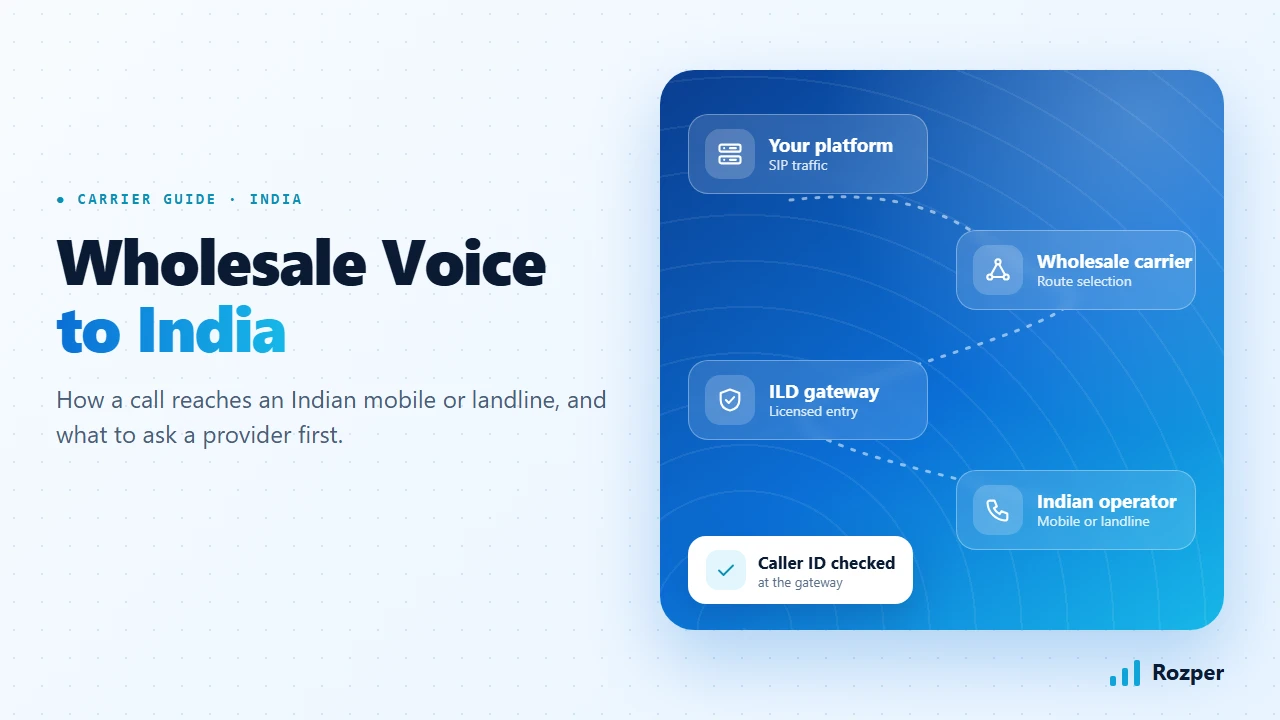
A call from abroad to an Indian mobile or landline passes through several hands:
- Your platform sends the call over SIP to a wholesale carrier.
- The wholesale carrier selects a route, usually among several upstream carriers, based on price and quality.
- An international gateway hands the call into India's network.
- The Indian terminating operator delivers it to the mobile or landline number.
The key point for India is step 3. Indian rules require international inbound calls to enter through licensed international long distance (ILD) gateways. Routes that bypass them are often called "grey routes." Since August 1, 2022, the Department of Telecommunications' amended Unified License has also required ILD operators to drop international calls that arrive with no caller ID or an improper one, which is why caller-ID handling on India routes matters. Buying the cheapest per-minute rate without asking how the traffic enters India is the most common way a reseller ends up with blocked or disappearing calls.
CLI and non-CLI routes to India
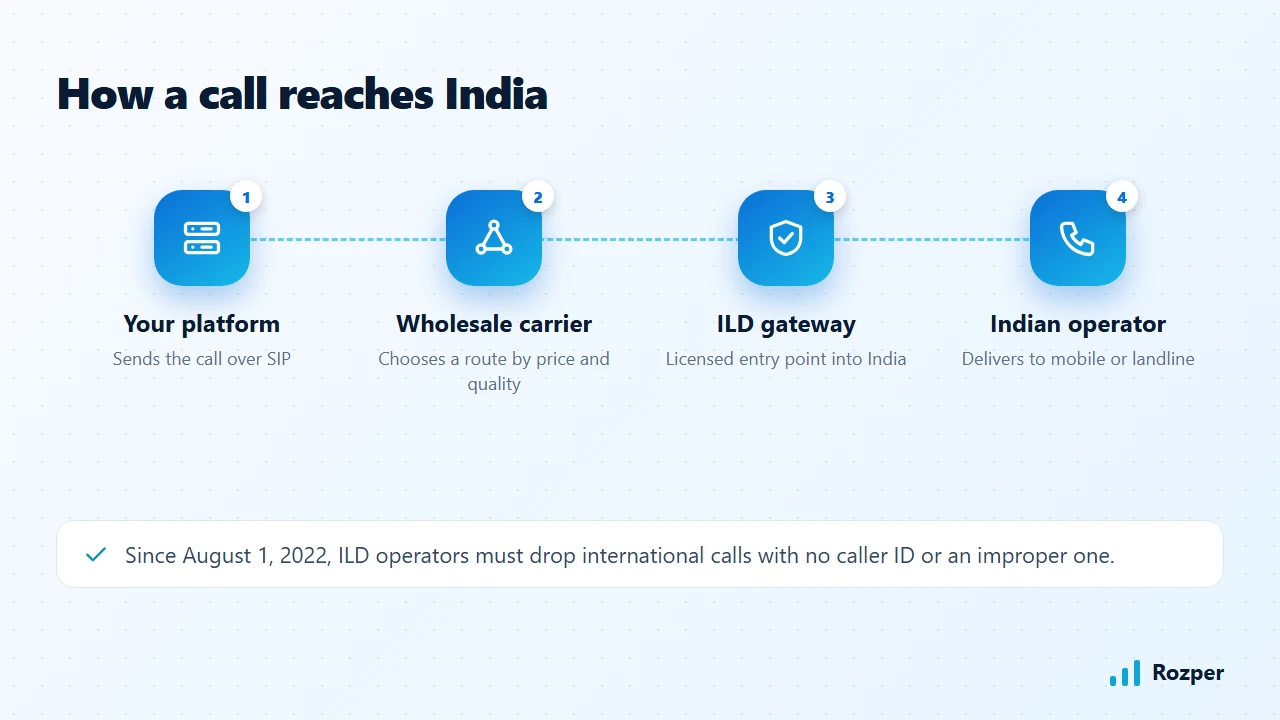
Wholesale providers usually describe routes by how they treat caller ID:
- CLI routes attempt to deliver the caller's number to the recipient. They usually cost more and are the right choice when the person you are calling needs to recognise you.
- Non-CLI routes do not guarantee the original number is shown; the recipient may see a random or generic number. They are cheaper and used mainly for volume traffic where caller ID matters less.
Because ILD gateways must drop calls with missing or improper caller ID, a route that does not pass a valid number can fail to complete at all, not just show the wrong number. Ask the provider to test your own numbers, not only their sample numbers. For a deeper explanation of route types, see our guide to wholesale VoIP routes.
What to ask a wholesale provider before sending India traffic
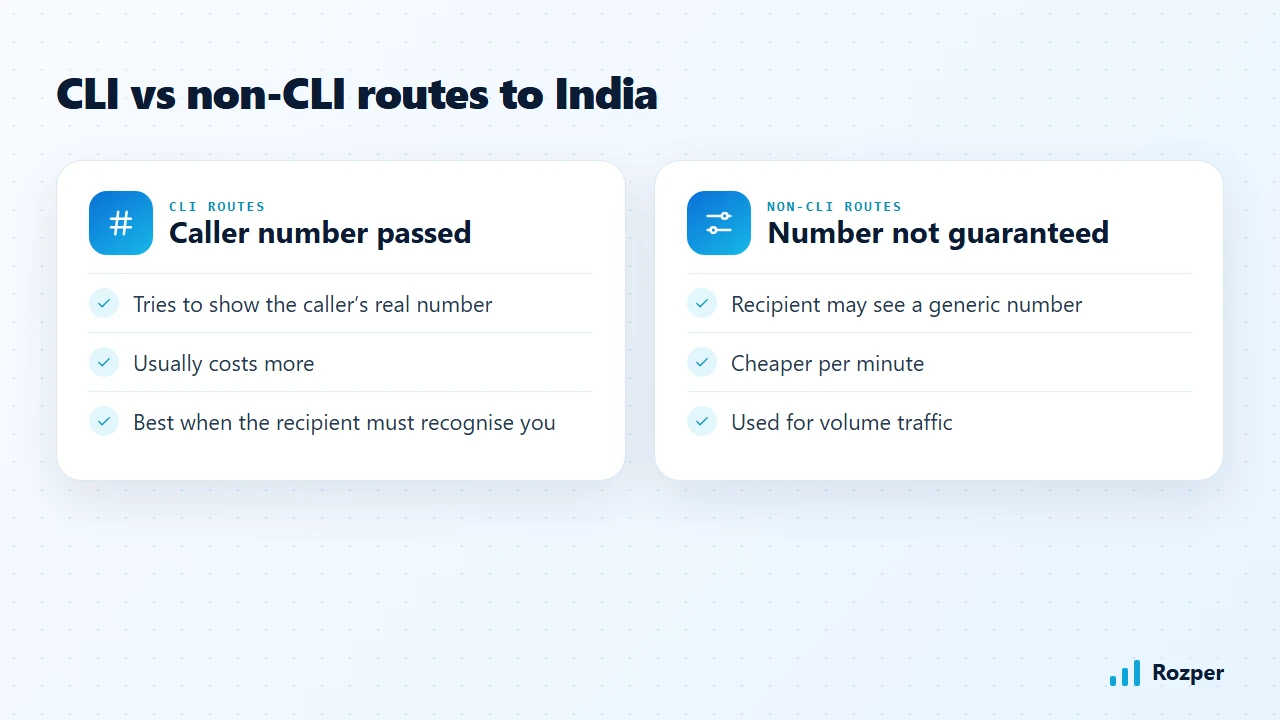
Use these questions when you compare providers:
- How does the traffic enter India? Ask them to confirm that it goes through licensed international gateways, and what their upstream carriers say about it.
- Which quality metrics do you report? ASR (answer-seizure ratio), ACD (average call duration) and PDD (post-dial delay) per destination are the baseline.
- Can you test CLI delivery with my numbers? A short trial on your own traffic tells you more than a rate sheet.
- How are rates quoted? Ask whether mobile, landline and each operator are priced separately, and how rate changes are notified. Our guide to wholesale VoIP rates explains how rate decks are built.
- What is the billing increment? 1/1 billing versus 60/60 changes the real cost of short calls.
- Who do I contact when a route degrades? A provider with a 24/7 NOC can reroute faster than one with email support.
Regulation: where to check
Rules for internet telephony and international routing in India have changed over the years, and the Department of Telecommunications has been moving licensees to new authorisations under the 2026 telecom rules. Confirm the current framework with official sources rather than a blog. Start with the Department of Telecommunications and the Telecom Regulatory Authority of India, and talk to a licensed Indian telecom adviser before building a business model around Indian termination.
Choosing a route for your use case
- Call centers and outbound dialers care most about connect rates and caller ID. Test CLI routes.
- Resellers and carriers care about price stability and rate-deck clarity. Compare per-operator pricing.
- Businesses with a local presence may also want Indian numbers for inbound calls. That is a separate service from termination; see virtual phone numbers.
To see how Rozper handles interconnection and rates, start with the wholesale VoIP overview and the VoIP termination page.
How to Test an India Route Before You Commit
A rate sheet shows the price, not whether calls connect. Before you move volume to India, run a short trial:
- Use your own numbers. Test with your real caller IDs and destinations, including mobile and landline, rather than only the provider's samples.
- Compare the metrics. Measure ASR, ACD and PDD per destination group and compare them with what the provider quoted.
- Check what the recipient sees. Confirm caller-ID delivery on calls to several Indian operators.
- Ask how failures are handled. Find out how fast a degraded route is rerouted and who you contact.
- Get terms in writing. Billing increment, rate-change notice and the route type (CLI or non-CLI) should all be documented.
For a longer question list, use our wholesale VoIP provider checklist. To understand how rates are built, see wholesale VoIP rates.
Common Mistakes When Sending Traffic to India
- Buying on price alone. The cheapest per-minute rate may enter India through a route that fails or gets filtered.
- Not testing caller ID. Calls that arrive with a missing or improper number can be dropped at the gateway.
- Mixing route types. Sending traffic that needs caller ID over a non-CLI route leads to confusing results.
- Ignoring billing increments. Short calls cost more under 60/60 than under 1/1 billing.
- Skipping local advice. Rules change, so check with the Department of Telecommunications and a licensed Indian adviser.
For the technical side, read how wholesale VoIP termination works and the wholesale voice termination guide.
Conclusion
Termination to India is a routing and compliance question as much as a price question. Ask how traffic enters India, test CLI with your own numbers, and compare providers on measured quality, not only the rate per minute.
FAQs
Is wholesale VoIP termination to India legal?
Rules apply to how calls enter and are delivered in India, so it depends on the route and the parties involved. Confirm the current requirements with the Department of Telecommunications and a licensed Indian adviser.
What is a grey route?
A route that bypasses the licensed international gateways. It can be cheaper but is often unreliable, and regulators have acted against networks used this way.
What is the difference between CLI and non-CLI routes to India?
CLI routes try to show the caller's real number. Non-CLI routes do not guarantee this and are cheaper.
How do I test a route before committing?
Run a short trial with your own numbers and compare ASR, ACD and PDD against the provider's claims.
How much does wholesale voice termination to India cost?
It depends on the operator, the route type and the billing increment, so there is no single price. Ask for per-destination rates for mobile and landline and compare the effective cost of your own traffic.
Which metrics should I check on an India route?
ASR (answer-seizure ratio), ACD (average call duration) and PDD (post-dial delay) for each destination group, tested on your own numbers.