Introduction
Area code 830 stretches across the Hill Country, San Antonio's outer suburbs, and much of the Texas border region, making it one of the largest and most varied codes in the state. If your business is deciding whether a number here will actually feel local to your customers, the sheer size of the territory changes that answer more than most guides admit. This article walks through where 830 really reaches, why one code covers so much ground, and how to pick a number that matches the specific market you're calling into rather than the region as a whole. By the end, you will know exactly how to choose, set up, and protect an 830 number so it earns trust instead of just occupying space on a caller ID.
Key Takeaways:
- Area code 830 spans nearly 30 counties, from San Antonio's suburbs to Del Rio, so it covers far more ground than a typical metro overlay.
- A number that reads as local in New Braunfels will not automatically read as local in Kerrville or Uvalde, even though both sit inside 830.
- A well-matched 830 number can still noticeably raise answer rates within its specific sub-market.
- Setup now takes minutes through a cloud phone provider instead of the days a traditional carrier once required.
Where Area Code 830 Actually Covers
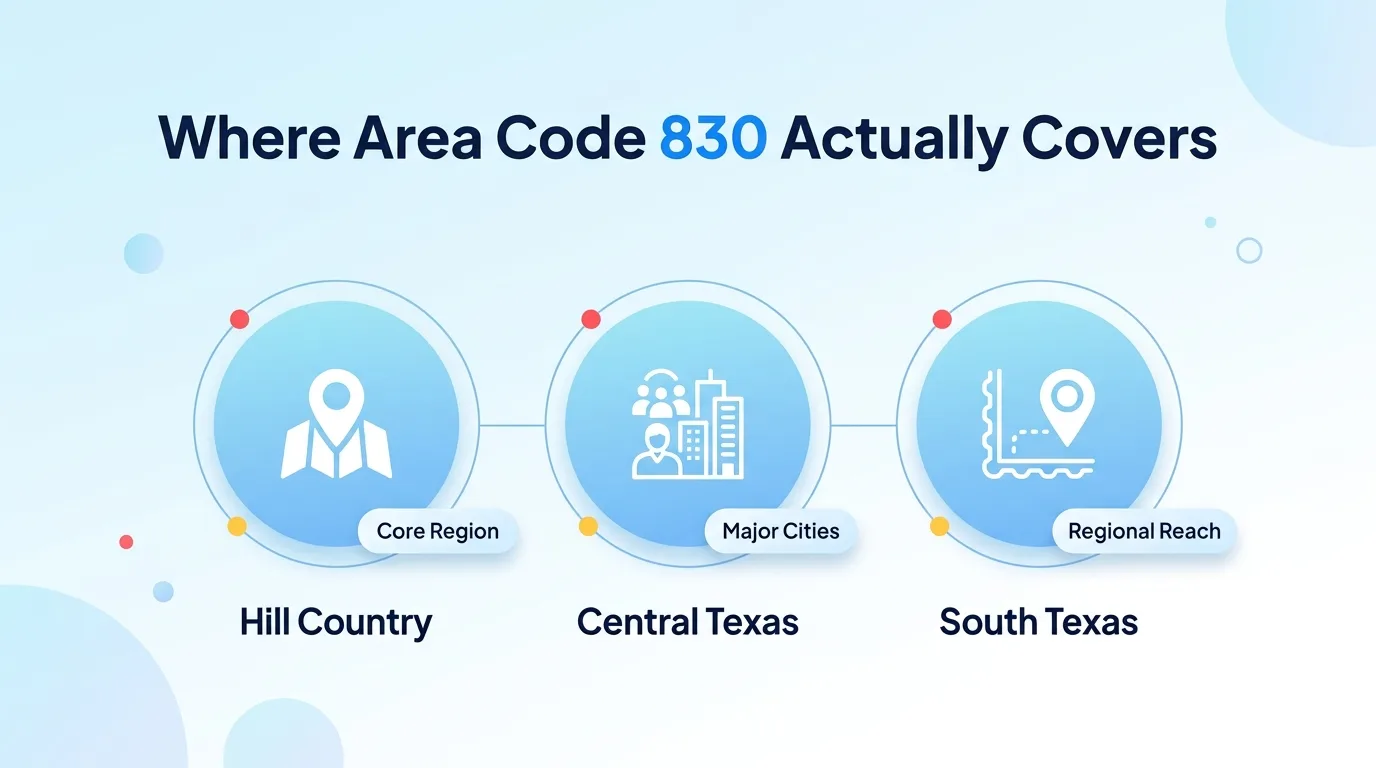
Area code 830 covers roughly 28 counties and more than 90 cities, running from the outer edges of San Antonio through the Hill Country and out toward the Mexican border. It reaches New Braunfels, Kerrville, Boerne, Fredericksburg, Seguin, Uvalde, and Del Rio, among many smaller towns.
- Comal and Guadalupe Counties: New Braunfels, Seguin
- Kerr and Gillespie Counties: Kerrville, Fredericksburg
- Kinney and Val Verde Counties: Uvalde, Del Rio
- Atascosa and Karnes Counties: smaller South Texas communities
This is not a single metro with a tidy overlay code. It is a patchwork of small cities, ranch country, and border towns that all happen to share one set of prefixes.
That patchwork is also economically diverse. Area code 830 covers booming Hill Country tourism towns, working ranch communities, and border-region logistics hubs, all inside the same three digits. A number that performs well for a Fredericksburg bed-and-breakfast will not necessarily perform the same way for a trucking company dispatching out of Del Rio.
Why One Area Code Covers Nearly 30 Counties
Area code 830 was created on July 7, 1997, splitting off from area code 210 as San Antonio's rapid growth and the early wave of cell phones and pagers pushed the parent code toward exhaustion. Rather than carving out a single dense suburb, regulators drew the new boundary around everything outside the immediate city core, which is why 830 ended up so large.
That decision made sense in 1997, when rural exchanges needed far fewer numbers per capita than they do today. Decades of growth in the Hill Country tourism economy and continued expansion along the border region have since filled in much of that space, but the boundary itself never shrank. The result is a single area code doing the job that would normally take three or four smaller ones.
Understanding this history matters because it explains why area code 830 feels so different depending on where you're calling from. A code built for a handful of rural exchanges in 1997 now covers a mix of fast-growing suburbs, tourist towns, and border communities that regulators never designed it to serve as one uniform market.
Picking the Right 830 Number for Your Specific Market
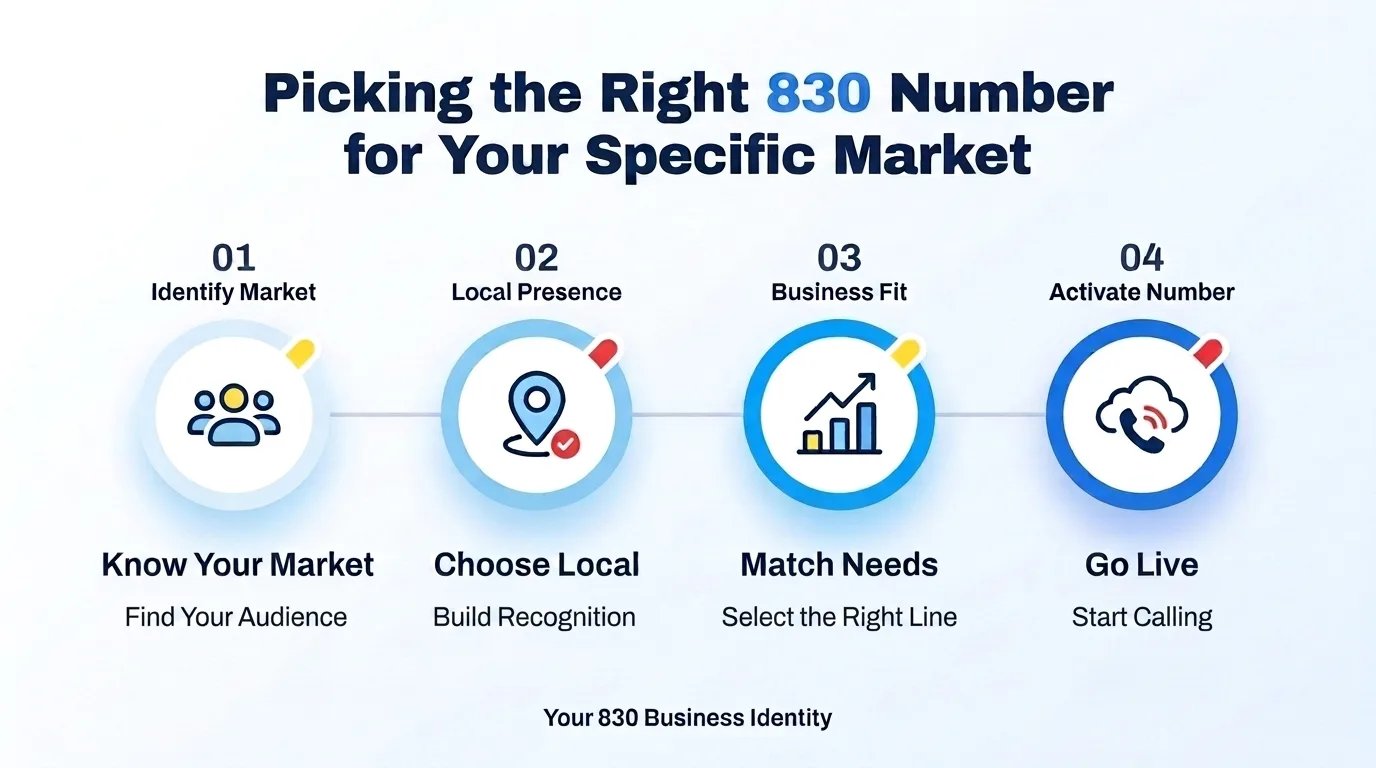
Because area code 830 covers so much ground, the number itself does not automatically signal "local" to every customer inside it. A prefix associated with New Braunfels reads differently to a rancher near Uvalde than it does to a retiree in the Hill Country.
- Match the prefix to your actual customer base — some prefixes cluster around specific towns even within one area code.
- Check the provider's number map — reputable providers can show which city a given prefix is historically associated with.
- Consider multiple numbers for multiple markets — a business serving both New Braunfels and Del Rio may need more than one local line to feel native in both places.
- Don't assume the whole region reads the same — Hill Country tourism traffic and border-region logistics traffic respond to very different cues.
This is the biggest thing generic area code guides for this region miss: getting a number is easy, but getting the right number for your specific customers takes real thought. Rozper's number search tools let businesses filter available prefixes by the town they're historically tied to, rather than just by the area code as a whole.
Does a Local 830 Number Actually Raise Answer Rates in Their Towns?
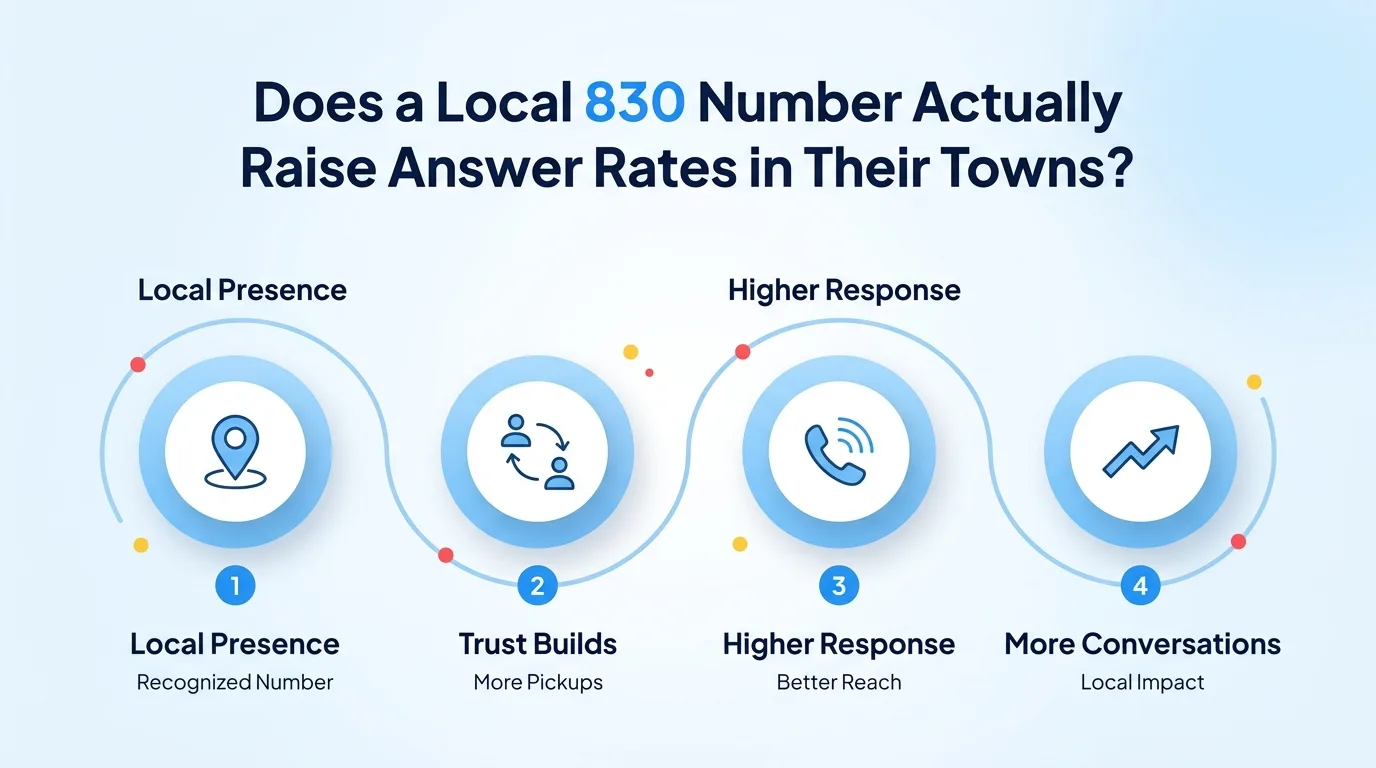
Yes, within the right sub-market. Calls from an area code that matches the recipient's own region consistently get answered more often than calls from a clearly unfamiliar one, and area code 830 is recognized on sight across the Hill Country and border counties.
- Recipients in small towns are often more suspicious of unfamiliar area codes than big-city customers are.
- A locally recognized prefix cuts down the hesitation that kills first-touch calls in tight-knit communities.
- Tourism, home services, and healthcare providers calling repeat customers see the clearest benefit.
- The effect weakens if the specific prefix doesn't match the sub-market you're actually calling into.
Businesses that get this right — matching the number, not just the area code, to their customer base — consistently outperform those that treat the whole region as one interchangeable market. Local familiarity builds faster in a small Hill Country town than it typically does in a dense metro.
A Scenario: A Home Services Company Covers New Braunfels and Kerrville
Picture a home repair company based in San Antonio that wants to expand service routes into both New Braunfels and Kerrville, two towns roughly an hour apart inside area code 830. Using a single generic number, dispatchers noticed Kerrville customers were slower to pick up, since the prefix had always been associated with New Braunfels in local caller ID databases. After adding a second, Kerrville-associated 830 line, answer rates in that market improved within a few weeks.
This kind of mismatch is common across large, fragmented codes like 830 but rarely gets addressed in generic area code guides. Rozper's call routing tools let a business run both numbers through one system, sending each call to the right dispatcher without customers ever noticing the difference behind the scenes, even as the company adds more towns to its service area over time.
The lesson scales beyond home services. Any business covering multiple towns inside area code 830 — clinics, contractors, real estate teams — runs into the same mismatch the moment it treats the whole region as one market instead of several smaller ones stitched together.
Setting Up an 830 Number Without Losing Caller Trust
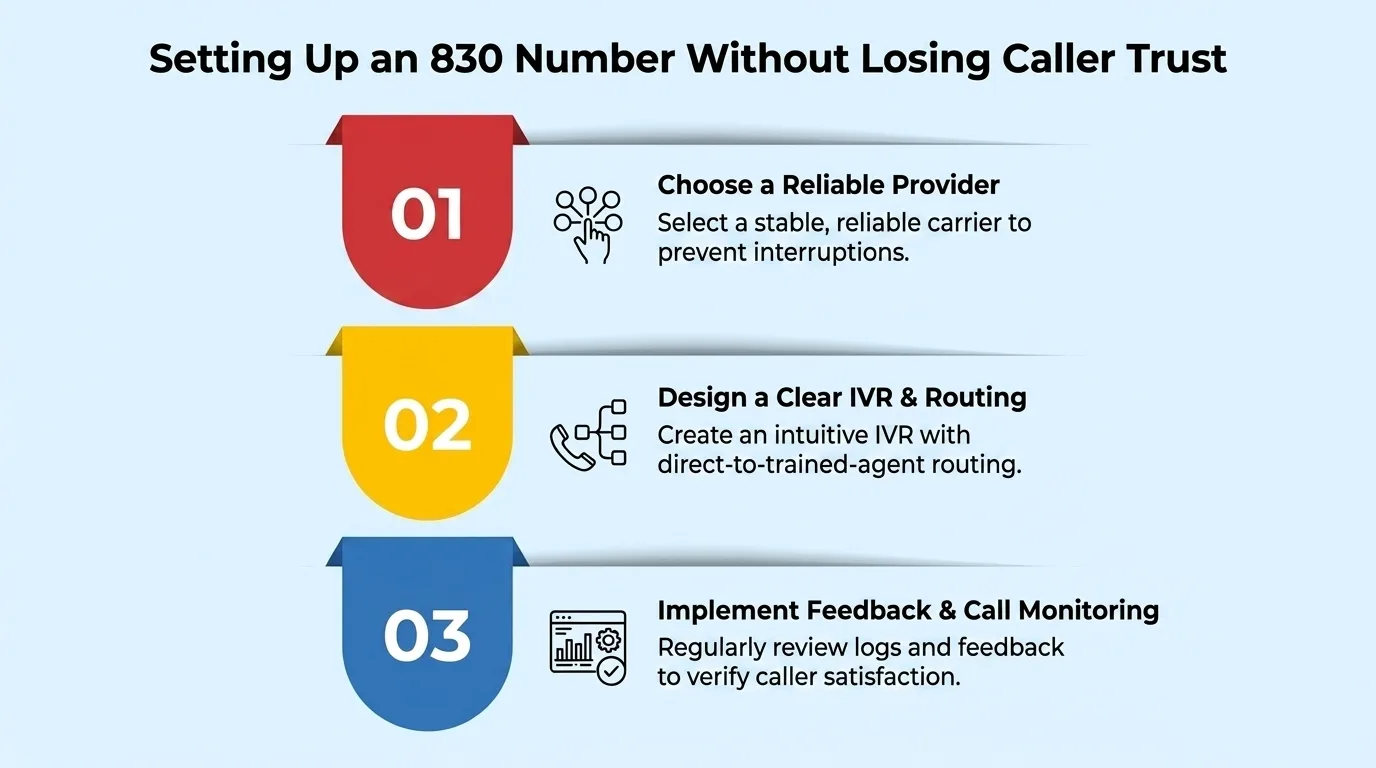
Claiming a number is the easy part, especially across a region this large. The setup process and the habits behind it decide whether that number actually earns trust in its market.
Same-Day Setup Steps
- Pick a cloud phone provider with Hill Country and border-region provisioning.
- Search prefixes tied to your specific target town, not just "830" broadly.
- Connect the number to your existing phone, app, or desk system.
- Set a matching caller ID and greeting before taking live calls.
Protecting Your Caller Reputation
A number is only as trustworthy as the calling pattern behind it. High call volume without spam registry registration can get a legitimate 830 number flagged, especially in smaller towns where unusual call volume stands out fast. Check the spoofing guidance if a call ever looks suspicious, and register outbound numbers with STIR/SHAKEN-compliant providers so your own calls don't get mistakenly flagged either.
Rozper bundles this reputation monitoring directly into its call management dashboard, so a business running several numbers across different towns can catch a spam flag or a caller ID mismatch before it costs answered calls in any one market.
Conclusion
Area code 830 covers one of the largest and most varied territories in the state, running from San Antonio's suburbs through the Hill Country and out to the border region. The 1997 split from area code 210 explains why the boundary is so wide, but the practical challenge for businesses is matching a specific number to a specific sub-market rather than assuming the whole region reads the same way. A well-chosen 830 number can meaningfully improve answer rates, provided it's tied to the right town and backed by consistent, honest calling habits. Treating this area code as one uniform market is the single biggest mistake businesses make when they set one up.
If your business serves customers across this stretch of Texas, start by mapping your customer base to specific towns before picking a prefix, not after. Rozper's call routing and monitoring tools make it easy to manage several 830 numbers under one system while keeping every line trustworthy as call volume grows. Confirm prefix availability for your target markets first, then build the habits that keep each number credible over time. From there, the only thing left to do is start dialing into the market you actually chose.
FAQs
What cities does area code 830 cover?
Area code 830 covers roughly 90 cities across nearly 30 counties, including New Braunfels, Kerrville, Fredericksburg, Uvalde, and Del Rio. It spans San Antonio's outer suburbs, the Hill Country, and much of the border region.
Where is area code 830 located?
It covers a broad stretch of South Central and Southwest Texas, surrounding San Antonio's city-center codes without overlapping them. The territory runs from the Hill Country out to the Texas-Mexico border.
When was area code 830 created?
It was created on July 7, 1997, as a split from area code 210. San Antonio's rapid growth and the early rise of cell phones pushed regulators to carve out the surrounding region separately.
How do I get an 830 phone number for my business?
Sign up with a cloud phone provider that offers Hill Country and border-region provisioning, then search for a prefix tied to your specific target town. Most numbers connect to your existing phone or app the same day.
Is a call from an 830 area code safe to answer?
Answering is safe, but any area code, including 830, can be spoofed by scammers. Call back a published business number if a request involves money or sensitive information.
What time zone does area code 830 use?
The entire 830 region runs on Central Time, following the same daylight saving shifts as San Antonio and the rest of Texas. This matters when scheduling calls with contacts elsewhere in the country.
Does an 830 number cost more in rural towns than in San Antonio's suburbs?
No, pricing depends on your provider's plan rather than which town the prefix is associated with. Most cloud phone platforms charge the same rate for every 830 number regardless of location.
Will one 830 number work for both Hill Country and border-town customers?
Not always — a prefix associated with one town may not read as local to customers in another, even within the same area code. Businesses serving multiple sub-markets often need more than one number to feel local everywhere they operate.