Introduction
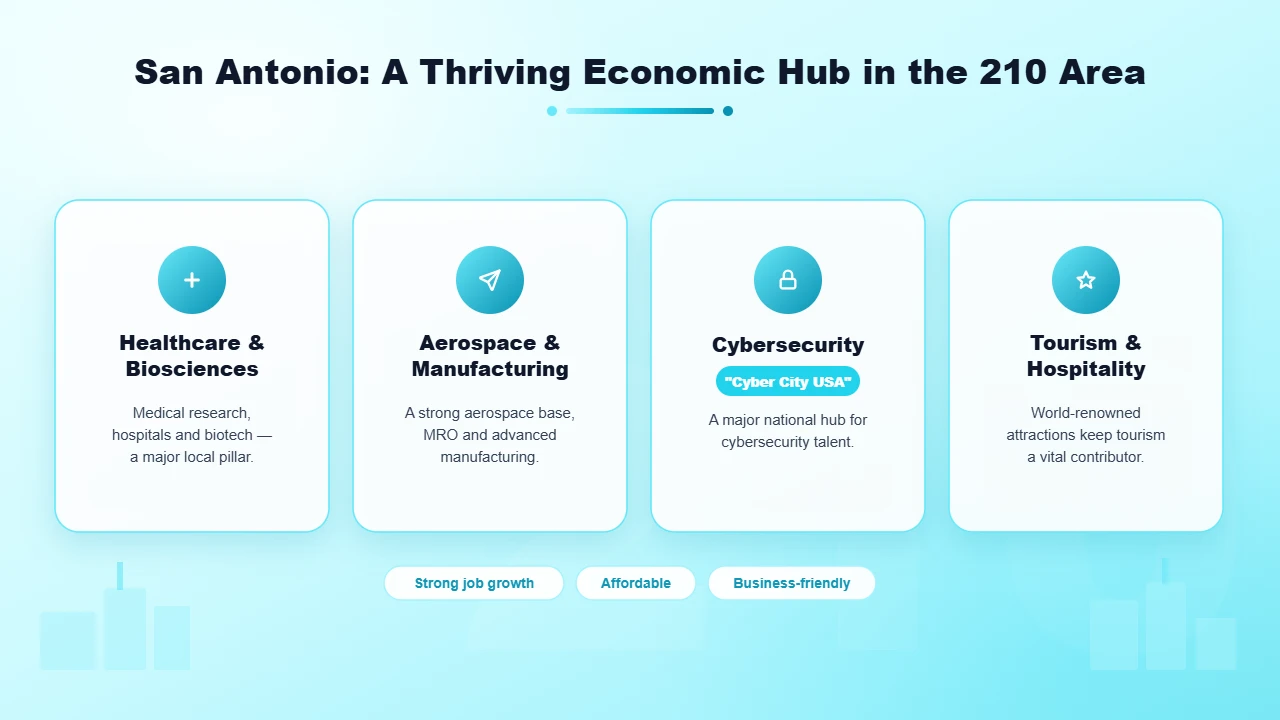
Few US cities are defined by military presence like San Antonio. Five installations — Fort Sam Houston, Lackland AFB, Randolph AFB, Camp Bullis, and Camp Stanley — generate a combined $5 billion annual economic impact and tens of thousands of Bexar County jobs. Defense contractors, healthcare providers, aerospace firms, and retailers all orbit that same workforce, and reaching it starts with one credential: a local San Antonio number.
San Antonio is the seventh-largest city in the United States, and the 210 area code — carved out of the older 512 area code that once covered all of central Texas — is its identity. Whether you need to know what area code 210 covers, how the 726 overlay affects dialing, which scam patterns are active in 2026, or how to get a 210 business number from anywhere, this guide covers it all.
What Is the 210 Area Code?
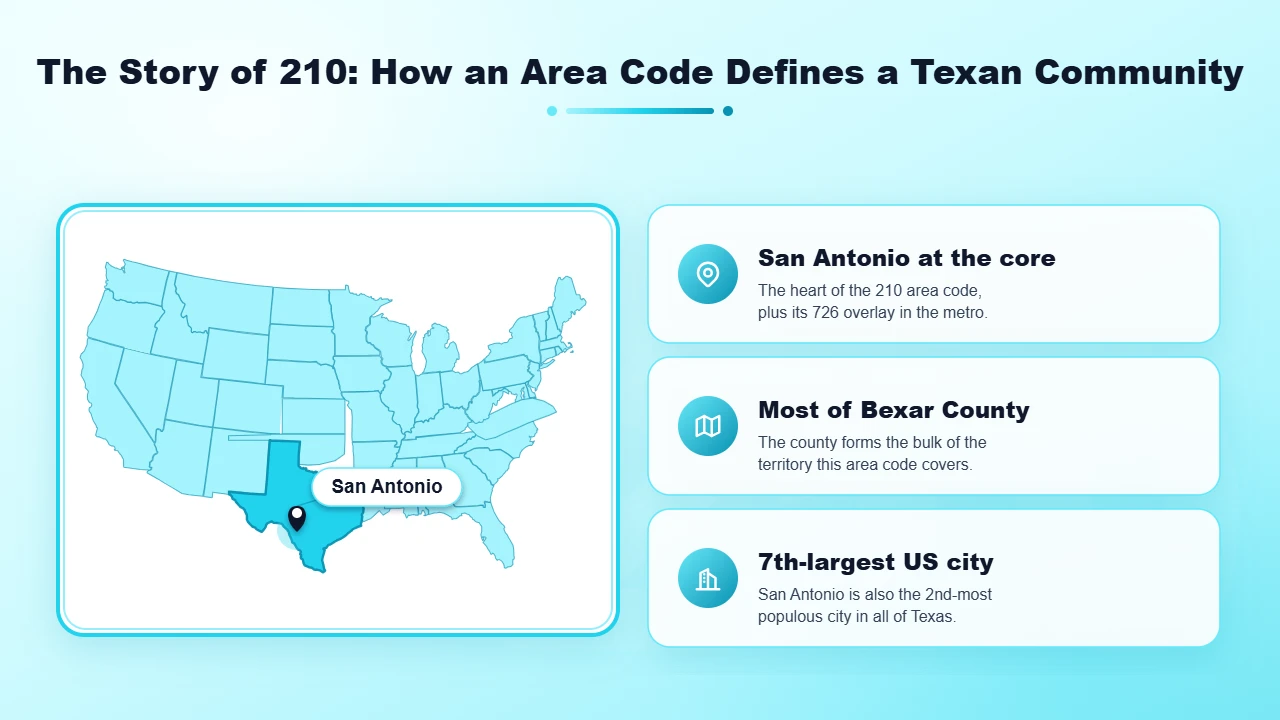
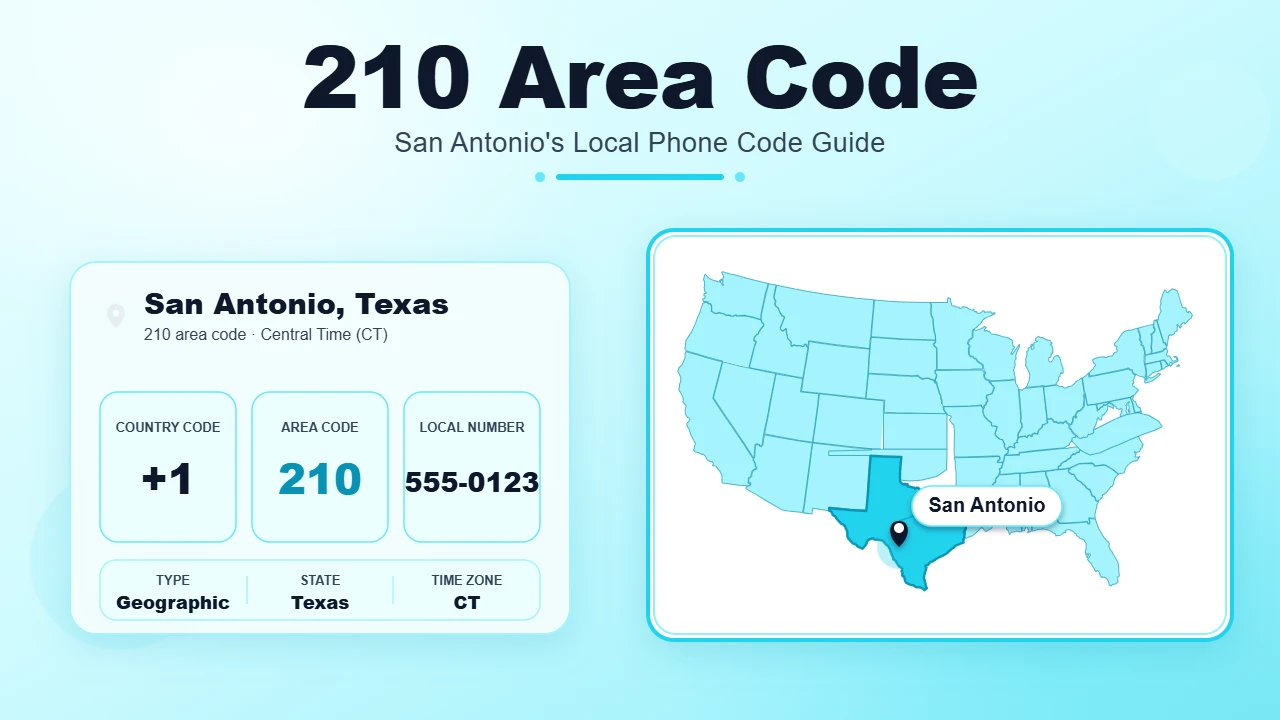
The 210 area code is a NANPA-assigned telephone code covering San Antonio and the surrounding south-central Texas region. It was established in 1992 as a geographic split from the 512 area code, which had covered all of central Texas since the original NANPA assignment in 1947. San Antonio's steady population growth eventually required additional number capacity, and the 726 area code was introduced as an overlay — meaning both 210 and 726 now serve the same geographic area without geographic distinction.
| Fact | Detail |
|---|---|
| State | Texas |
| Region | South-central Texas; Bexar County and surrounding counties |
| Anchor City | San Antonio (7th largest US city; ~1.5 million residents) |
| Created | 1992 (split from 512) |
| Overlay | 726 (same geographic area) |
| Time Zone | Central Time — CST (UTC−6) / CDT (UTC−5) |
| DST | Observed — clocks change in March and November |
| Counties | Bexar, Atascosa, Comal, Guadalupe, Medina, Wilson |
| Metro Population | ~2.6 million |
The History of San Antonio's 210: From 512 to Its Own Identity
When NANPA established the original US area codes in 1947, all of central and south Texas — Austin, San Antonio, Corpus Christi — shared the 512 area code. For decades, that single code held. The mobile phone explosion of the late 1980s and early 1990s changed the calculus everywhere.
1992: The Texas Public Utility Commission approved a geographic split, assigning the new 210 to San Antonio and south-central Texas, under the numbering administration framework that governs area code assignments nationwide. Austin and surrounding central Texas retained 512. The split gave San Antonio its own telephonic identity for the first time.
Later years: As San Antonio grew into one of the fastest-expanding US metros, even 210 began approaching number exhaustion. Rather than a second geographic split, regulators introduced 726 as an overlay, preserving existing 210 numbers while opening new inventory under both codes. Much like the 713 area code serves Houston alongside its overlays, 210 and 726 are now both valid San Antonio codes with no geographic boundary between them.
The 210 area code carries more than 30 years of San Antonio identity — making it the code businesses reach for when local recognition matters most. No other San Antonio prefix holds that history.
Cities and Communities Served by the 210
The 210 footprint is anchored by San Antonio but extends into the broader Bexar County metro and several surrounding counties:
| City / Community | What It's Known For |
|---|---|
| San Antonio | Anchor city; 7th largest US city; tourism, military, healthcare hub |
| Schertz | Northeast growth corridor; military community near Randolph AFB |
| Universal City | Adjacent to Randolph AFB; established military and contractor community |
| Converse | East Bexar County; residential growth; active military families |
| Cibolo | Rapidly growing northeastern suburb; family-oriented community |
| Live Oak | Commercial corridor northeast of downtown San Antonio |
| Leon Valley | West-side residential and commercial community |
| Helotes | Northwest hill country suburb; growing professional community |
| Alamo Heights | Upscale enclave within San Antonio city limits |
| Shavano Park | Northwest San Antonio; executive residential community |
| Castle Hills | Established enclave; commercial district along Blanco Road |
| Windcrest | Northeast San Antonio; independent city with retail corridor |
| Terrell Hills | Affluent east-side enclave near Fort Sam Houston |
Understanding the 210 and 726 Overlay
The 726 area code was introduced as a full overlay for the same south-central Texas region as 210. Here is what it means in practice:
Same geography. Both 210 and 726 serve every address in the same counties. There is no city or neighborhood that belongs exclusively to one code.
New numbers, either code. When a new line is provisioned in San Antonio today, the carrier may assign either a 210 or a 726 number. Virtual phone providers often carry inventory from both codes.
Mandatory 10-digit dialing. Because 210 and 726 are a full overlay, you must always include the area code — 10-digit dialing is required for all calls within the region. Dialing only 7 digits will not connect.
Recognition gap. Despite identical coverage, 210 carries 30+ years of San Antonio brand recognition. Established businesses, military contractors, healthcare institutions, and longstanding local firms overwhelmingly hold 210 numbers. A 726 number is functionally identical but reads as newer.
Time Zone and Dialing Rules
The 210 area code operates in Central Time (CT) — CST (UTC−6) in winter, CDT (UTC−5) in summer.
San Antonio observes Daylight Saving Time, so the clock shifts twice per year — one hour forward in mid-March, one hour back in early November.
Time comparison vs. other major zones:
| Time Zone | Offset vs. 210 (CT) |
|---|---|
| Eastern (ET) | +1 hour |
| Mountain (MT) | −1 hour |
| Pacific (PT) | −2 hours |
| UTC | +6 hours (CST) / +5 hours (CDT) |
Dialing format:
- Domestic: 1 + 210 (or 726) + 7-digit number
- International: your country's exit code + 1 + 210 + 7-digit number
10-digit dialing is standard throughout the San Antonio metro. If your phone system stores any San Antonio number without the full area code 210 prefix, update it — 7-digit dialing will not connect.
Industries That Define the 210 Region
Military & Defense — Joint Base San Antonio (JBSA) combines Fort Sam Houston, Lackland AFB, and Randolph AFB under one command structure, making San Antonio home to the largest military installation complex in the US by training throughput. The defense industry contributes approximately $5 billion annually to the local economy. Contractors, suppliers, and veteran-owned businesses throughout the metro depend on local credibility and reliable communications to serve this sector.
Aerospace & MRO — Port San Antonio, built on the former Kelly Air Force Base, operates as a 1,900-acre aerospace and technology campus. It houses major maintenance, repair, and overhaul (MRO) operations for commercial and military aircraft, employing thousands of technicians, mechanics, and engineers. Global demand for MRO services is projected to double within two decades, positioning San Antonio as a key growth market in commercial aviation.
Healthcare & Bioscience — The South Texas Medical Center is one of the largest medical complexes in the US, hosting UT Health San Antonio, University Hospital, Methodist Healthcare, Baptist Health System, and the Audie L. Murphy VA hospital. Healthcare is among the city's largest employment sectors, with demand for patient communication, scheduling, and telehealth services growing year over year.
Tourism & Hospitality — The River Walk, the Alamo, SeaWorld San Antonio, and Fiesta Texas draw more than 34 million visitors annually. The hospitality and food service sector employs a significant share of the San Antonio workforce, creating consistent demand for reservation systems, customer service lines, and local business presence.
Education — The University of Texas at San Antonio (UTSA), Trinity University, St. Mary's University, and the Alamo Colleges district collectively serve hundreds of thousands of students and create a robust market for education technology, tutoring services, and workforce development programs.
Is the 210 Area Code a Scam?
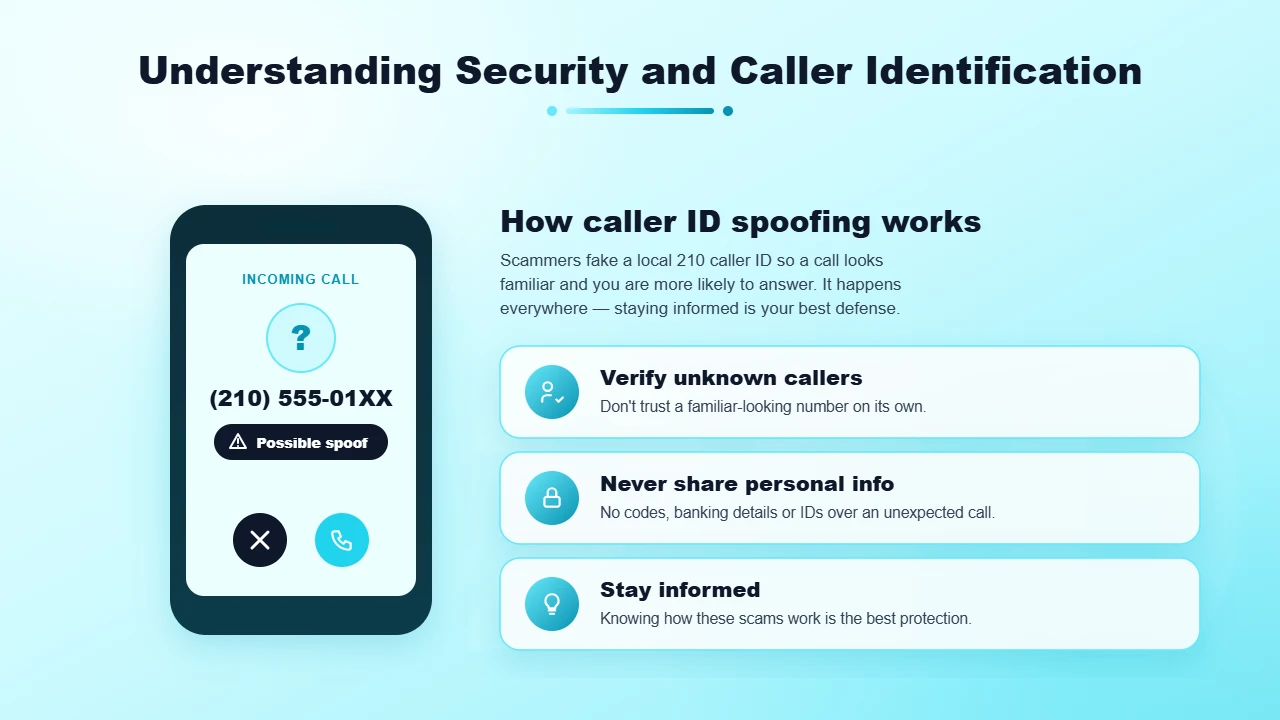
The 210 area code is legitimate — officially assigned by NANPA to San Antonio and south-central Texas. Like every major US metro code, it sees spoofed scam calls. Scammers target 210 specifically because San Antonio residents are more likely to answer what appears to be a local call.
Common 210 scam patterns in 2026:
- Insurance impersonation (the dominant 210 scam) — Health insurance calls account for 11.4% of all 210 spam complaints. Callers claim to represent carriers like Allstate, Farmers, Liberty Mutual, or State Farm and offer discounted coverage or policy reviews. These calls originate from overseas call centers using spoofed 210 numbers to appear local.
- Medicare/Medicaid fraud — Second-most-reported at 9.07% of complaints. Callers target older San Antonio residents — a significant demographic given JBSA's large veteran and retiree population — with fake Medicare enrollment offers, supplement upsells, and benefit verification requests.
- Auto warranty robocalls — Pre-recorded messages warn of expiring vehicle warranties and prompt the recipient to "press 1" to speak with a representative who will capture personal and financial information.
How to protect yourself:
- Let unfamiliar 210 numbers go to voicemail before calling back
- Never share insurance policy numbers, Medicare IDs, or financial information with unsolicited callers
- Verify any insurance offer by calling the carrier directly using the number on your card
- Report scam calls to the FTC at reportfraud.ftc.gov or the FCC consumer complaint portal
STIR/SHAKEN caller authentication — required by the FCC for US carriers — increasingly marks spoofed 210 numbers as "Scam Likely" on compliant networks. Legitimate business numbers from verified VoIP providers pass authentication and display cleanly on caller ID.
210 vs. Nearby Texas Area Codes
| Code | Region | Identity Signal |
|---|---|---|
| 210 | San Antonio metro (Bexar County + surrounding counties) | Original San Antonio code; military city identity; 30+ year legacy |
| 726 | Same San Antonio metro (overlay) | Newer overlay; same geographic footprint; less brand recognition |
| 512 | Austin metro + surrounding central Texas | Austin tech scene; state government; Hill Country |
| 830 | Texas Hill Country, Kerrville, Laredo, Del Rio | Rural south/central Texas; not San Antonio metro |
| 956 | Rio Grande Valley (McAllen, Laredo, Brownsville) | Border economy; entirely different region |
| 361 | Corpus Christi and South Texas Coast | Coastal and port economy; separate market |
If your customers, partners, or prospects are in San Antonio — military families, healthcare patients, defense contractors, tourism visitors — either 210 or 726 reaches them. But 210 carries the recognition advantage. A 512 positions you in Austin; an 830 reads as Hill Country rural. Neither signals San Antonio the way 210 does.
Why a 210 Number Matters for Business
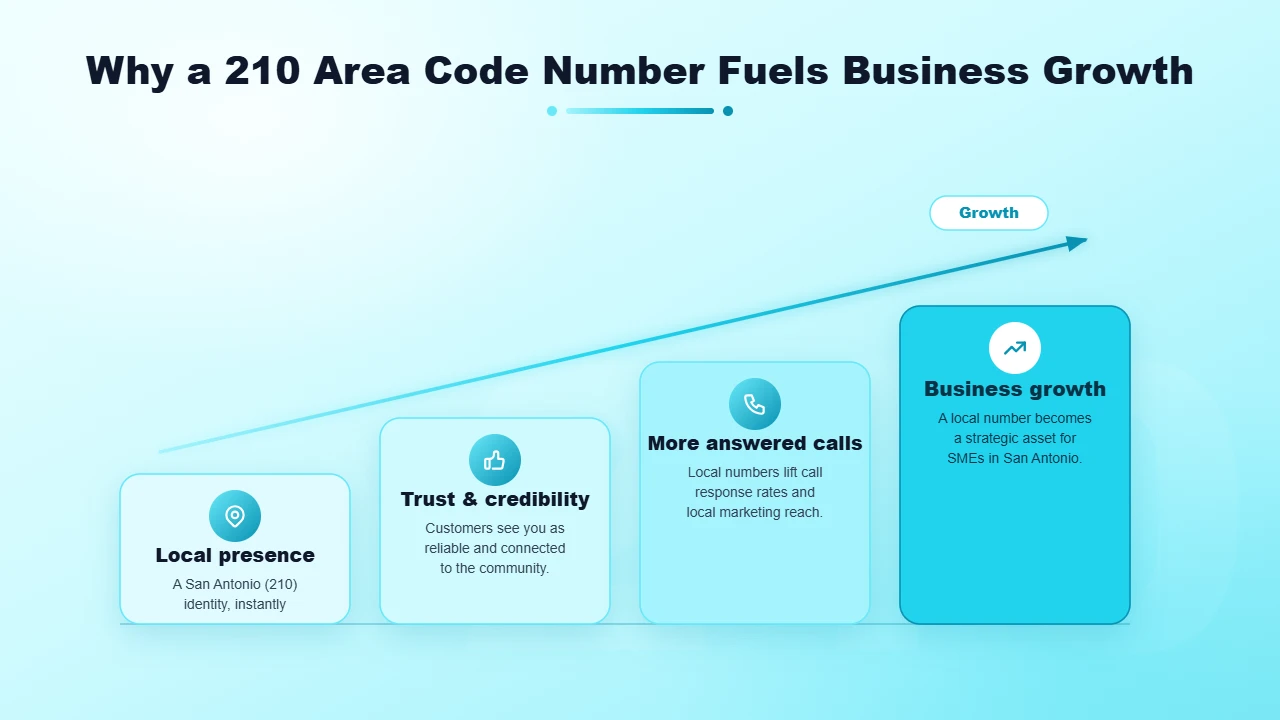
Trust in a military-heavy market. San Antonio's economy is built around JBSA, veteran services, defense contracting, and the communities that support them. Military families and veterans are research-oriented and skeptical of unfamiliar numbers. A local 210 number signals that you are part of the local community — not a distant call center.
Answer rates in a competitive landscape. San Antonio is one of the fastest-growing metros in Texas. More businesses are competing for the same customer base. Calls from recognizable local area codes are answered significantly more often than toll-free or out-of-state numbers, giving 210 businesses a measurable edge in outreach and follow-up.
Local SEO and citation consistency. Google uses phone number area codes as a local proximity signal. A 210 number on your Google Business Profile and local directory listings strengthens relevance for "near me" searches across San Antonio neighborhoods — from Alamo Heights to Leon Valley to Schertz.
Two codes, same geography. Because 726 covers the same area as 210, customers do not distinguish between them — both feel equally local. Businesses with existing 210 numbers benefit from the deeper brand recognition the original code carries, while new entrants can register under either.
How to Get a 210 Business Phone Number
Getting a 210 area code number through a cloud phone provider takes minutes:
- Browse available 210 inventory — search a virtual phone provider's portal for standard local DIDs or vanity numbers with memorable patterns
- Reserve your number — claim it immediately; San Antonio's population growth keeps 210 in active demand
- Set up call routing — forward to a softphone, mobile device, or existing PBX; configure IVR menus, after-hours voicemail, and team extensions
- Activate and go live — the number is portable under FCC rules if you ever switch providers; no geographic restriction on where you physically operate
Rozper is one option worth considering here, maintaining 99.999% uptime and coverage in 150+ countries so a single platform can serve both your local San Antonio line and any international operations. Whichever provider you choose, the number itself remains subject to the same numbering administration framework that governed the original 1992 split from 512 and the later 726 overlay.
FAQs
What cities are served by the 210?
The 210 covers San Antonio — Texas's seventh-largest city — along with surrounding communities in Bexar County and portions of Atascosa, Comal, Guadalupe, Medina, and Wilson counties. Key communities include Schertz, Universal City, Converse, Cibolo, Live Oak, Leon Valley, Helotes, Alamo Heights, Castle Hills, and Windcrest. The 726 is a full overlay serving the identical geographic region.
When was the 210 created?
The 210 was established in 1992 as a geographic split from the 512 area code, which had served all of central and south Texas since 1947. Rapid population growth and mobile phone adoption in the San Antonio region exhausted the available 512 numbers, prompting regulators to assign a dedicated code to the city.
What time zone does the 210 serve?
Central Time — UTC−6 during Central Standard Time (November through mid-March) and UTC−5 during Central Daylight Time (mid-March through November). San Antonio observes Daylight Saving Time, so the offset shifts twice per year.
What is the 726 and how does it relate to 210?
The 726 is an overlay for the same San Antonio region served by 210. Both codes are equally valid for any address in the metro. The overlay was introduced to handle number demand as San Antonio's population expanded. New numbers may be assigned under either code; callers and businesses cannot tell them apart geographically.
Is 210 used by scammers?
No. Area code 210 is a legitimate, NANPA-assigned code for San Antonio and south-central Texas. Like any large metro code, it sees spoofed scam calls — health insurance impersonation is the most-reported type. Let unfamiliar calls go to voicemail, never share financial or insurance information with unsolicited callers, and report suspicious numbers at reportfraud.ftc.gov.
Does 210 require 10-digit dialing?
Yes. Because 210 and 726 are a full overlay sharing the same geographic area, 10-digit dialing is required for all calls — even within the same neighborhood. Dialing only 7 digits will not connect.
Can I get a 210 number if my business is outside San Antonio?
Yes. Cloud-based virtual phone providers allow businesses anywhere in the world to provision a 210 number routed to any device or system. FCC number portability rules also allow you to keep your number if you switch providers.