Introduction
The 737 area code covers Austin and the surrounding Central Texas region, and if you've come across one, you're probably trying to confirm where it's from or whether your business needs one. This matters because the code exists purely to protect a much older number that almost went to a different city entirely.
In this guide, you'll learn exactly which counties and cities it covers, the surprising history behind why Austin kept its original code, and how regulators rushed this overlay into service to beat a looming deadline. Stick around, because the backstory here involves a decision that could have easily gone the other way.
Key Takeaways:
- The 737 area code overlays 512 across seven counties, including Travis, Williamson, and Hays, covering more than 50 cities.
- Austin kept the original 512 code after a 1992 split specifically to spare state government agencies from switching numbers, even though San Antonio was larger at the time.
- Regulators activated 737 in July 2013 to beat a projected exhaustion of 512 numbers before the end of that year.
- Ten-digit dialing was already mandatory across the region by June 2013, months before the first 737 number was ever assigned.
Seven Counties, Fifty Cities: Where 737 Actually Rings
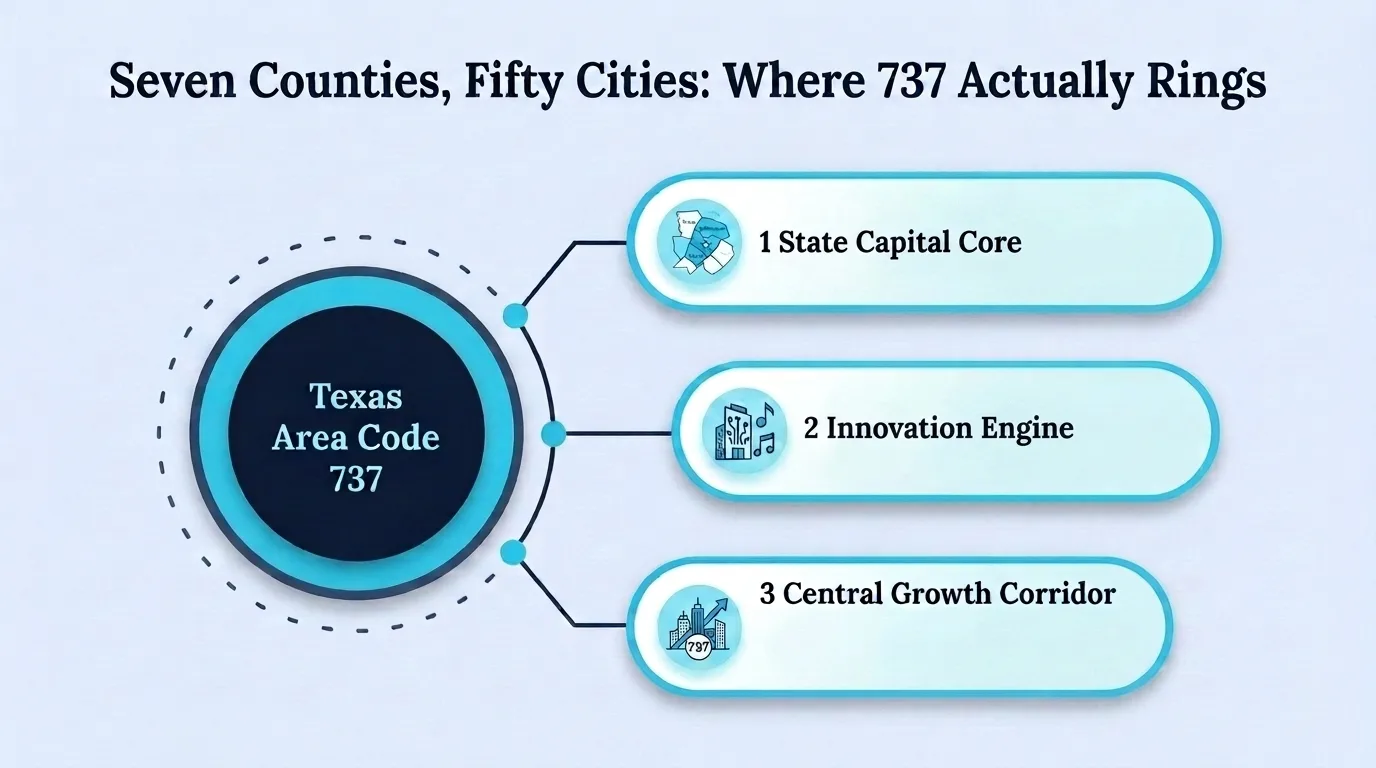
This code doesn't cover new ground on the map. It shares the exact same footprint as 512, stretching across Central Texas from the state capital outward.
- Travis County, including Austin itself
- Williamson County, including Round Rock, Cedar Park, and Georgetown
- Hays County, including San Marcos and Kyle
- Bastrop, Burnet, Caldwell, and Milam counties rounding out the territory
- More than 50 municipalities sharing this single overlay pool
- Small pockets of surrounding rural exchanges that draw from the same numbering territory
Between the state capitol, the University of Texas, and Austin's tech corridor often nicknamed Silicon Hills, this stretch of Central Texas generates enough new phone lines every year that regulators have had to intervene more than once. Directories that use the area-code-737 tag typically group these listings by county, since availability now varies more from one exchange to the next than it did a decade ago.
Why Austin Kept 512 Instead of San Antonio
Most area code splits favor whichever city is largest at the time. This one didn't. Area code 512 dates back to 1947, making it one of the original area codes assigned when the national numbering system launched, and it originally covered a huge swath of south-central Texas.
When regulators split the territory in 1992 to create area code 210, San Antonio was actually the bigger city, yet Austin kept the original 512 code specifically to spare state government agencies from the cost and hassle of switching every listed number.
That decision protected 512 through a second split in 1999, which carved out area code 361 for the Corpus Christi region, leaving Austin's numbering identity untouched for decades.
It also set the stage for everything that came next, since protecting 512 meant Austin's eventual growth would eventually need to be solved with an overlay rather than another disruptive split, which is exactly how the 737 area code came to exist years later.
The Race to Launch 737 Before Numbers Ran Out in 2013
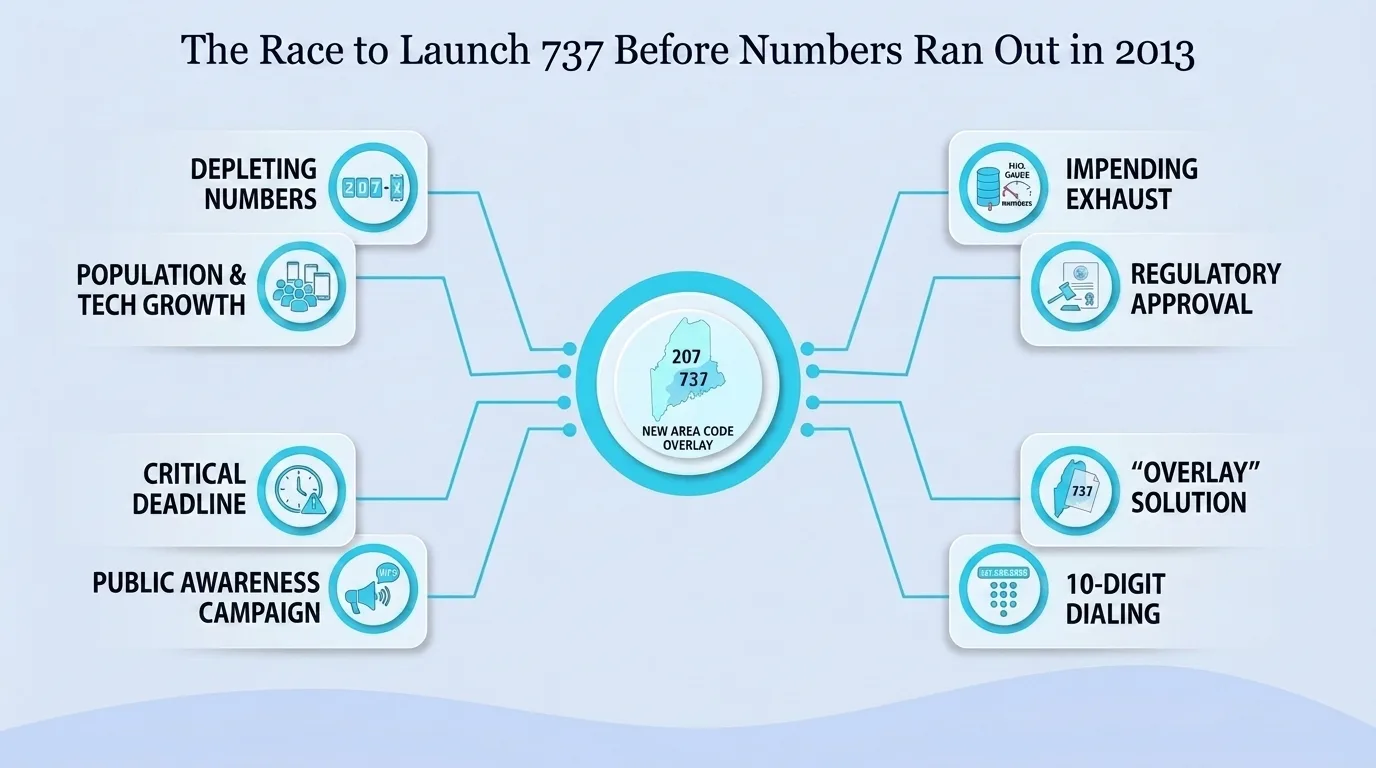
This is the detail most directory pages skip entirely, and it explains why the 737 area code exists at all. By the early 2010s, Austin's population and business growth had pushed the 512 numbering pool toward genuine exhaustion, faster than many nearby regions were experiencing at the time.
- Regulators projected 512 would run out of available numbers by the end of 2013
- The 737 overlay activated in July 2013, leaving only a few months of runway
- Unlike a geographic split, the overlay let every existing 512 number stay exactly the same
- New number requests after activation began drawing from the 737 pool instead
- Businesses that requested numbers early in 2013 sometimes still received 512, right up until the pool actually ran dry
Did Ten-Digit Dialing Arrive Before or After the Overlay?
The answer surprises a lot of people who assume the dialing change came alongside the new code.
Before: December 2012 Through June 2013
Ten-digit dialing was phased in starting December 2012 and became fully mandatory by June 2013, months before a single 737 number was ever assigned to a customer. That gap gave every business in the region a full runway to update phone systems long before the overlay itself became relevant.
After: July 2013 Onward
By the time 737 actually activated, every phone system in the region had already adjusted, which is part of why the rollout caused so little disruption compared to overlays elsewhere. Anyone getting a new 737 area code number today never has to think about that transition at all, since ten-digit dialing has simply been the norm here for over a decade.
512 and 737 Side by Side in Austin's Tech Corridor
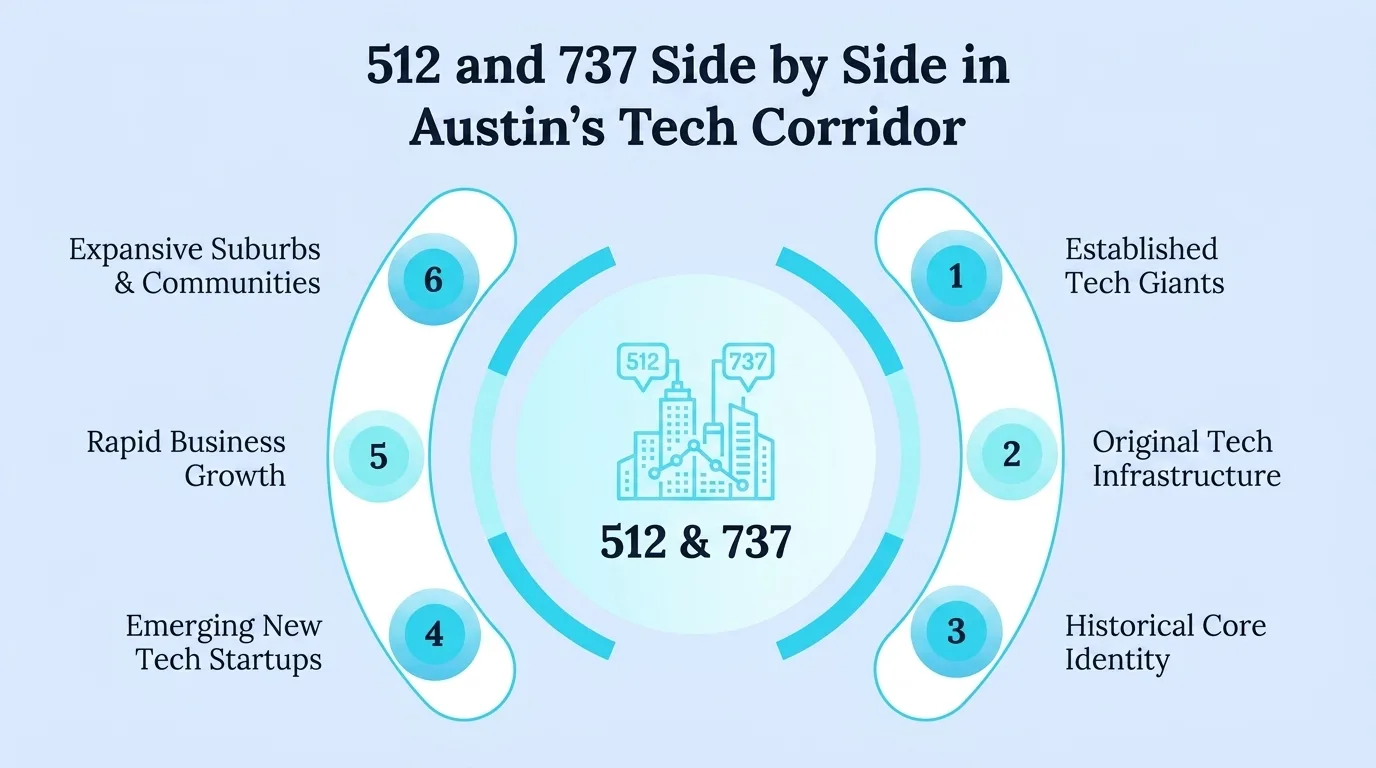
Since both codes serve the exact same seven counties, the difference between them comes down entirely to timing, not geography.
- Call quality, coverage, and local rates are identical no matter which code a number carries
- A 737 area code number costs no more than a 512 number from any carrier
- New number requests today are more likely to draw from the 737 pool, since much of the original 512 supply is already assigned
- Businesses and households can hold both codes side by side without any technical issue
- An area code 737 Texas search today will often turn up listings for both codes mixed together in the same neighborhood
Claiming a 737 Number for Your Austin Business
Getting a working number in this region is simple, whether you're setting up downtown or out in Round Rock or San Marcos.
- Contact your carrier or a cloud phone provider like Rozper and request a number in your target Austin-area exchange.
- Ask whether the number will draw from the 512 or 737 pool, since availability shifts by exchange.
- Confirm ten-digit dialing is configured correctly on every phone line before the number goes live.
- Update your website, directory listings, and marketing materials as soon as the number is active.
- Ask your provider whether overlay dialing between 512 and 737 is handled automatically for your account.
- Train front-desk and support staff to treat both codes as equally local when greeting callers.
Where Newcomers Mix Up Austin's Two Area Codes
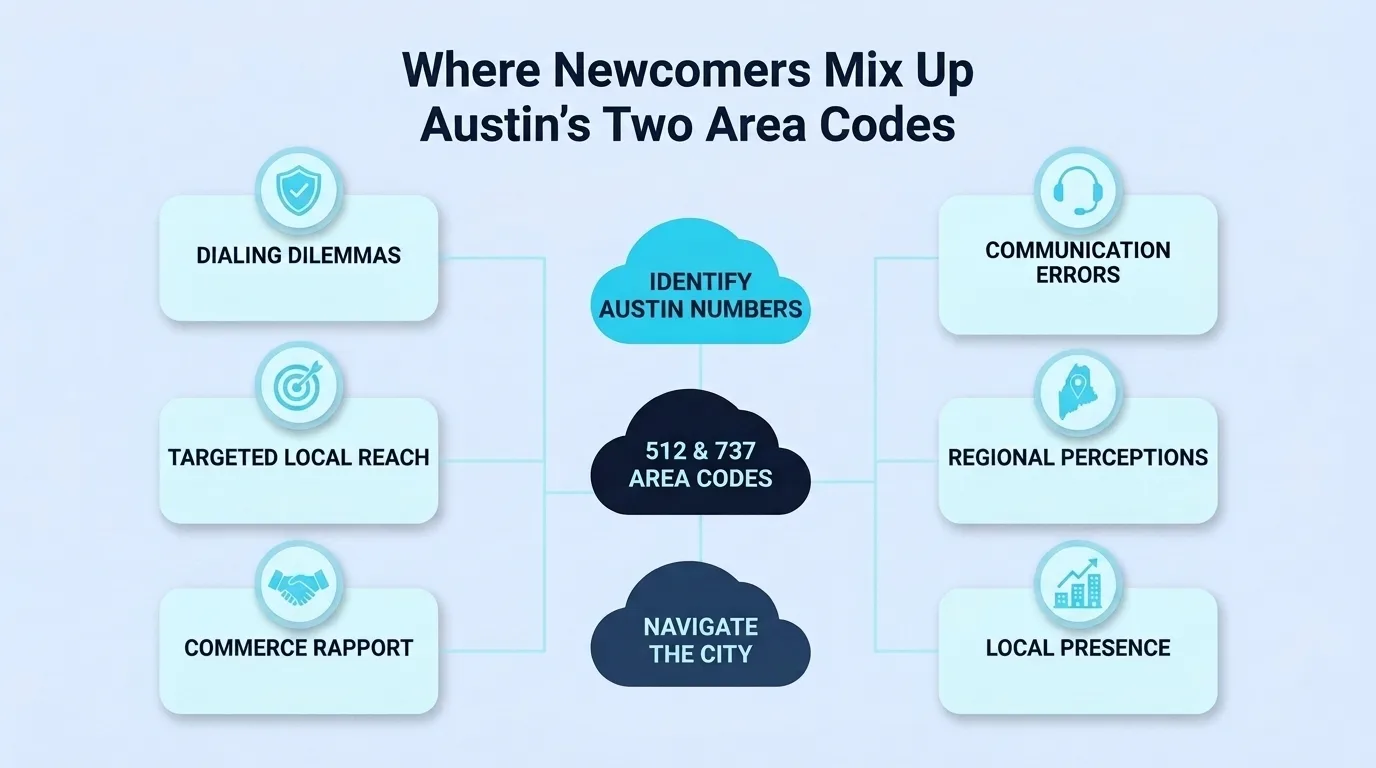
Even people who deal with Central Texas numbers regularly run into a few avoidable mix-ups with this overlay.
- Assuming a 737 area code number means the caller is located somewhere different from a 512 number
- Searching only under area-code-737 listings without checking real 512 availability first
- Believing seven-digit dialing still works anywhere in this region
- Forgetting that older phone systems may still need manual configuration for ten-digit calls
- Treating an area code 737 Texas search as covering only Austin, when it actually spans seven counties and more than 50 cities
- Assuming every provider automatically supports requests for both overlapping codes without confirming availability first
Rozper's 970 area code guide covers a similar exhaustion story in Colorado, useful for comparing how different states handle a shrinking numbering pool. Rozper's 352 area code guide explains a Florida region now facing the same kind of exhaustion pressure that pushed Austin toward its own overlay years ago.
Conclusion
The 737 area code exists today because Austin's explosive growth pushed the original 512 numbering pool to the edge of exhaustion by 2013, and understanding that history makes the current overlay far less confusing.
From the 1992 decision to protect 512 for state government continuity to the rushed activation of 737 that same year, this region's numbering story reflects just how fast Central Texas has grown. Ten-digit dialing, mandatory since June 2013, was already in place months before the first 737 number was ever issued, keeping the transition smooth.
With this guide, you now understand the area code 737 Texas situation far better than a simple directory listing could ever explain.
Businesses expanding into Austin, Round Rock, or San Marcos should treat their phone setup as part of their growth plan, not a technical afterthought. Rozper's cloud-based phone system configures ten-digit dialing correctly from day one, so a new 737 area code number works exactly as expected whether it lands in the 512 or 737 pool.
FAQs
What cities and counties does the 737 area code cover?
It overlays 512 across seven counties, including Travis, Williamson, and Hays, covering more than 50 cities. That includes Austin, Round Rock, Cedar Park, and San Marcos.
Where did the 737 area code come from?
Regulators activated it in July 2013 as an overlay to prevent the older 512 code from running out of numbers before year's end. Every existing 512 number stayed exactly the same.
When did ten-digit dialing become mandatory in this region?
Ten-digit dialing was phased in starting December 2012 and became fully mandatory by June 2013. That happened months before the first 737 number was ever assigned.
How do I get a 737 area code number for my business?
Contact a carrier or a cloud phone provider and request a number in your target Austin-area exchange. Most providers can activate a working line within a day.
Is calling or receiving calls from a 737 number safe?
Yes, but scammers can spoof any area code, including this one, to appear local. Always verify unexpected requests for personal or financial information independently.
What time zone does the 737 area code use?
The entire region runs on Central Time year-round, following Texas's standard seasonal changes. This applies from Austin through Round Rock and San Marcos.
Does a 737 number cost more than a 512 number?
No, both codes carry identical local rates since they cover the exact same territory. Pricing depends entirely on your provider and calling plan, not the specific code.
Why did Austin keep the 512 area code instead of San Antonio back in 1992?
Regulators chose to protect 512 for Austin specifically to spare state government agencies from the cost of changing their listed numbers. San Antonio was actually the larger city at the time, but continuity mattered more than population.