Introduction
Silicon Valley workers produce $336,515 in economic output per person — 75% above the national average — and businesses in San Jose, Cupertino, Sunnyvale, and Santa Clara compete for clients and talent at an unmatched pace. In that environment, small credibility signals matter, and a phone number is one of them.
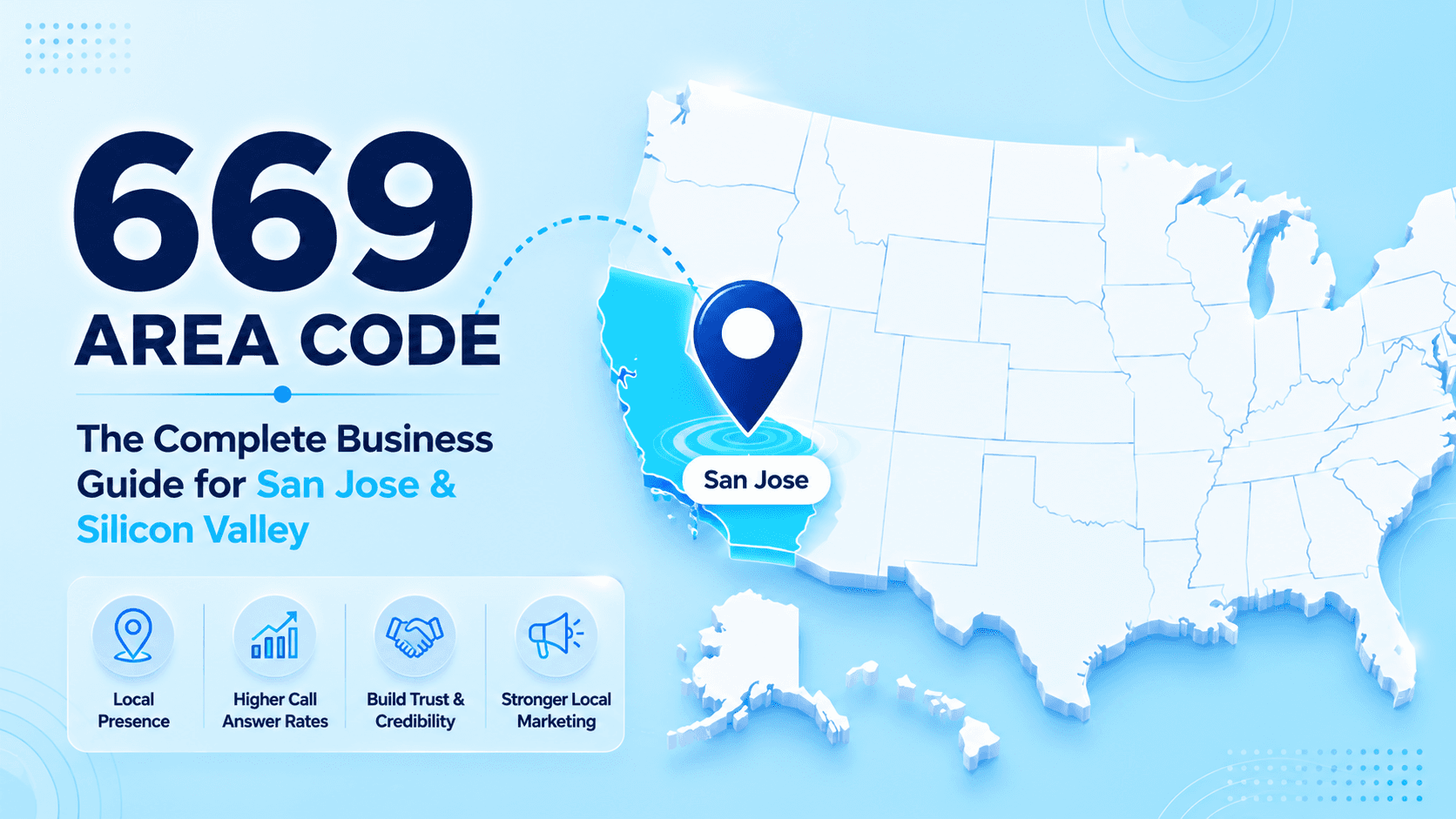
The 669 area code is Silicon Valley's local identifier, covering the same footprint as the original 408 area code — from San Jose's tech corridor to the research parks of Cupertino and Sunnyvale's corporate campuses. Whether you're an early-stage startup or a remote team targeting the South Bay without a physical office, a 669 number signals that your business belongs in this ecosystem.
This guide covers where 669 came from, what it covers today, why it works as a business asset, and how to pair it with a VoIP platform that amplifies every call your team makes or receives.
What Is the 669 Area Code? History, Coverage, and Cities
The story of area code 669 begins in 1959, when area code 408 split off from area code 415, which had served all of Northern California since 1947. For nearly four decades, 408 served the entire greater San Jose region without relief.
The explosion of pagers, fax machines, and mobile phones drove rapid number exhaustion. In 1998, the southern portion of 408's territory was reassigned to a new area code, 831, covering Monterey Bay, Santa Cruz, and the Salinas Valley. The reduction bought time, but not enough.
By 2011, the California Public Utilities Commission projected the remaining 408 pool would be exhausted by mid-2012. Rather than another split, on October 20, 2011, it approved 669 as a full overlay of the 408 area — meaning the new code covers the same geography and no one is forced to change their existing number.
New telephone lines and services began receiving 669 numbers on November 20, 2012. Because 408 and 669 share the same geographic footprint, ten-digit dialing — area code plus number — has been required for all local calls throughout the 408/669 overlay since the new code launched. Overlay decisions like this remain part of the broader numbering framework that the Federal Communications Commission coordinates nationwide, even when a state utilities commission makes the local call.
Geographic Coverage
The 669/408 overlay serves the heart of Santa Clara County — Silicon Valley's anchor — along with adjacent portions of Alameda County and northern Santa Cruz County. The region spans from the tech corridor of north San Jose to the orchard communities of Morgan Hill and Gilroy in the south.
Major Cities and Communities in the 669 Area Code:
- San Jose — The largest city in Northern California and the economic center of Silicon Valley, home to major tech headquarters, a growing healthcare sector, and a vibrant startup ecosystem
- Sunnyvale — Home to LinkedIn, Yahoo, and dozens of multinational technology companies
- Santa Clara — Site of Intel's global headquarters, a major conventions center, and significant enterprise technology infrastructure
- Cupertino — Home to Apple Inc.'s global headquarters and associated technology supply chain
- Mountain View — Home to Google's main campus and a cluster of leading AI and software companies
- Milpitas — A key Silicon Valley suburb with significant semiconductor manufacturing and research presence
- Campbell, Los Gatos, Saratoga, Monte Sereno — Established South Bay communities with strong small business and professional services economies
- Morgan Hill and Gilroy — The southern anchor of the 408/669 territory, blending agricultural heritage with a growing commuter and commercial base
For businesses, acquiring a 669 number means communicating — before anyone answers — that your company operates in the heart of the global technology industry.
Why a 669 Area Code Gives Your Business a Competitive Edge
Picture a San Jose decision-maker receiving two calls pitching the same enterprise software: one shows a 669 caller ID, the other a 1-800 number from a Midwest call center. The 669 call gets answered more often — that's the measurable psychology of local trust at work.
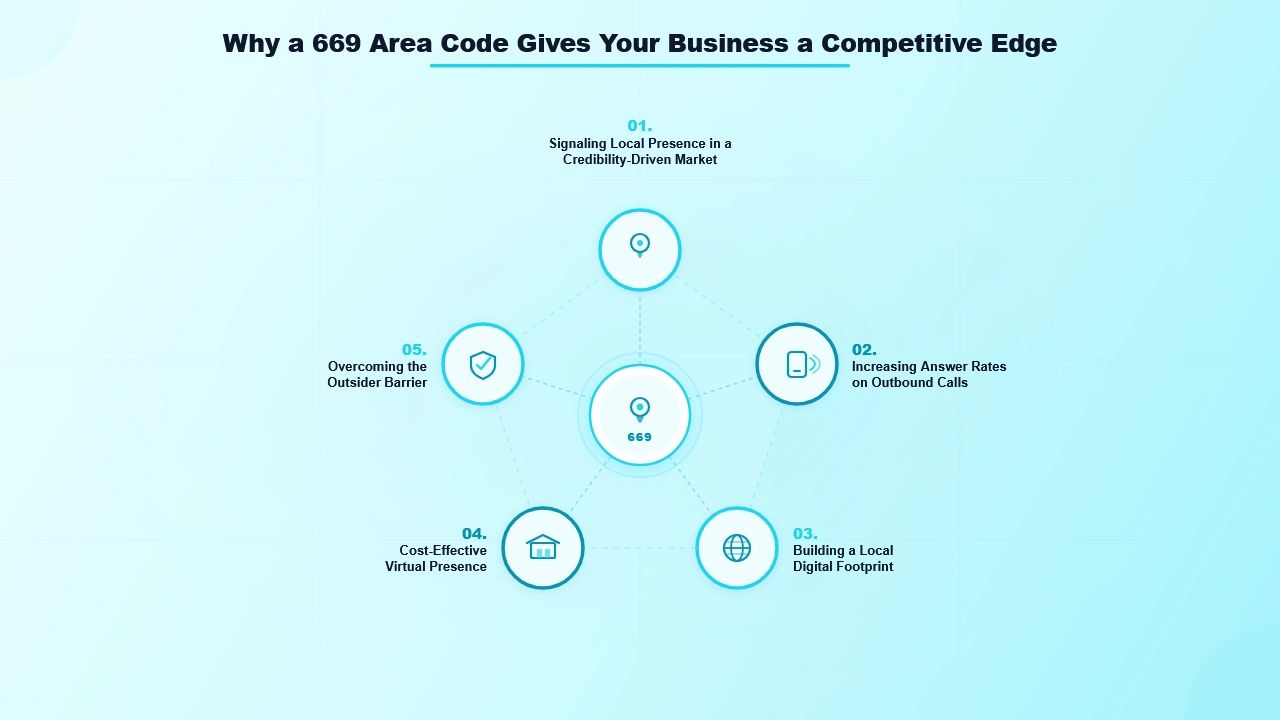
Signaling Local Presence in a Credibility-Driven Market
Silicon Valley is a high-trust ecosystem built on referrals and warm introductions. A 669 area code signals that your company has skin in the game — that you're operating in the same market as your prospects, not dialing in from a distance. For B2B outreach targeting Cupertino tech firms or mid-market companies in Sunnyvale, that local marker is a meaningful accelerator.
Increasing Answer Rates on Outbound Calls
The Bay Area has one of the highest robocall rates in the country, so local contacts have become aggressive call screeners. A recognizable 669 or 408 caller ID bypasses that default suspicion, and sales teams using a 669 number consistently see more live conversations per dial session.
Building a Local Digital Footprint
Search engines evaluate the consistency of a business's Name, Address, and Phone across the web. A 669 number embedded in your Google Business Profile, website, and directory listings reinforces your Silicon Valley identity to both algorithms and local customers, strengthening SEO signals and conversion rates for geotargeted campaigns.
Establishing a Cost-Effective Virtual Presence
A 669 virtual phone number gives any business a credible Silicon Valley identity without the cost of leasing South Bay office space. Calls route to your team wherever they work, whether that's a distributed startup, a remote-first organization, or a company expanding into California without a physical footprint.
Overcoming the "Outsider" Barrier
In markets where relationships and regional expertise are table stakes, a toll-free or out-of-area number creates unnecessary friction. Prospects wonder whether an out-of-market provider truly understands the Bay Area's pace, deal structure, and competitive environment. A 669 number removes that concern before the conversation starts.
Beyond the Number: How a VoIP Platform Powers Your 669 Strategy
Owning a 669 number is the entry point; the multiplier is the platform behind it. Modern VoIP solutions transform a local number into a full communications stack — connecting voice, video, messaging, analytics, and integrations into one system your team can manage from any device, anywhere.
Providers like Rozper include at least one local number, including 669, in every paid plan, built for the demands of sales teams, support operations, and distributed workforces — which matters in Silicon Valley, where headcount is lean and teams often span multiple time zones.
What comes standard with a modern VoIP plan:
- HD voice calls — Crystal-clear audio quality that reflects the professionalism your Bay Area clients expect
- Video conferencing — Client meetings, product demos, and internal syncs without switching platforms
- SMS/MMS messaging — Text-based engagement on the channels used by tech-forward clients
- Team messaging — Internal collaboration built into the same application as outbound calling
Flexible custom pricing ensures that a two-person startup in a co-working space in San Jose and a fifty-person support team in Santa Clara can both access enterprise-grade tools — without paying for capacity they haven't earned yet.
Essential Communication Features for 669 Area Code Users
The 669 number is the front door. What happens inside the platform determines whether it becomes a competitive asset or just another line.
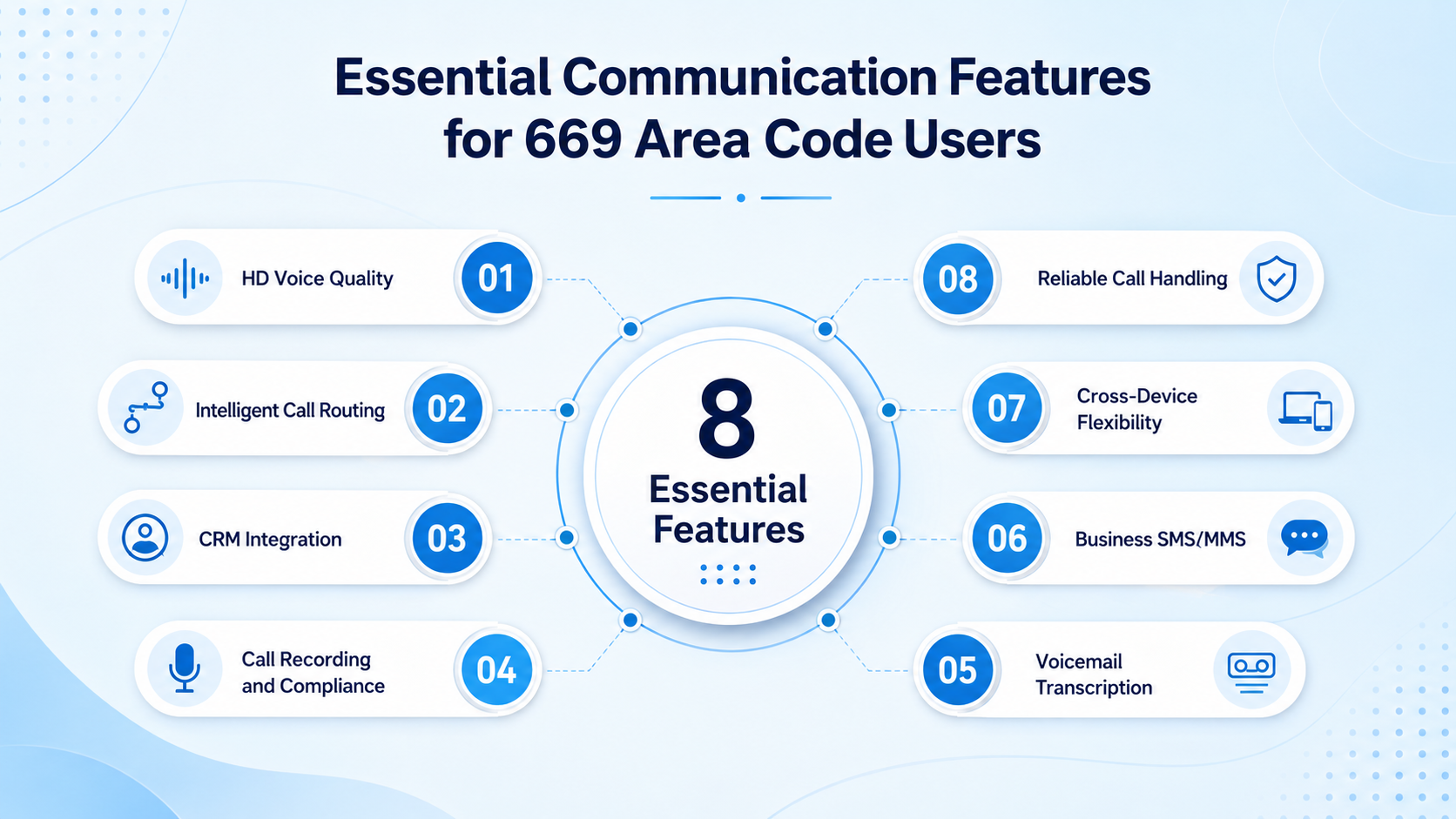
1. HD Voice Quality
HD voice stands out in an era of compressed audio and over-saturated video calls. Silicon Valley clients, who spend their days on product demos and technical evaluations, notice call quality immediately — a platform with wideband audio codecs builds trust passively, before your team even makes its pitch.
2. Intelligent Call Routing
Connect every incoming 669 call to the right person instantly. Skill-based routing sends callers to the best-equipped agent, time-of-day routing redirects after-hours calls to on-call staff or voicemail, and IVR menus handle high-volume inbound without the hold-time frustration that erodes B2B customer satisfaction.
3. CRM Integration
The most productive Silicon Valley sales teams connect their CRM and phone system rather than treating them as separate tools. Every inbound and outbound 669 call is logged automatically against the contact record, and screen pops surface full CRM context the moment a known caller dials in.
4. Call Recording and Compliance
California is a two-party consent state for call recording. A platform with built-in recording and automated consent prompts keeps your 669 number compliant with Penal Code § 632 without manual process management, while recorded calls support QA reviews, onboarding, and ongoing coaching.
5. Voicemail Transcription
San Jose reps and support agents spend their days in back-to-back calls. Voicemail transcription delivers every missed 669 call as readable text, in email and the mobile app, so follow-up is faster and the written record integrates cleanly into CRM notes.
6. Real-Time Call Analytics
Understand exactly how your 669 lines are performing. Live dashboards and historical reports on call volume, answer rates, handle time, and per-agent performance give team leads the data to optimize staffing, refine scripts, and quantify ROI on every South Bay campaign.
7. Business SMS/MMS
Text-based communication has become a primary engagement channel for Silicon Valley sales cycles, particularly for demo follow-ups and web inquiry responses. Sending business SMS/MMS from your 669 number keeps professional and personal messaging separated and captures full message history in your system of record.
8. Cross-Device Flexibility
Silicon Valley teams rarely work from a single desk. Full-featured apps across desktop, iOS, Android, and browser ensure every team member's 669 caller ID travels with them, whether they're on-site in Cupertino, at a co-working space in San Jose, or working remotely.
How to Maximize Your 669 Area Code Number's Impact
Getting the number and the platform is the foundation. Active integration into your operations is what turns a 669 number into sustained competitive advantage.
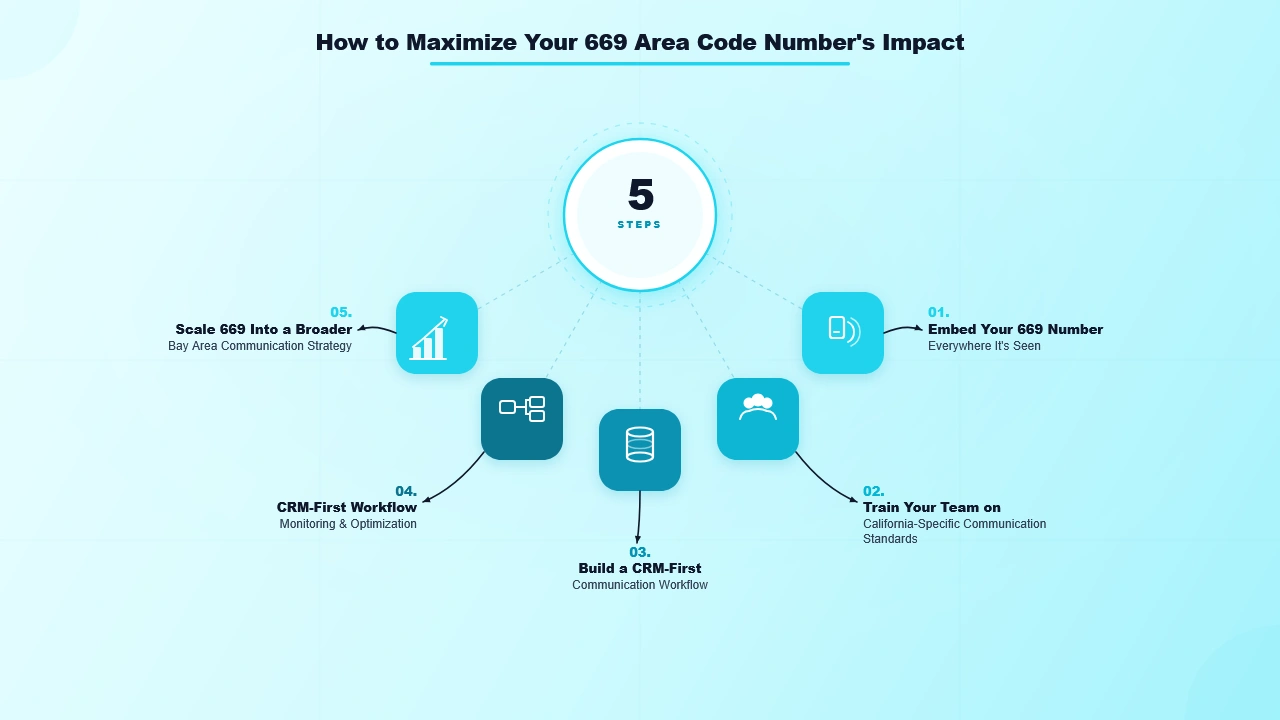
Embed Your 669 Number Everywhere It's Seen
A 669 number that only appears on outbound calls provides a fraction of its potential value. To maximize local SEO and brand recognition:
- Feature the 669 number on your website homepage, contact page, and footer as crawlable text
- Update your Google Business Profile with the 669 number alongside your Santa Clara County service area
- Ensure consistent formatting across all directory listings — Yelp, LinkedIn, the San Jose Chamber of Commerce, and any industry-specific platforms serving the Bay Area market
- Use it as the call tracking number in all local paid search and display campaigns to capture clean attribution
Train Your Team on California-Specific Communication Standards
Your platform enables the call; your team closes it. Equip them to:
- Acknowledge regional context naturally in outbound prospecting (e.g., "We work with a lot of teams in the Bay Area — what are you currently using for...?")
- Follow California two-party consent requirements when recording calls — your VoIP platform should handle the automated disclosure, but reps should understand the standard
- Use routing rules, transfer protocols, and voicemail consistently so no caller experience diverges from your brand standard
Build a CRM-First Communication Workflow
The highest-performing 669 deployments in Silicon Valley connect directly and deeply to a CRM:
- Automatic call logging — every inbound and outbound call captured against the contact record without manual data entry
- Click-to-dial — outbound calls initiated from within the CRM using the 669 number, keeping activity tracking accurate and eliminating dialing time
- Post-call notes — rep notes, disposition codes, and voicemail transcriptions attached to the correct opportunity automatically
Scale 669 Into a Broader Bay Area Communication Strategy
A 669 number is the core. As your Bay Area presence grows, the same VoIP platform can expand to cover adjacent markets:
- Add call forwarding rules to route overflow calls from 669 to team members in other time zones without missing South Bay business
- Activate SMS campaigns targeting your 669 contact database for product launches, event invitations, or customer reactivation programs
- Layer on additional numbers — the 510 area code for the East Bay, the 415 area code for San Francisco — all managed from the same admin dashboard
Choosing the Right VoIP Plan for Your Bay Area Business
The right plan depends on team size, call volume, California compliance requirements, and the features your operation requires. Most leading providers structure plans in tiers:
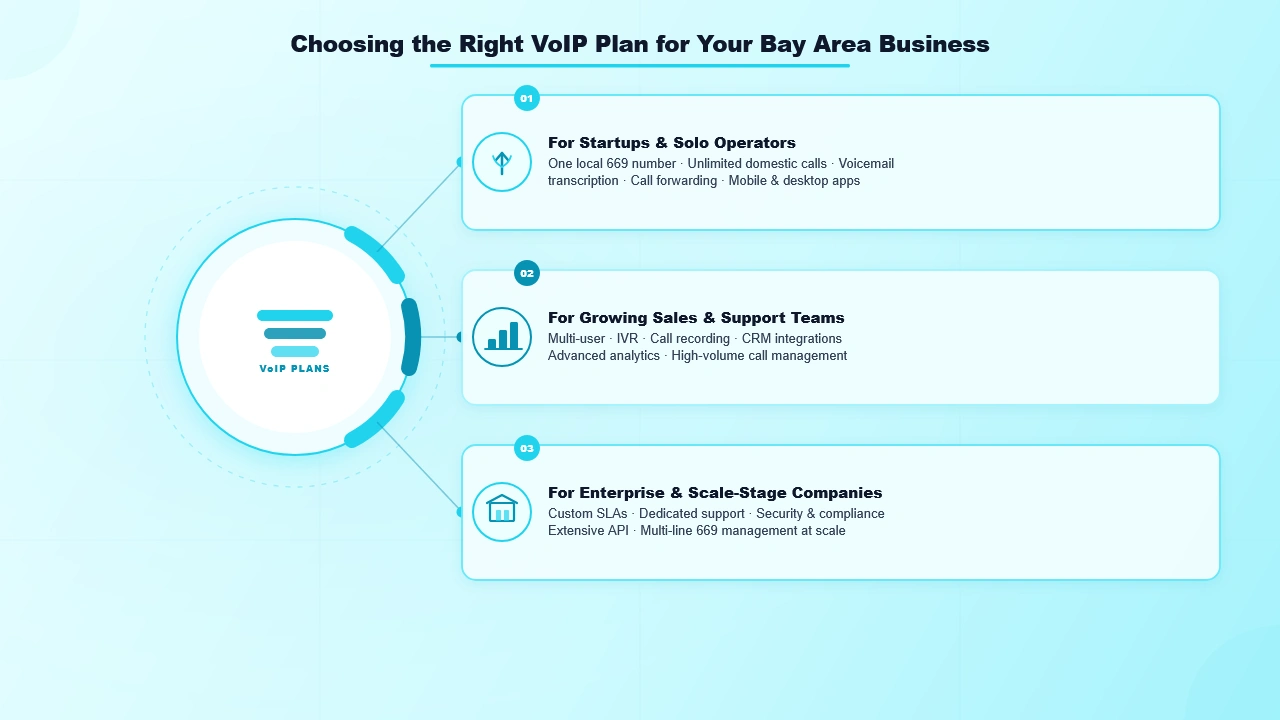
For Startups and Solo Operators: Entry-level plans include one local 669 number, unlimited domestic calling, voicemail transcription, call forwarding, and mobile/desktop apps — everything a lean Bay Area startup needs to project a professional local identity from day one.
For Growing Sales and Support Teams: Mid-tier plans add multi-user support, IVR, call recording, CRM integrations, and advanced analytics, built for teams handling higher call volumes and more complex customer journeys.
For Enterprise and Scale-Stage Companies: Custom plans provide dedicated support, SLA guarantees, compliance tooling, API access, and the flexibility to manage dozens of 669 lines or additional Bay Area codes simultaneously.
When evaluating providers, look beyond the headline price. Factor in uptime SLAs, California compliance support, integration depth, and the ability to scale without re-platforming. Rozper's pricing page offers transparent options built for Silicon Valley teams at every growth stage.
Scale Confidently: Reliability Built for Silicon Valley's Pace
Silicon Valley businesses don't tolerate downtime. In a market where deals close on calls and support queues generate real-time satisfaction scores, a dropped connection creates immediate, measurable business cost.
The 2026 Silicon Valley Index reports $92 billion in venture capital and over 23,000 patents filed in the region — a pace that demands communication infrastructure to match. Downtime here doesn't just inconvenience; it can cost deals and damage the credibility a 669 number was deployed to build.
Scalability is the defining strength of cloud VoIP. Adding team members, new 669 lines, or numbers in adjacent area codes (510, 415, 408) requires no hardware procurement and no lead time — your phone system grows in real time through a single admin panel.
Reliability demands scrutiny beyond the sales deck. Rozper is one option worth considering here, maintaining 99.999% uptime and coverage in 150+ countries so a single platform can serve both your local Silicon Valley line and any international operations. Before committing to any provider, verify their stated uptime commitment and published incident history.
Conclusion
In a region that runs on reputation, speed, and precision, a 669 area code is one of the most efficient trust signals a business can deploy. It tells San Jose prospects, Cupertino partners, and Sunnyvale enterprise accounts that you operate in the same competitive ecosystem they do.
But local presence alone doesn't win deals. Pairing a 669 number with a modern, fully featured VoIP platform transforms a phone line into a competitive tool — equipped with intelligent routing, call recording, CRM integration, and the analytics needed to prove ROI to stakeholders.
If you're ready to build or strengthen your Silicon Valley presence, Rozper is worth exploring as a provider for this kind of setup. Every number in the 669/408 overlay is still administered under the Federal Communications Commission's numbering framework, the same oversight that keeps area codes coordinated nationwide.
FAQs
What cities does the 669 area code cover?
It's an overlay of area code 408, covering Santa Clara County plus portions of Alameda and northern Santa Cruz County — including San Jose, Sunnyvale, Santa Clara, Cupertino, Mountain View, Milpitas, and Morgan Hill/Gilroy.
Why does Silicon Valley have two area codes — 408 and 669?
The 408 area code was established in 1959. By 2011, explosive demand from mobile phones and VoIP exhausted its number supply, so the California Public Utilities Commission approved 669 as a full overlay, with new numbers available starting November 2012.
Is ten-digit dialing required for 669 area code calls?
Yes. Because 408 and 669 overlay the same area, ten-digit dialing has been required for all local calls in the region since 669 launched in 2012.
Can a business outside California use a 669 area code number?
Yes. A virtual 669 phone number lets any business, regardless of location, present a 669 caller ID and route calls to any device worldwide — practical for remote-first companies and national brands building a Bay Area presence.
Does California have special rules for recording calls on a 669 number?
Yes. California requires two-party consent under Penal Code § 632, so businesses must provide audible disclosure before recording. Most VoIP platforms include automated consent prompts that handle this.
What VoIP features matter most for Silicon Valley businesses using a 669 number?
CRM integration, California-compliant call recording, intelligent routing, and real-time analytics matter most. For high-volume outbound teams, business SMS and cross-device compatibility are equally critical.
What's the difference between using a 669 number and a toll-free number for Bay Area sales outreach?
A 669 local number consistently outperforms toll-free numbers in answer rates — prospects are more likely to pick up a call that looks local, while toll-free numbers are heavily associated with bulk outreach and robocalls.