Introduction
What does your area code say about your business before you say a word?
For anyone reaching clients in San Francisco, the answer matters more than most cities. The 415 area code doesn't just identify a phone exchange — it identifies a worldview. It's the prefix that still rings at the desks of Salesforce, Wells Fargo, and Visa, signaling to Bay Area residents that your business belongs to their community rather than prospecting from outside it — a distinction locals notice just as quickly as they would a call from the 510 area code across the Bay Bridge.
This guide covers everything you need to know about this iconic San Francisco prefix: its geographic coverage, the 628 overlay that extended its capacity, accurate dialing details, scam call awareness, the SF economy it serves, and how to get a 415 business number that works as hard as the city it represents.
What Is the 415 Area Code?
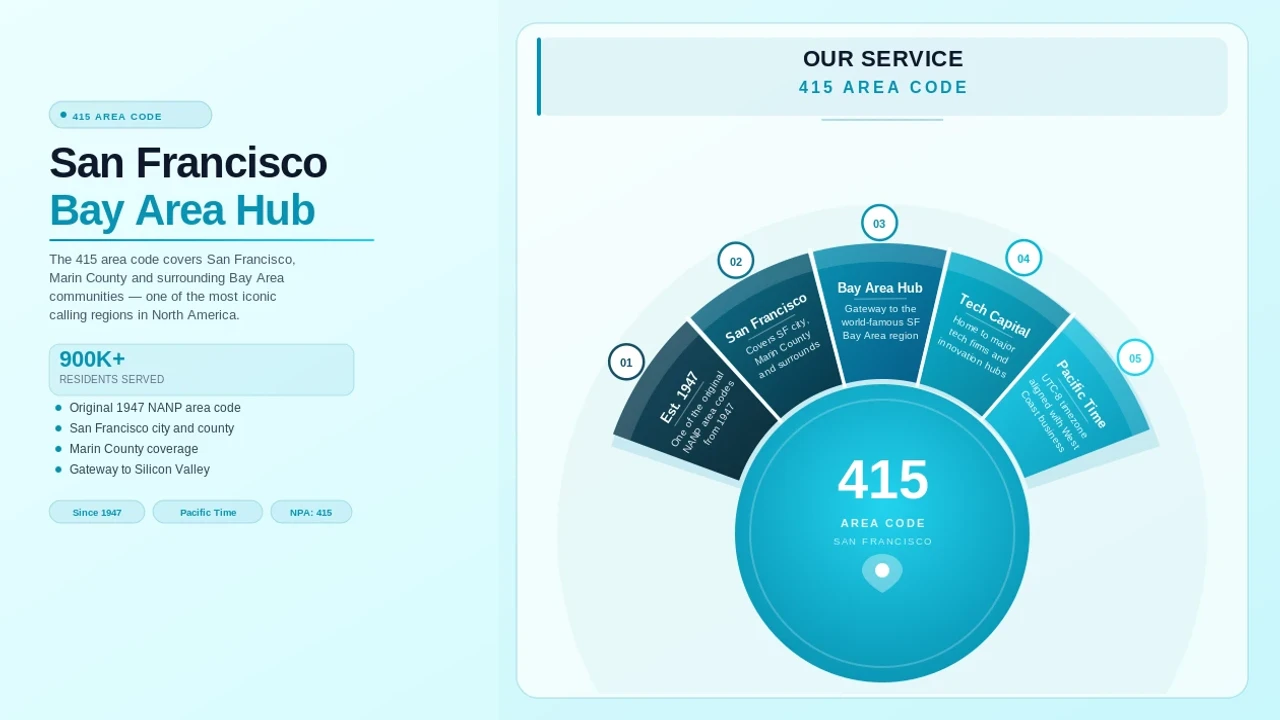
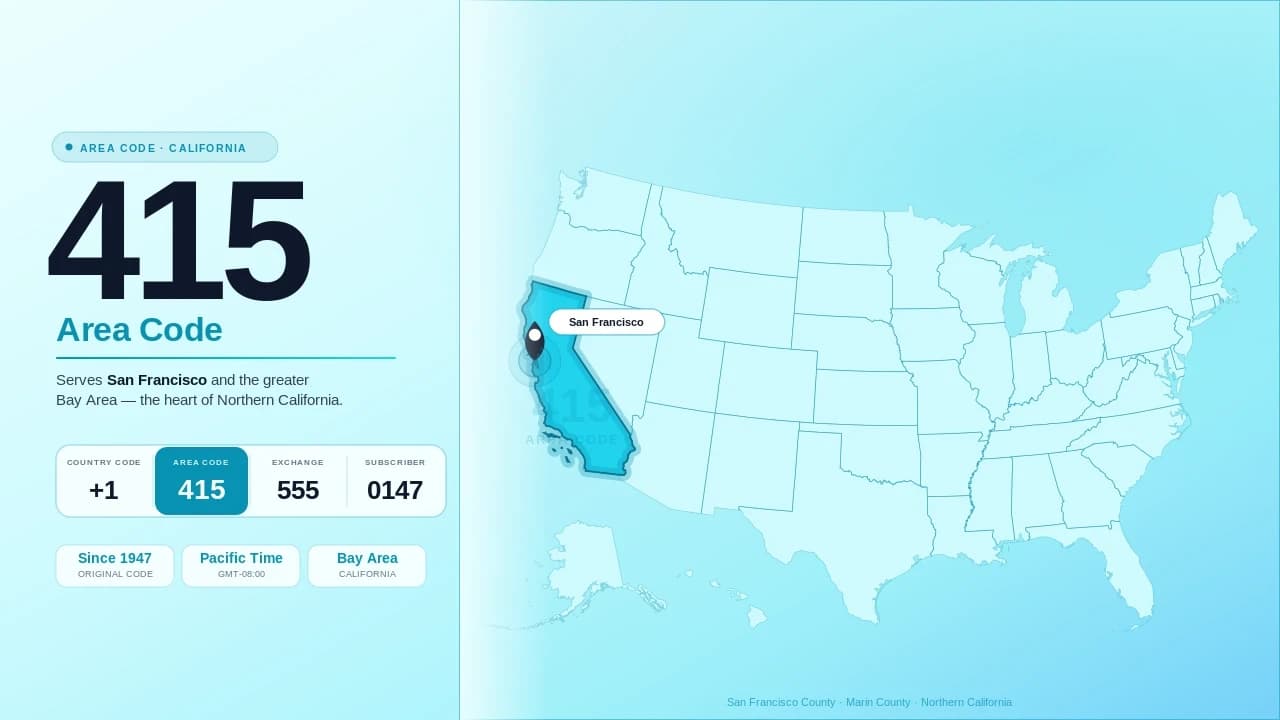
The 415 area code is one of California's original telephone area codes, established in 1947 as part of the North American Numbering Plan (NANP). Today it serves San Francisco city and county, most of Marin County, and a small portion of northeastern San Mateo County — one of the most economically and culturally significant geographic footprints of any area code in the United States.
Quick Facts:
| Detail | Info |
|---|---|
| Area Code | 415 |
| Overlay Code | 628 (added March 21, 2015) |
| State | California |
| Region | San Francisco, Marin County, NE San Mateo County |
| Time Zone | Pacific Time (PT) — UTC−8/UTC−7 |
| Dialing | 10-digit mandatory (since 2015) |
| Established | 1947 (one of California's original three codes) |
| Originally Covered | All of central California |
| Key Adjacent Codes | 510 (East Bay), 650 (Peninsula), 707 (North Bay/Wine Country) |
Area code 415 is a prestige marker tied to one of the world's most recognized innovation hubs — having a 415 number signals immediate San Francisco credibility to both local contacts and international partners who recognize the Bay Area's global standing.
Where Does the 415 Code Cover?
The 415 code covers San Francisco city and county in full, the majority of Marin County to the north across the Golden Gate Bridge, and the northeastern corner of San Mateo County to the south.
San Francisco
San Francisco is the primary city and commercial hub of the 415 territory. It is home to the Financial District — where Wells Fargo, Charles Schwab, Visa, and Salesforce all maintain major operations — as well as the Mission Bay biotech corridor, SoMa (South of Market) tech district, and the Civic Center government hub. Despite covering only 47 square miles, San Francisco generates one of the highest GDP-per-capita figures of any city in the world.
The city's distinct neighborhoods serve equally distinct commercial purposes. The Financial District and Jackson Square house banking, law, and professional services. SoMa is home to Salesforce Tower, Uber's headquarters, and a dense concentration of tech startups. Mission Bay is anchored by UCSF's research campus and a world-class biotech cluster. Union Square and Fisherman's Wharf drive some of the highest-volume tourism and hospitality commerce in Northern California.
Marin County
Marin County, accessible via the Golden Gate Bridge, falls within the 415/628 coverage zone. Key communities include:
San Rafael — the county seat and primary commercial hub of Marin, with law firms, financial services, and healthcare providers.
Sausalito — a waterfront arts and hospitality community with a strong tourism economy and proximity to major SF tech commuter routes.
Mill Valley, Tiburon, and Belvedere — affluent residential communities with growing professional service and boutique retail sectors.
Novato — the largest city in Marin County, with a diversified economy including manufacturing, healthcare, and retail.
Fairfax, San Anselmo, Corte Madera, and Larkspur — additional Marin communities within the 415/628 footprint.
Point Reyes, Stinson Beach, and Inverness — coastal and rural communities in western Marin that extend the geographic diversity of the code.
San Mateo County (Partial)
The northeastern edge of San Mateo County — including parts of Daly City and Brisbane — falls within the 415/628 zone, creating a southern connection point between San Francisco and the broader Peninsula.
History of the 415 Area Code
The 415 area code carries one of the longest histories of any code in the United States. It was one of only three original area codes assigned to California when AT&T introduced the North American Numbering Plan in 1947. At that time, 415 covered all of central California — a vast territory stretching from the Bay Area inland.
For decades, area code 415 served all of central California before being progressively refined as population centers grew and telephone demand surged. The Bay Area's rapid growth through the tech industry's emergence in the 1980s and 90s accelerated number consumption significantly. By the early 2000s, the proliferation of mobile phones — each requiring its own number — put enormous strain on the remaining 415 inventory.
The Splits: 408 and Beyond
Throughout the 1980s and early 1990s, the original California area codes underwent multiple splits. San Jose and Silicon Valley proper eventually moved to the 408 area code, and the Bay Area's East Bay communities transitioned to 510. By the mid-1990s, 415 had been refined to its current geographic footprint: San Francisco, Marin, and a sliver of San Mateo County.
2015: The 628 Overlay
By 2015, the remaining 415 number inventory was approaching exhaustion. The California Public Utilities Commission (CPUC) and NANPA approved the 628 area code as an overlay — using the same mechanism as the 310 area code and its 424 overlay in Los Angeles, all administered under the Federal Communications Commission's national numbering framework.
628 went live on March 21, 2015. Unlike a geographic split, the overlay preserved all existing 415 numbers intact. New subscribers in the San Francisco/Marin/San Mateo zone began receiving numbers from the 628 area code. Both area codes coexist as fully local identifiers for the same territory.
A key consequence of the 628 overlay: mandatory 10-digit dialing for all local calls. Since 2015, dialing a 7-digit local number no longer works within the 415/628 zone — the full area code must be included on every call.
415 Area Code Time Zone
This region operates entirely within the Pacific Time Zone (PT):
- Pacific Standard Time (PST): UTC−8 — observed from early November to mid-March
- Pacific Daylight Time (PDT): UTC−7 — observed from mid-March to early November
Cross-Timezone Calling Guide
From the East Coast (ET): Eastern Time is 3 hours ahead of Pacific. Calling a San Francisco client at 9 AM PT means reaching them at noon ET — manageable for afternoon East Coast calls but important to track for morning meetings.
From the Midwest (CT): Central Time is 2 hours ahead of Pacific. An 11 AM CT call reaches the 415 zone at 9 AM PT — a clean cross-timezone morning sync.
From Mountain Time (MT): Generally 1 hour ahead, though Arizona (excluding Navajo Nation) does not observe Daylight Saving Time, creating a 2-hour gap during DST periods.
International calls to 415: From the UK, dial 00 + 1 + 415 + 7-digit number. From Australia, dial 0011 + 1 + 415 + 7-digit number. Globally on mobile: +1-415-XXX-XXXX.
Optimal calling window: 9 AM to 5 PM PT is the standard SF business day. For East Coast-based companies managing SF client lines, your 415 IVR business hours should be Pacific — not Eastern — to avoid routing calls incorrectly.
Is a 415 Call a Scam?
The 415 prefix is entirely legitimate, serving millions of real residents and businesses across San Francisco and Marin County. However, because it's strongly associated with an economically significant and culturally recognized region, scammers actively spoof 415 numbers to make fraudulent calls appear local and credible.
According to consumer reporting data, prerecorded voice calls make up 55% of all spam complaints associated with these San Francisco numbers — higher than the national average — indicating a systematic, automated approach to spoofing these numbers.
Common 415-Spoofed Scam Patterns
IRS impersonation: Callers claiming to be IRS agents threaten legal action or arrest unless the recipient pays a fabricated tax debt immediately via wire transfer or gift card. The IRS does not initiate enforcement through unsolicited phone calls.
Social Security Administration (SSA) suspension threats: Scammers impersonating the SSA claim the recipient's Social Security number has been suspended due to suspicious activity, and that benefits will stop unless they provide personal information or pay a fee to reactivate. The SSA does not suspend Social Security numbers over the phone.
One-ring scams: A spoofed number rings once and disconnects. The tactic relies on curiosity — if the recipient calls back, they may be connected to a premium-rate number charging per-minute fees.
Robocall prerecorded message scams: Automated calls playing prerecorded messages — claiming prize winnings, warranty expirations, or account security alerts — constitute the majority of 415-spoofed scam volume.
How to Stay Protected
- Legitimate government agencies — IRS, SSA, courts — do not initiate enforcement contact through unsolicited calls. Always verify via the agency's official website number.
- If a number rings once and disconnects, do not call back unless you recognize it or receive a voicemail.
- Use a reverse phone lookup to check unfamiliar 415 or 628 numbers before returning calls.
- Businesses operating legitimate 415 lines benefit from STIR/SHAKEN-compliant VoIP providers — this framework verifies caller ID authenticity and reduces spoofing effectiveness at the carrier level.
The 415 Economy: What Powers San Francisco
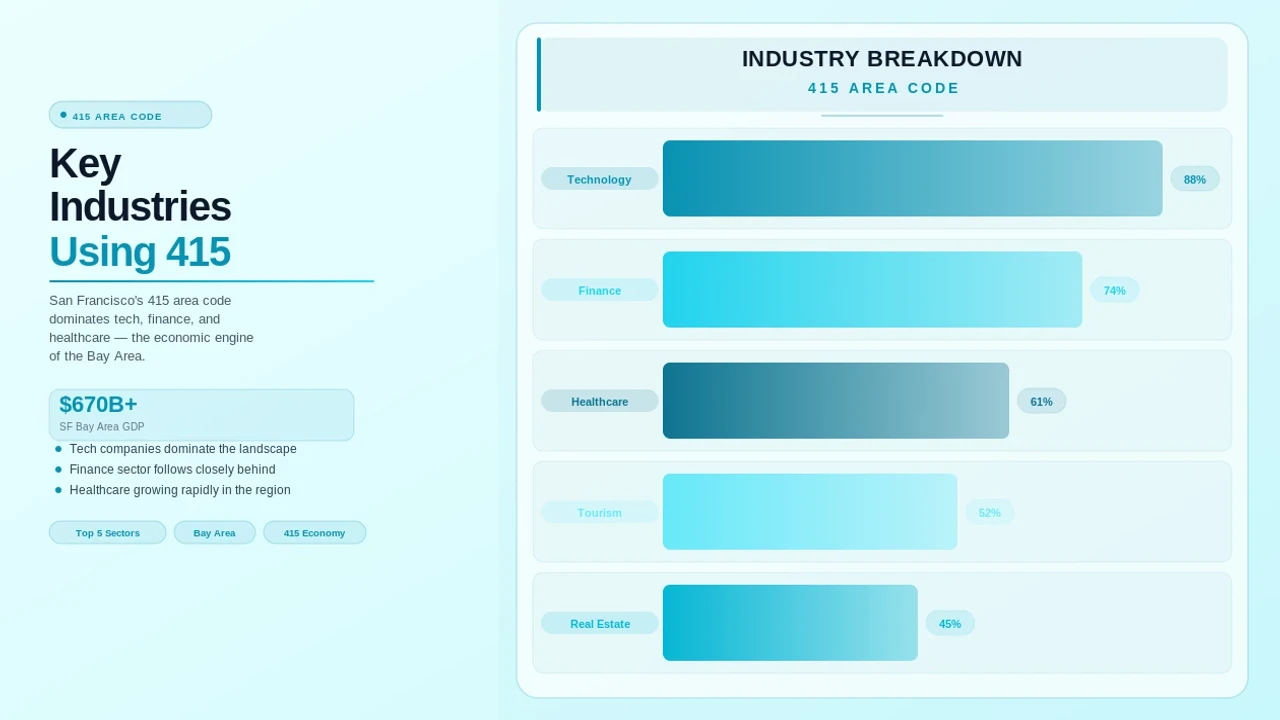
The 415 code sits atop one of the densest concentrations of high-value industries in the world. Understanding what drives this economy gives businesses the context to position themselves effectively.
Technology
San Francisco's SoMa district is the densest urban node of the Bay Area tech ecosystem outside of the South Bay. Salesforce — the world's largest CRM company — is headquartered at Salesforce Tower, the tallest building in the SF skyline. Uber established its global headquarters in Mission Bay. Twitter/X, Lyft, Dropbox, Airbnb, and dozens of other category-defining companies have called SF home.
Financial Services
San Francisco's Financial District is one of the most significant banking and finance corridors in the United States. Wells Fargo — one of the four largest US banks — is headquartered there. Charles Schwab, Visa, and First Republic have maintained major SF presences. The density of asset managers, wealth advisors, fintech companies, and investment banks in the Financial District makes it a natural target for any business-to-business financial services provider.
Biotechnology and Life Sciences
Mission Bay has become one of the premier biotech research hubs in the world. UCSF's Mission Bay campus anchors the ecosystem, with pharmaceutical companies, genomics firms, and biotech startups clustering around its research facilities.
Tourism and Hospitality
San Francisco consistently ranks among the top US cities for international visitor arrivals. The Golden Gate Bridge, Alcatraz, Fisherman's Wharf, Chinatown, and Union Square generate hundreds of millions in annual visitor spending.
Professional Services
A dense concentration of law firms, consulting practices, accounting firms, and marketing agencies supports the 415 zone's finance and tech sectors. For professional service businesses, a 415 number functions as a credibility marker — signaling direct participation in SF's commercial ecosystem rather than remote engagement.
Why a 415 Business Number Strengthens Your Market Position
A 415 number does measurable work for your business before the conversation even starts.
Local Trust in a Skeptical Market
San Francisco consumers and business decision-makers are among the most discerning — and the most inundated with unsolicited outreach — in the country. A 415 number signals that your business is a local participant, not an outside vendor cold-reaching into the market. That recognition translates directly into higher call answer rates and warmer first-call reception.
Alignment With SF's Innovation Identity
In the tech, fintech, and biotech sectors that dominate 415 territory, a local number isn't just about geography — it's about belonging to a shared culture of innovation. For startups pitching enterprise clients, professional service firms seeking SF corporate business, or international companies entering the US market through San Francisco, a 415 number is part of the professional identity package.
Local SEO Signal
A consistent 415 number in your Google Business Profile, website footer, and local citations reinforces geographic relevance for SF-specific searches. Google's local ranking algorithm factors in NAP (Name, Address, Phone) consistency — a 415 number aligned with SF-targeting content strengthens visibility in one of the highest-value local search markets in the country.
Remote Presence Without a San Francisco Lease
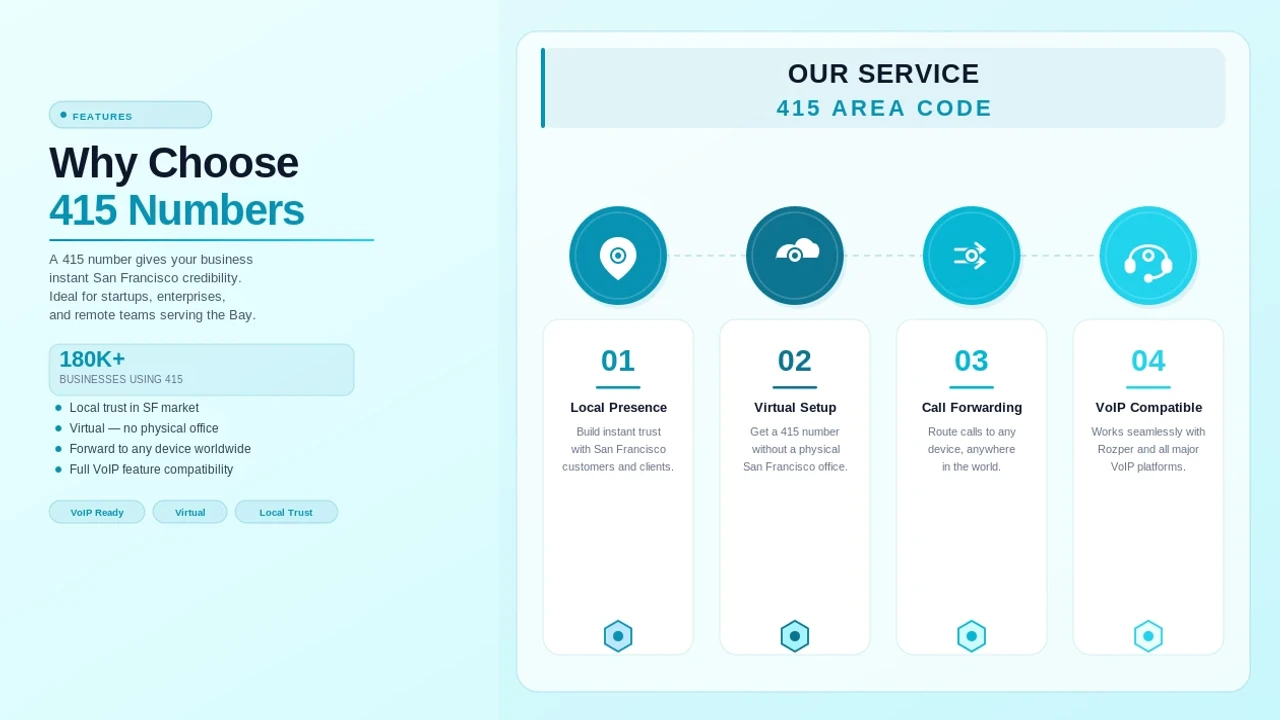
You do not need a SoMa office to carry a SoMa area code. Virtual 415 numbers route calls to any device globally — mobile, softphone, or desktop — allowing remote teams, national businesses, and international companies to project a credible SF presence without the cost of Bay Area real estate.
Attribution Across Campaigns
Assigning dedicated 415 numbers to specific marketing channels — digital ads, local print, PR outreach, landing pages — gives you clean inbound call data per channel for the SF market. This attribution clarity drives smarter budget decisions and measurable ROI on SF-specific campaigns.
How to Get a Local 415 Business Number
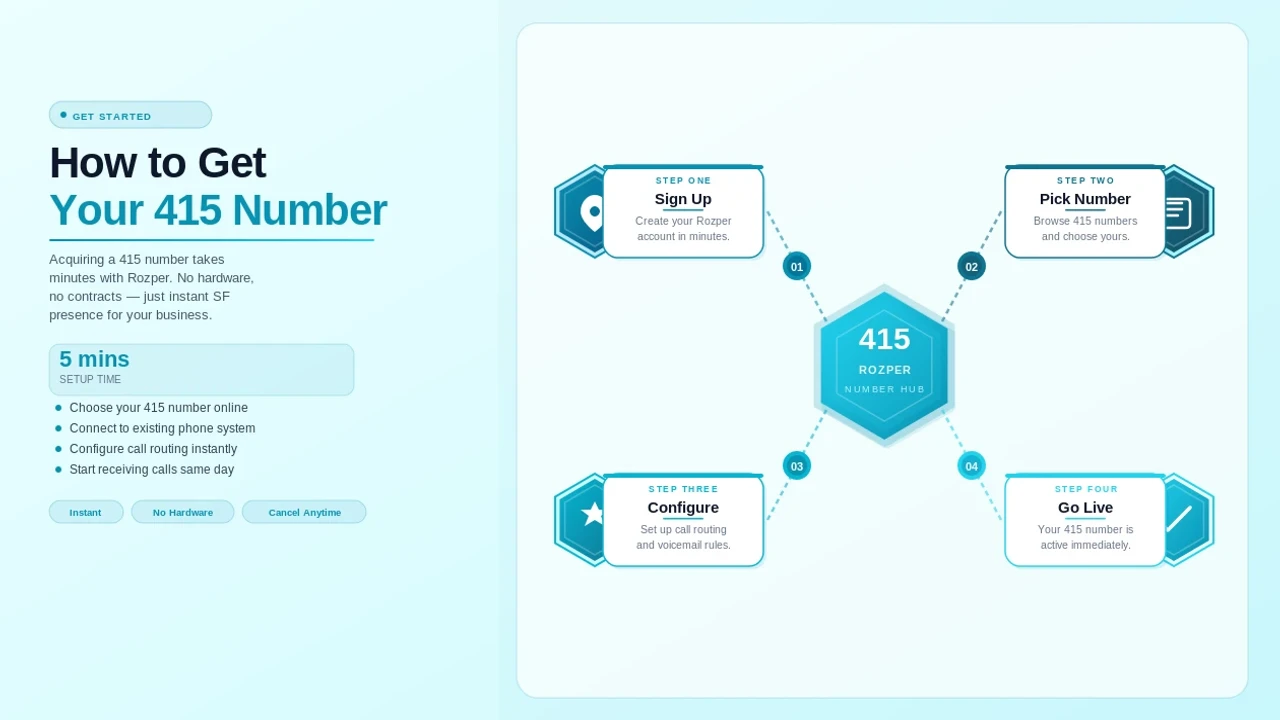
1. Choose a VoIP or virtual number provider Select a provider with active 415 inventory. Note that both 415 and 628 are local SF numbers — confirm the provider stocks 415 specifically if that prefix is important for your brand.
2. Browse and select your number Most platforms let you search available 415 numbers by digit pattern. Some offer vanity number options for brand recall.
3. Configure 10-digit dialing compliance Since the 628 overlay, all local calls within the 415/628 zone require 10-digit dialing. Ensure your IVR system, call routing rules, and CRM dial-out settings are all formatted with the full area code — 7-digit dialing no longer works.
4. Set up call routing Configure how incoming 415 calls are handled: forward to mobile, connect to a call queue, route through an IVR, or ring a softphone app on desktop or mobile.
5. Enable SMS Activating two-way text messaging on your 415 number adds an important parallel channel for appointment reminders, follow-ups, and customer support.
6. Port an existing number if needed Local Number Portability (LNP) regulations allow you to transfer an existing 415 number to a new provider. Coordinate the port timeline with your new provider to prevent any service gap during the transition.
What to Look for in a Provider
When selecting a provider for a local SF number, evaluate:
- Uptime reliability — Rozper delivers 99.999% uptime, keeping your SF line live for every call, including during peak demand and Bay Area events.
- Call quality — Tier-1 carrier connections and HD Voice codec support are non-negotiable for a market where professional communication is expected at every level.
- Feature depth — IVR, call forwarding, call recording, voicemail-to-email, analytics, and SMS should come standard.
- International reach — If your SF presence connects to global operations, a provider covering 150+ countries consolidates your entire communication stack.
- Transparent pricing — No hidden fees or punishing contract lock-in.
Rozper is one option worth considering here, maintaining 99.999% uptime and coverage in 150+ countries so a single platform can serve both your local San Francisco line and any international operations.
Common Challenges and Practical Solutions
| Challenge | Solution |
|---|---|
| Calls missed after Pacific Time business hours | Configure after-hours IVR with voicemail-to-email routing |
| Legacy systems still using 7-digit local dialing | Update all dial-out configurations to 10-digit format (area code required since 2015) |
| Scam spoofing undermining brand trust | Use STIR/SHAKEN-compliant provider + educate customers on your contact protocols |
| Scaling call volume for product launches or campaigns | Cloud VoIP adds concurrent lines on demand without hardware changes |
| Remote team needing a unified SF number | Call forwarding and softphone apps route from any global location |
| Multiple campaign numbers difficult to track | Centralized dashboard shows per-number analytics in real time |
| CRM data entry overhead from inbound calls | Integrate VoIP with CRM for automatic screen-pop and call logging |
What's Next for the 415 Region
AI and UCaaS adoption is reshaping SF communications. San Francisco's tech-forward businesses are early adopters of Unified Communications platforms that integrate voice, video, messaging, and AI-assisted call management. Real-time transcription, sentiment analysis, and intelligent routing are moving from enterprise tools to standard business infrastructure in the 415 zone.
Mission Bay's biotech expansion continues. UCSF's growth plans and continued pharmaceutical investment are drawing additional life sciences companies into the 415 footprint, creating new B2B communication needs across clinical, research, and commercial operations.
Number demand remains high. The 628 overlay provided significant capacity relief, but the SF Bay Area's continued growth in mobile users, IoT devices, and VoIP service adoption keeps the CPUC monitoring utilization. Future relief mechanisms remain a possibility if exhaustion trends continue.
Local SEO and local numbers compound. As AI-driven search engines increasingly surface geographically specific results for high-intent queries, a consistent 415 number paired with SF-optimized content delivers growing SEO dividends in one of the country's highest-CPC local search markets.
Conclusion
The 415 area code is more than seven decades old, but its commercial weight has never been greater. From its origins as one of California's three founding telephone codes to its current role as the prefix of Salesforce, Wells Fargo, and the world's most watched biotech corridor, 415 has tracked the arc of San Francisco's rise from regional hub to global city.
For businesses, a 415 number is one of the most efficient signals of SF market participation available. It raises call answer rates among local decision-makers, reinforces local SEO, aligns your brand with the Bay Area's innovation culture, and lets distributed or remote teams project a credible SF identity — all without a SoMa lease. Behind every 415 or 628 number issued sits the Federal Communications Commission's numbering framework, the same administration that has kept San Francisco's phone system running smoothly since 1947.
FAQs
What is the 415 area code and what cities does it cover?
It serves San Francisco city and county in full, most of Marin County (including San Rafael, Sausalito, Mill Valley, Tiburon, Novato, Fairfax, and San Anselmo), and a portion of northeastern San Mateo County. It is one of California's original three area codes, established in 1947.
What is the 628 area code and how does it relate to 415?
The 628 area code is an overlay for the exact same geographic territory as 415. It was introduced on March 21, 2015, when the 415 number pool approached exhaustion. Both codes are equally local — 628 serves the same San Francisco and Marin County territory. A key consequence of the overlay is mandatory 10-digit dialing for all local calls within the region.
Do I still need to dial the area code for local calls in San Francisco?
Yes — since the 628 overlay took effect in 2015, 10-digit dialing (area code + 7-digit number) is mandatory for all calls within the 415/628 zone, including local calls. Dialing just a 7-digit number will not connect.
What time zone is the 415 code in?
Area code 415 is in the Pacific Time Zone (PT). It observes Pacific Standard Time (PST, UTC−8) from early November through mid-March, and Pacific Daylight Time (PDT, UTC−7) from mid-March through early November. Pacific Time is 3 hours behind Eastern Time.
Why are there scam calls from 415 numbers?
The 415 prefix is legitimate, but scammers spoof these numbers because San Francisco's recognition makes calls appear more credible. Common patterns include IRS impersonation, SSA benefit suspension threats, one-ring scams, and prerecorded robocall messages. Prerecorded voice scams account for over 55% of reported 415-related complaints. Legitimate agencies never demand immediate payment or personal data over an unsolicited call.
Can I get a 415 number without being physically located in San Francisco?
Yes. Virtual 415 numbers route calls to any device — mobile, softphone, or desktop app — regardless of your physical location. This allows businesses outside San Francisco to establish a credible local presence and participate in the Bay Area market without a physical SF office.
Does Rozper offer 415 business numbers?
Yes. Rozper provides local 415 numbers with full VoIP capabilities — call forwarding, IVR, call recording, voicemail-to-email, analytics, and SMS. With 99.999% uptime and coverage across 150+ countries, Rozper handles both local SF presence and global communication from a single platform.