Introduction
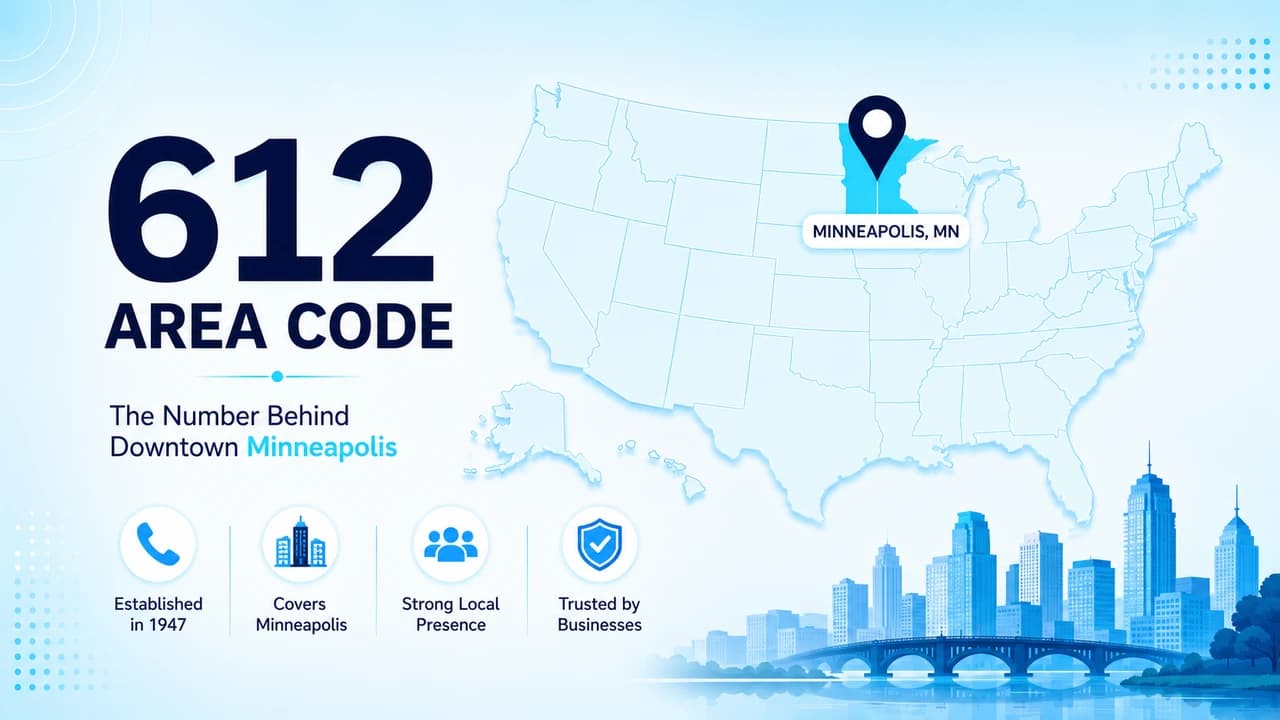
A downtown Minneapolis law firm calls a client across the river in St. Paul, now covered by the 651 area code, and the caller ID shows a prefix the client has known for decades. No hesitation, no wondering who's calling — just the quiet trust that comes from a number that has anchored the city's core since the numbering system began. That's the weight the 612 area code still carries today.
What Is the 612 Area Code?
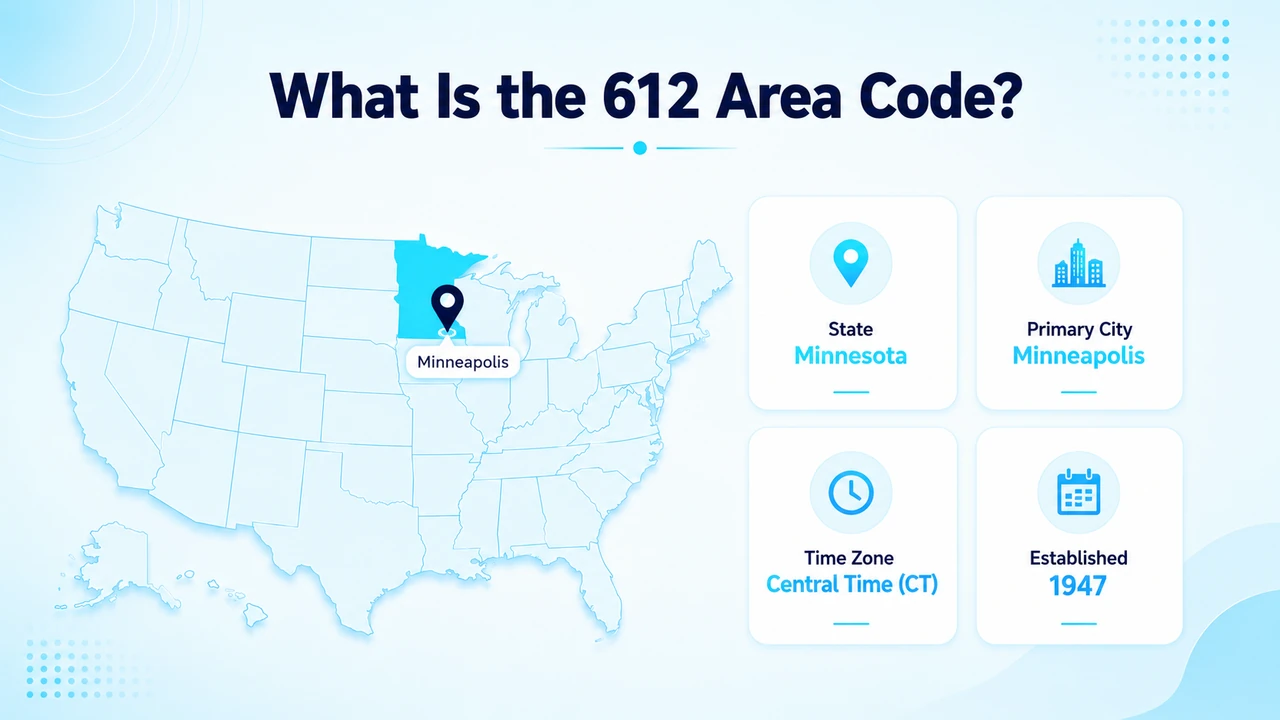
The 612 area code is one of Minnesota's two original telephone codes, assigned in 1947 when the North American Numbering Plan first launched. Today it is the smallest area code in the state by geography, covering only the city of Minneapolis and a handful of immediate suburbs.
Quick Facts:
| Detail | Info |
|---|---|
| Area Code | 612 |
| State | Minnesota |
| Region | Minneapolis and immediate suburbs |
| Time Zone | Central Time (CT) — UTC−6/UTC−5 |
| Dialing | 10-digit standard |
| Established | 1947 (original Minnesota code) |
| Key Splits | 320 (1996), 651 (1998), 763 & 952 (2000) |
| Adjacent Codes | 651, 763, 952 |
Area code 612 today covers the smallest geographic footprint of any Minnesota prefix, concentrated almost entirely inside Minneapolis.
Where Does the 612 Area Code Reach?
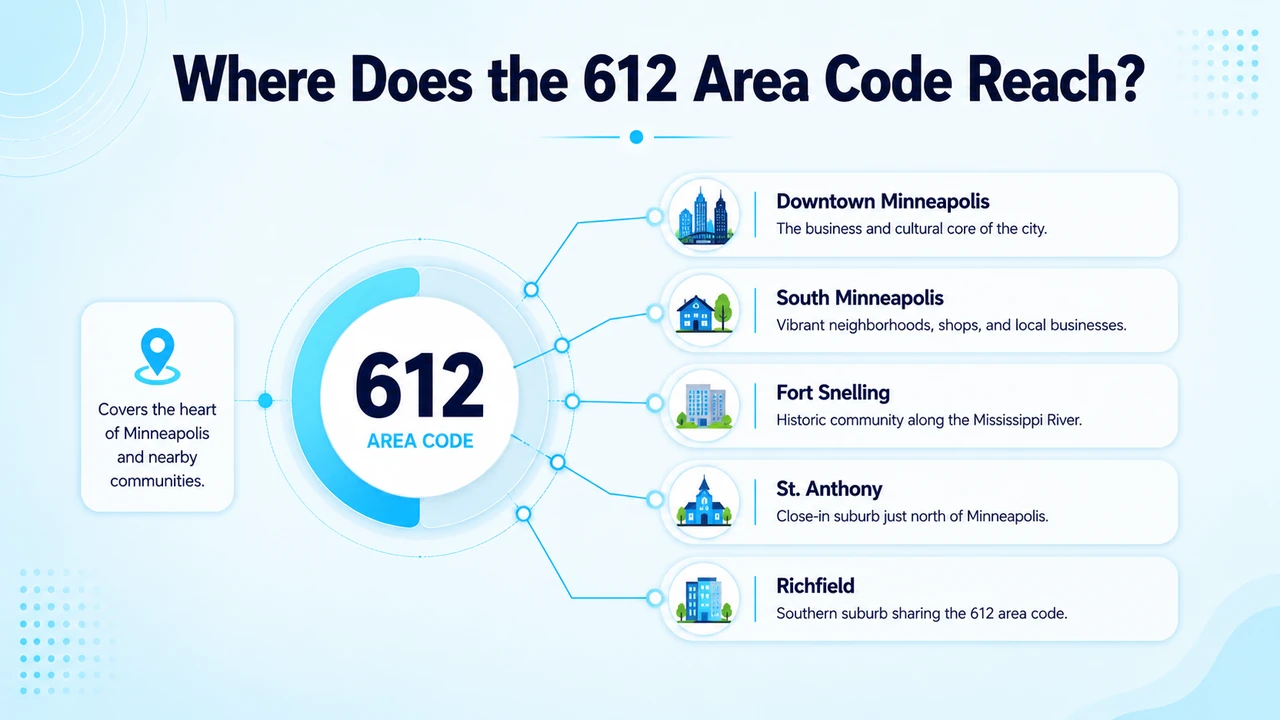
Unlike most metro-area codes that stretch across dozens of suburbs, this prefix is confined almost entirely to Minneapolis proper. Similar to the compact footprint of the 206 area code in Seattle, a tight geographic boundary makes local presence even more meaningful to callers.
Downtown and South Minneapolis
Downtown Minneapolis anchors the region's finance, legal, and healthcare sectors, home to major employers along Nicollet Mall and the Mississippi riverfront. South Minneapolis neighborhoods like Uptown and Lyn-Lake add a dense mix of retail, hospitality, and creative agencies.
Immediate Suburbs
A few close-in communities, including Fort Snelling, St. Anthony, and Richfield, share this prefix with Minneapolis, reflecting its original 1947 boundaries rather than later suburban growth patterns.
History of the 612 Area Code
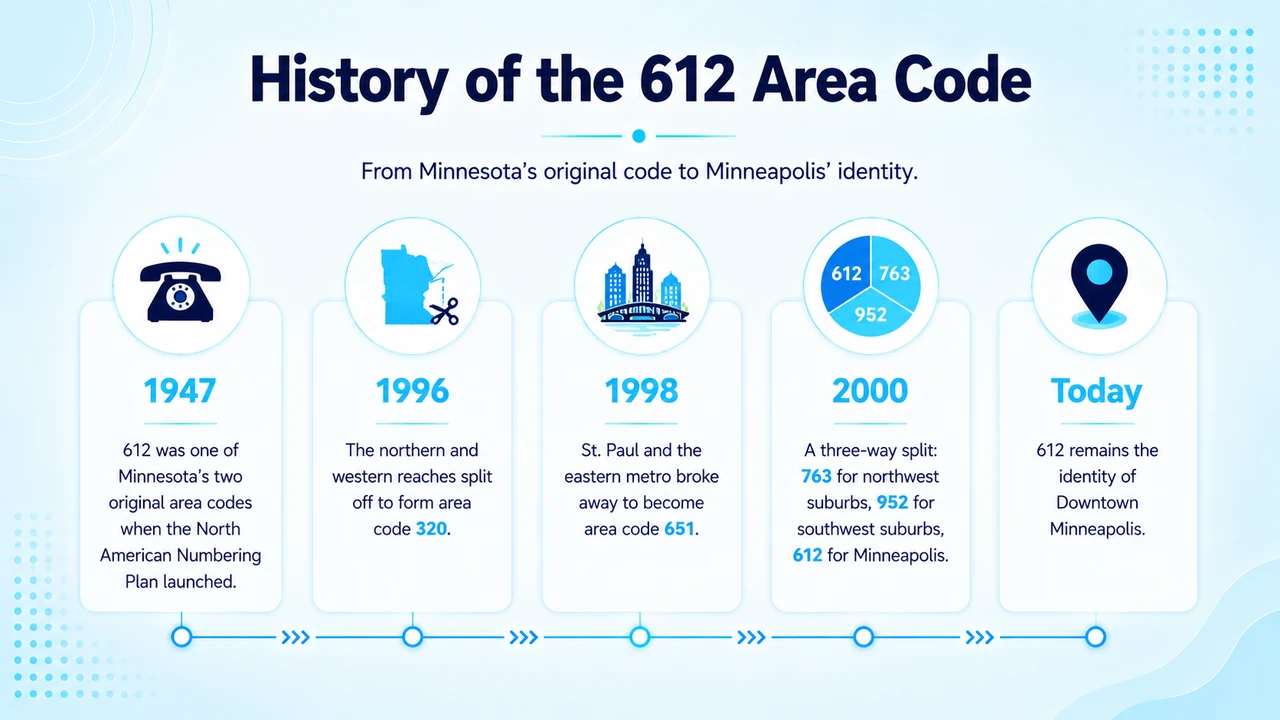
This prefix was one of only two codes assigned to Minnesota when the national numbering plan launched in 1947, originally covering a vast swath of the state.
The 1996 and 1998 Splits
In 1996, the northern and western reaches of the original territory split off to become area code 320. Two years later, in 1998, St. Paul and the eastern metro broke away entirely to form area code 651, narrowing 612 to the Minneapolis side of the Twin Cities.
The 2000 Three-Way Split
Continued growth forced a final three-way division in 2000: the northwest suburbs became area code 763, the southwest suburbs became area code 952, and Minneapolis itself retained its original code. For background on how these numbering decisions get made, the numbering resources page outlines the federal oversight process behind every area code split and overlay.
612 Area Code Time Zone
Minneapolis operates in the Central Time Zone (CT):
- Central Standard Time (CST): UTC−6 — early November to mid-March
- Central Daylight Time (CDT): UTC−5 — mid-March to early November
Because area code 612 shares Central Time with Chicago and Houston, cross-regional scheduling across the Midwest requires no time zone conversion.
Is a 612 Area Code Call a Scam?
The 612 area code is entirely legitimate, but its recognizable Minneapolis identity makes it attractive to scammers running local-sounding schemes.
Jury Duty and Court Fee Scams
Callers claim recipients missed jury duty and threaten arrest unless a fine is paid immediately by phone or gift card. Real Hennepin County courts never demand instant payment over the phone.
Charity and Storm Relief Fraud
Following Minnesota winter storms, callers solicit donations for fake relief funds using a familiar Minneapolis prefix to appear local and trustworthy.
Neighbor Spoofing
Scammers display a number resembling your own prefix to raise answer rates. Verify unfamiliar callers with a reverse lookup and rely on a STIR/SHAKEN-compliant provider to reduce spoofed calls.
The 612 Economy: What Anchors Downtown Minneapolis
Downtown Minneapolis under the 612 area code hosts a dense concentration of Fortune 500 headquarters, major hospital systems, and a thriving creative and design sector along the riverfront. The area's finance and legal corridors continue attracting talent from across the Upper Midwest, while South Minneapolis contributes a growing base of independent retail and hospitality businesses that keep the local economy diversified beyond corporate employment.
Why a 612 Business Number Builds Local Trust
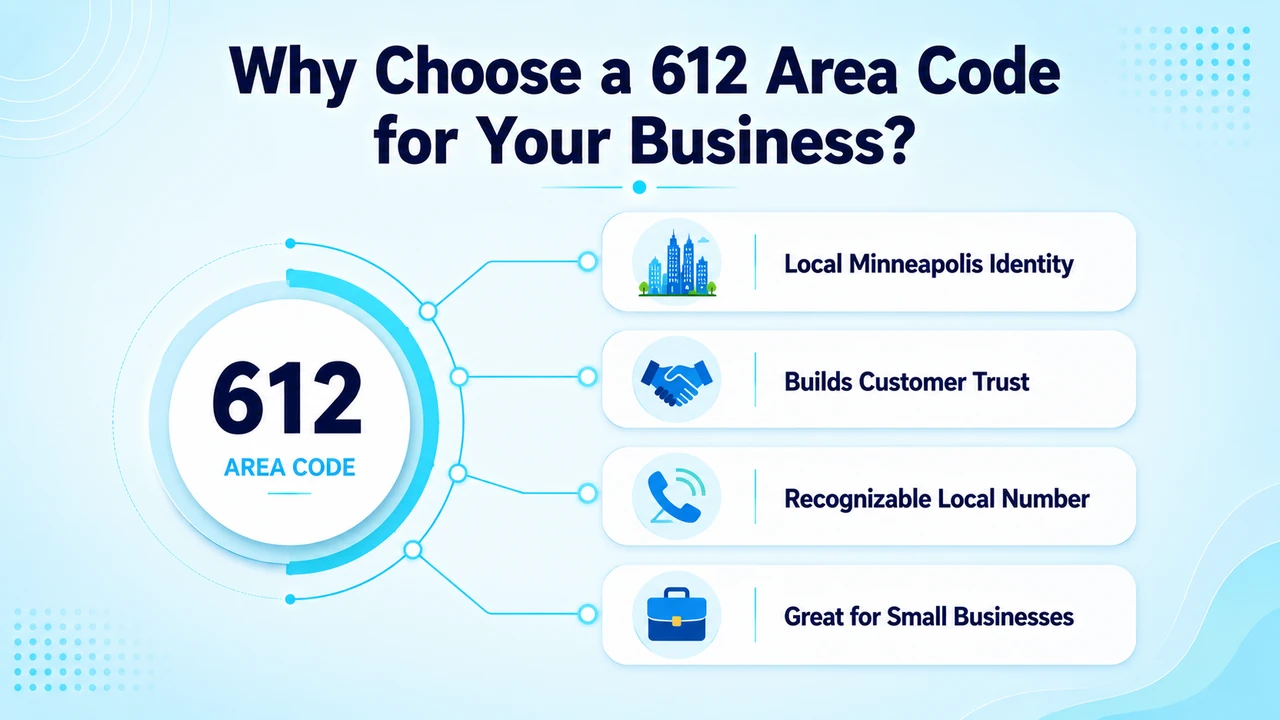
A 612 number signals something a toll-free or out-of-state number cannot: genuine roots in Minneapolis. Local callers, particularly in legal, healthcare, and financial services, answer familiar area codes at higher rates, and a consistent 612 number on your Google Business Profile strengthens local search rankings.
Virtual phone numbers make this achievable without leasing downtown office space — calls route to any device, anywhere, letting remote teams maintain a credible Minneapolis presence. The same local-trust principle applies to numbers reviewed in our 917 area code guide for New York City mobile lines. Rozper is one option worth considering here, maintaining 99.999% uptime and coverage in 150+ countries so a single platform can serve both your local Minneapolis line and any international operations.
How to Get a Local 612 Business Number
1. Choose a VoIP or virtual number provider — Confirm live inventory in area code 612, since demand for Minneapolis prefixes stays high.
2. Browse and select your number — Search by pattern, prefix, or vanity combination depending on your brand.
3. Confirm 10-digit dialing compliance — Update IVR menus, CRM records, and outbound dialing configurations.
4. Configure call routing — Forward calls to mobile devices, softphone apps, or shared queues.
5. Enable SMS — Two-way texting on a 612 number supports appointment reminders and client updates.
6. Port an existing number if needed — Local Number Portability allows a smooth carrier switch with no service gap.
What to Look for in a Provider
- Uptime — Look for a guarantee near 99.999% uptime so your Minneapolis line never drops.
- Call quality — Tier-1 carrier connections and HD Voice keep every conversation clear.
- Feature depth — IVR, call forwarding, recording, voicemail-to-email, and SMS should come standard.
- International reach — Coverage across 150+ countries keeps every call center on one platform.
- Transparent pricing — No hidden fees or contract terms that punish growth.
Common 612 Business Number Challenges and Solutions
| CHALLENGE | AFFECTED BUSINESS TYPE | SOLUTION | PRIORITY |
|---|---|---|---|
| Limited number inventory in a compact metro code | Growing SMBs | Reserve numbers early through your provider | High |
| Missed after-hours calls from out-of-state clients | Legal, healthcare firms | After-hours IVR with voicemail-to-email | High |
| Jury duty and charity scam calls damaging trust | SMBs and professional services | STIR/SHAKEN-compliant provider | High |
| Remote team needing a unified Minneapolis number | Distributed teams | Call forwarding + softphone from any location | Medium |
What's Next for the 612 Region
Downtown Minneapolis continues attracting healthcare and fintech startups drawn to the city's dense talent pool, even as hybrid work reshapes office demand. AI-assisted call handling — transcription, sentiment analysis, and automated routing — is quickly becoming standard for the businesses competing in this compact but high-value market.
Conclusion
The 612 area code has stayed remarkably close to its 1947 roots even as the surrounding Twin Cities numbering map fractured into five separate codes. Today it represents the tightest, most concentrated business identity in the state — a prefix tied directly to downtown Minneapolis rather than a sprawling suburban footprint. A local 612 number carries that same concentrated credibility, letting distributed teams sound as rooted in the city as a business with a Nicollet Mall address. Every split that shaped today's Twin Cities numbering map, from 320 to 651 to 763 and 952, still falls under the Federal Communications Commission's oversight of the North American Numbering Plan.
FAQs
What areas does the 612 area code cover today?
It covers Minneapolis and a few immediate suburbs, including Fort Snelling, St. Anthony, and Richfield, after three separate splits narrowed its original 1947 territory.
Why did area code 612 split into so many codes?
Rapid Twin Cities phone growth forced splits in 1996 (320), 1998 (651), and a three-way division in 2000 that created 763 and 952 while Minneapolis kept 612.
What time zone does the 612 area code use?
It uses Central Time — CST (UTC−6) in winter and CDT (UTC−5) in summer, matching Chicago, Houston, and Dallas.
Is this Minneapolis prefix an overlay?
No. Unlike many major metro codes, 612 has never been overlaid — it remains a single, standalone code covering Minneapolis proper.
Can I get a 612 area code number without living in Minneapolis?
Yes. Virtual 612 numbers route calls to any device regardless of location, letting businesses anywhere project a credible downtown Minneapolis presence.