Introduction
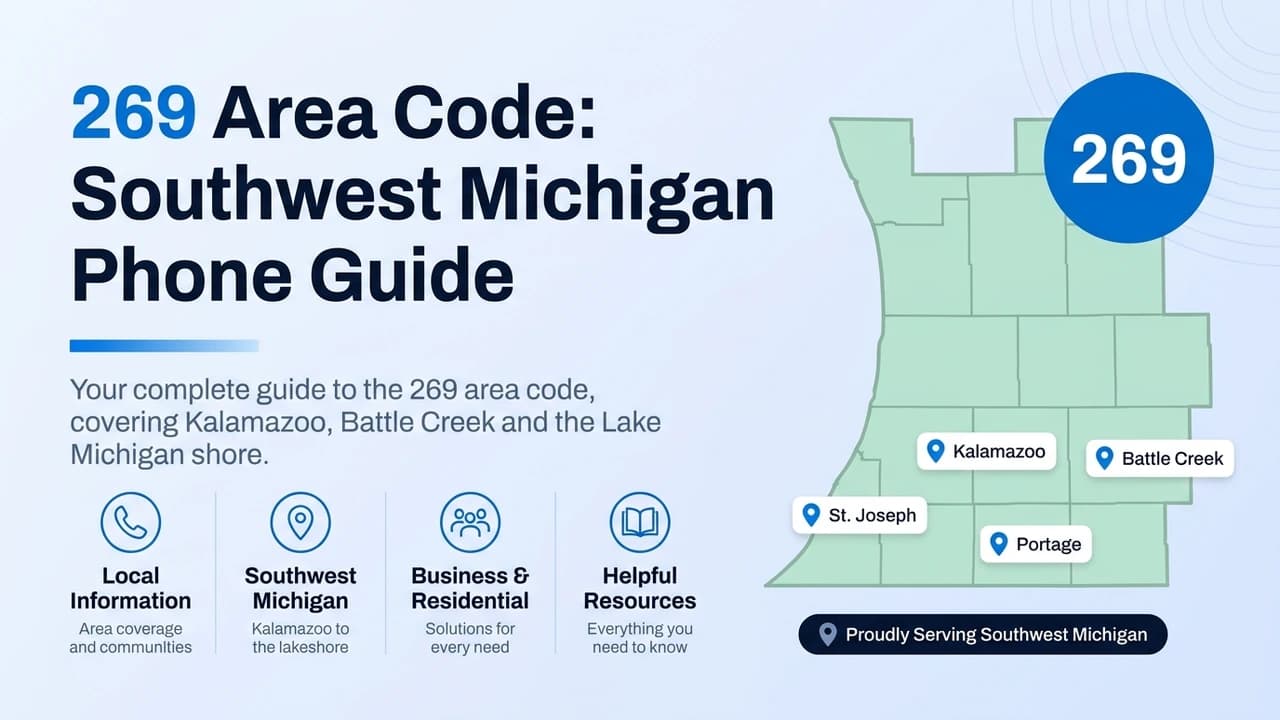
The 269 area code covers the southwest corner of Michigan's Lower Peninsula, from Kalamazoo and Battle Creek west to the Lake Michigan shore. Knowing what the 269 area code represents helps you tell a real local call from a spoofed one and reveals why this small region carries such outsized commercial weight. This guide maps the counties and cities it serves, explains the 2002 split that created it, walks through the Eastern Time dialing rules, and shows how to read a suspicious call. Few regions this size pack in as many household-name headquarters, and the details below explain why that still matters to anyone calling into it.
Key Takeaways:
- The 269 area code serves eight southwest Michigan counties, anchored by Kalamazoo and Battle Creek.
- It was created in 2002 when Michigan split the larger 616 code.
- Seven-digit local dialing still works here because no overlay was ever added.
- The region runs on Eastern Time and hosts several globally recognized company headquarters.
Where Southwest Michigan Draws Its Line
Picture the bottom-left corner of Michigan's mitten, and you have the 269 territory almost exactly. The code fills the southwest quarter of the Lower Peninsula, bordered by Lake Michigan on the west and the Indiana state line to the south. It covers roughly eight counties and dozens of communities, blending mid-sized cities, lakeshore towns, and a wide belt of farmland in between. Two cities carry most of the population and most of the call volume.
- Kalamazoo is the largest city and the region's economic and academic hub.
- Battle Creek sits to the east and is known worldwide for cereal.
- Portage, St. Joseph, and Benton Harbor anchor the western lakeshore.
- Marshall, Albion, and Coldwater round out the eastern farm counties.
Unlike a single-metro code, this region blends industry with agriculture across a broad map. A denser suburban code such as the 248 area code concentrates far more lines into much less space, which is why it needed relief while area code 269 has not.
The 2002 Split That Gave 616 a Southern Sibling
For decades, all of western Michigan shared a single code. Grand Rapids sat at the northern end and Kalamazoo at the southern end, both dialing under 616. Steady growth eventually exhausted the available prefixes, and rather than overlay the whole territory, regulators chose to split it. The lower third became its own numbering plan area, and southwest Michigan gained a distinct telephone identity.
Why a split, not an overlay
A split assigns the new code to one half of the old territory, so only the residents of that half have to change their numbers. Michigan used this approach in 2002, keeping 616 for the Grand Rapids area and issuing the 269 area code to the counties in the south. Everyone in those southern counties took the new prefix at the same time, which is why the whole region shares one consistent code today.
What that clean break preserved
Because 269 covers its own territory with no second code layered on top, the region kept simpler dialing than most metros. There is no competing prefix, no split neighborhoods, and no confusion about which code a nearby town uses. That tidiness is a quiet advantage the 269 area code still enjoys.
Eight Counties Under One Code
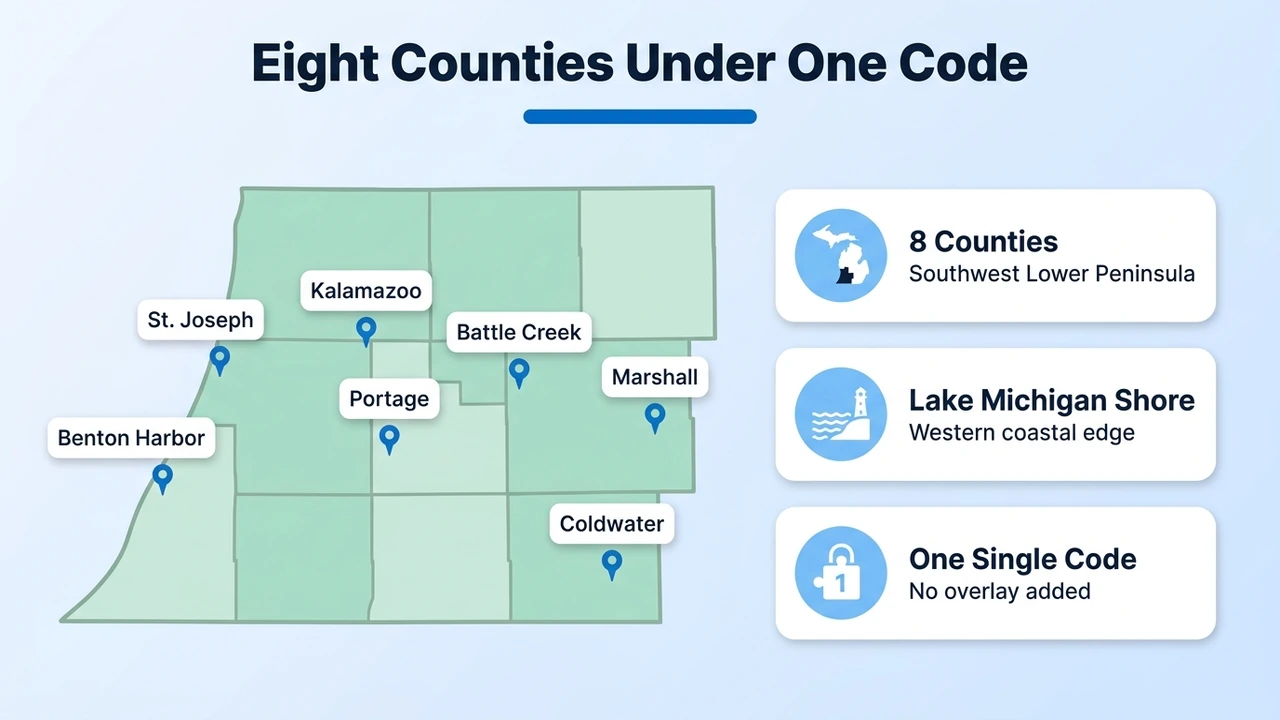
Coverage spans about eight counties, each with its own mix of city and countryside. Kalamazoo and Calhoun counties hold the largest populations, while the western tier along Lake Michigan draws tourists and lake-country residents through every summer season. The eastern counties lean agricultural, dotted with county seats, grain handlers, and small manufacturing towns. Anyone dialing into the region will most often reach one of these clusters.
- Kalamazoo County — Kalamazoo, Portage, Parchment, and Galesburg.
- Calhoun County — Battle Creek, Marshall, Albion, and Springport's edge.
- Berrien County — Benton Harbor, St. Joseph, Niles, and New Buffalo.
- Van Buren and Cass Counties — South Haven, Paw Paw, Dowagiac, and Cassopolis.
- Branch and St. Joseph Counties — Coldwater, Sturgis, Three Rivers, and Bronson.
That spread mixes lakeshore, campus, and farm economies under one prefix. A metro-only code like the 414 area code across the lake in Milwaukee packs a similar headcount into a fraction of the land, while area code 269 Michigan trades density for reach across the whole southwest corner.
How To Dial A 269 Number
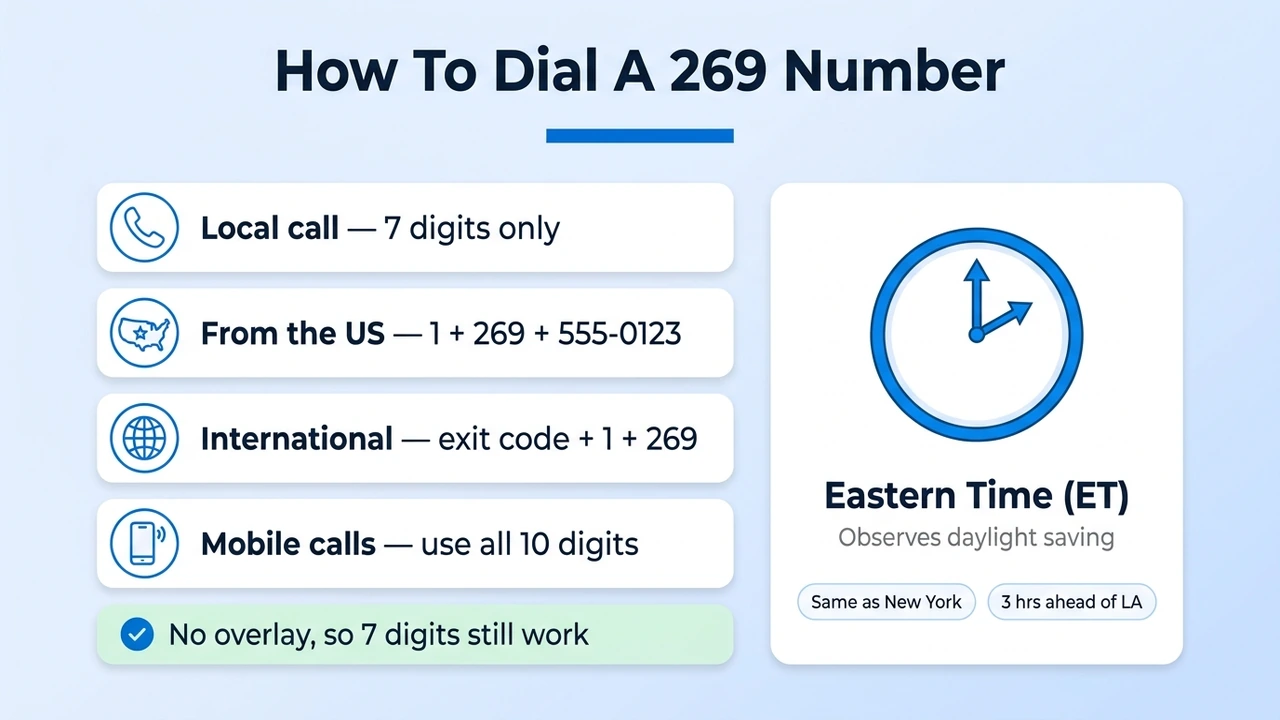
Southwest Michigan runs on Eastern Time and observes daylight saving, matching New York and sitting three hours ahead of Los Angeles. Dialing here stayed simple because the region never received an overlay. Local calls placed within the 269 territory can still be completed on seven digits, a convenience most American metros surrendered years ago.
- Calling locally inside southwest Michigan: dial the seven-digit number, with no area code needed.
- Calling into the region from elsewhere in the US: dial 1, then 269, then the seven-digit number.
- Calling from abroad: dial your exit code, then country code 1, then 269, then the number.
- Calling a mobile phone: use all ten digits, since wireless carriers route that traffic nationally.
Nationwide, more than eighty codes were pushed onto mandatory ten-digit dialing when 988 launched as the crisis lifeline, because those codes used 988 as a local prefix. Southwest Michigan was not among them. The guidance lists every code that had to change. Cloud platforms such as Rozper handle this routing automatically, so your team never counts digits at all.
Global Industries In One Corner

Here is what makes this code genuinely unusual. For a region of mid-sized cities, southwest Michigan hosts a remarkable cluster of globally recognized companies, and that concentration drives a surprising share of its call traffic. A local number here reaches boardrooms that supply the whole planet.
Names you already know
Battle Creek built its identity on breakfast cereal and still anchors that industry today. Benton Harbor is the headquarters of a global home-appliance maker, and Kalamazoo is a major center for medical devices and pharmaceutical research. These are not satellite branch offices; they are headquarters and primary campuses sitting inside the 269 area code, employing thousands of people across the region.
Why that matters for your caller ID
Vendors, recruiters, and partners across the country dial into these companies every working day, and a matching local prefix helps those calls get answered instead of screened. A supplier presenting a southwest Michigan number reads as closer and more credible than one calling from an unfamiliar out-of-state code. Rozper lets a distributed sales or support team share a single 269 presence, no matter where each rep actually sits.
Spotting A Spoofed 269 Call
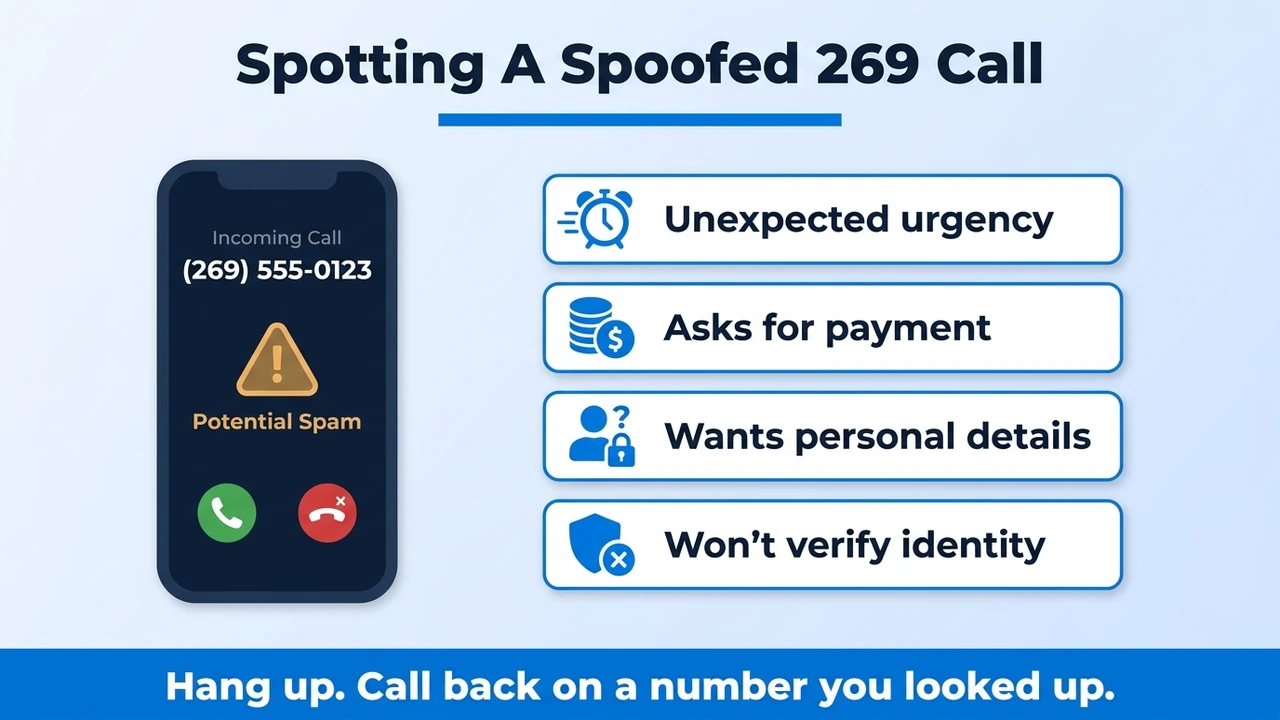
Neighbor spoofing fakes a caller ID so it looks local, and a mid-sized region is no safer from it than a big city. Scammers copy the first six digits of your own number so an incoming call seems to come from a town just up the road. A 269 area code on your screen is not, by itself, proof the caller is anywhere in southwest Michigan.
- Let unfamiliar numbers go to voicemail, since real callers usually leave a message.
- Never share personal or financial details with someone who called you first.
- Hang up and call the organization back on a number you looked up yourself.
- Treat sudden urgency or demands for immediate payment as clear red flags.
- Report repeated spoofed calls to your carrier and to federal regulators.
Established businesses across area code 269 keep steady, verifiable numbers for years, which is exactly what makes a spoofed call easier to spot once you know the pattern. Rozper signs outbound calls with carrier-level authentication, so calls from your own team stay trusted across the network.
Conclusion
The 269 area code covers the southwest corner of Michigan's Lower Peninsula, spanning about eight counties from Kalamazoo and Battle Creek out to the Lake Michigan shore. It arrived in 2002 through a split of the larger 616 code, giving the southern counties their own telephone identity for the first time. Because no overlay ever followed, seven-digit local dialing survives across area code 269 Michigan, and the whole region runs cleanly on Eastern Time. Understanding these facts makes it far easier to judge whether an incoming call is worth your trust.
Southwest Michigan will keep punching above its weight, with global brands and busy campuses driving traffic through this modest-looking code. Businesses building a presence here should establish a recognizable local number before their next outreach push begins. Whether you sell into Kalamazoo's medical corridor or support customers along the lakeshore, the right calling setup makes the whole region feel close. Rozper can have that presence live long before your next campaign starts dialing.
FAQs
Where is the 269 area code located?
It covers the southwest corner of Michigan's Lower Peninsula, from Kalamazoo and Battle Creek to the Lake Michigan shore. Around eight counties fall inside it.
What time zone does area code 269 use?
Southwest Michigan observes Eastern Time and follows daylight saving each year. That matches New York and sits three hours ahead of Los Angeles.
Can you still dial seven digits in southwest Michigan?
Yes, because no overlay was ever added, so local calls still complete on seven digits. Calls to mobile phones should always use all ten digits.
What area code did 269 come from?
It was split from 616 in 2002, taking the lower third of that older territory. Grand Rapids kept 616 while the southern counties moved to 269.
Which cities use the 269 area code?
Kalamazoo, Battle Creek, Portage, St. Joseph, Benton Harbor, Marshall, and Coldwater are among the largest. Dozens of smaller towns share the code too.
Is a call from a 269 number always genuine?
Not necessarily. Neighbor spoofing lets scammers fake a local caller ID, so verify unexpected callers by hanging up and dialing back independently.
What does a southwest Michigan number cost a business?
Pricing depends on your provider and plan rather than the code itself. Cloud calling plans usually cost far less than traditional landline service.
Does the 269 area code have an overlay?
No. It remains a single code covering its own territory, which is why seven-digit local dialing still works throughout the region.