Introduction
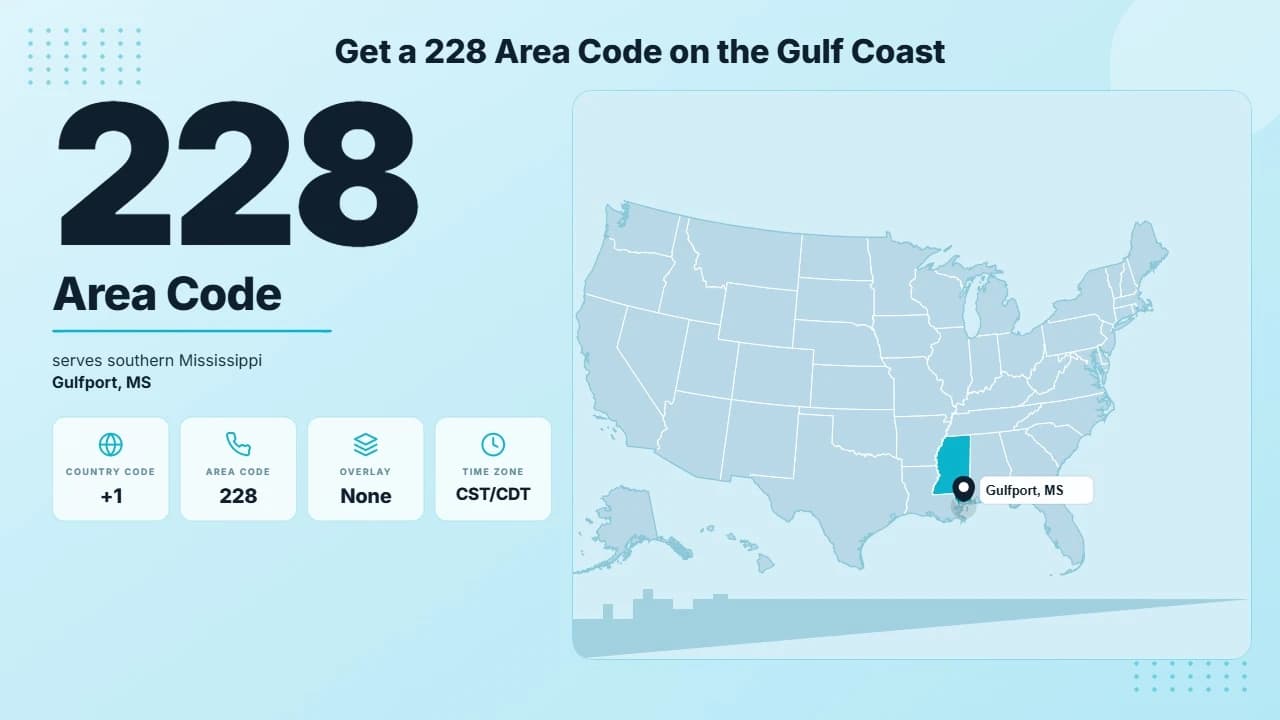
Most businesses expanding along the Gulf South think of Texas or Florida first. Mississippi's Gulf Coast rarely makes the opening shortlist — precisely the advantage waiting for businesses that show up there first. The 228 area code covers three strategically positioned counties: home to the Navy's single largest surface shipbuilding enterprise, a casino industry generating over $1.6 billion annually, a designated strategic seaport, and a military presence whose economic impact exceeds $1 billion per year. This is an underrated market.
This guide covers everything you need to know about this Mississippi Gulf Coast prefix: the three counties and cities it serves, how it was carved from Mississippi's original 601 code in 1997, why it has never needed an overlay the way the 213 area code in Los Angeles eventually did, the Central Time Zone business calendar, the scam call patterns most active in the region, the economic sectors that drive the Gulf Coast, and how to get a local 228 business number that positions you credibly in one of the South's most distinctive markets.
What Is the 228 Area Code?
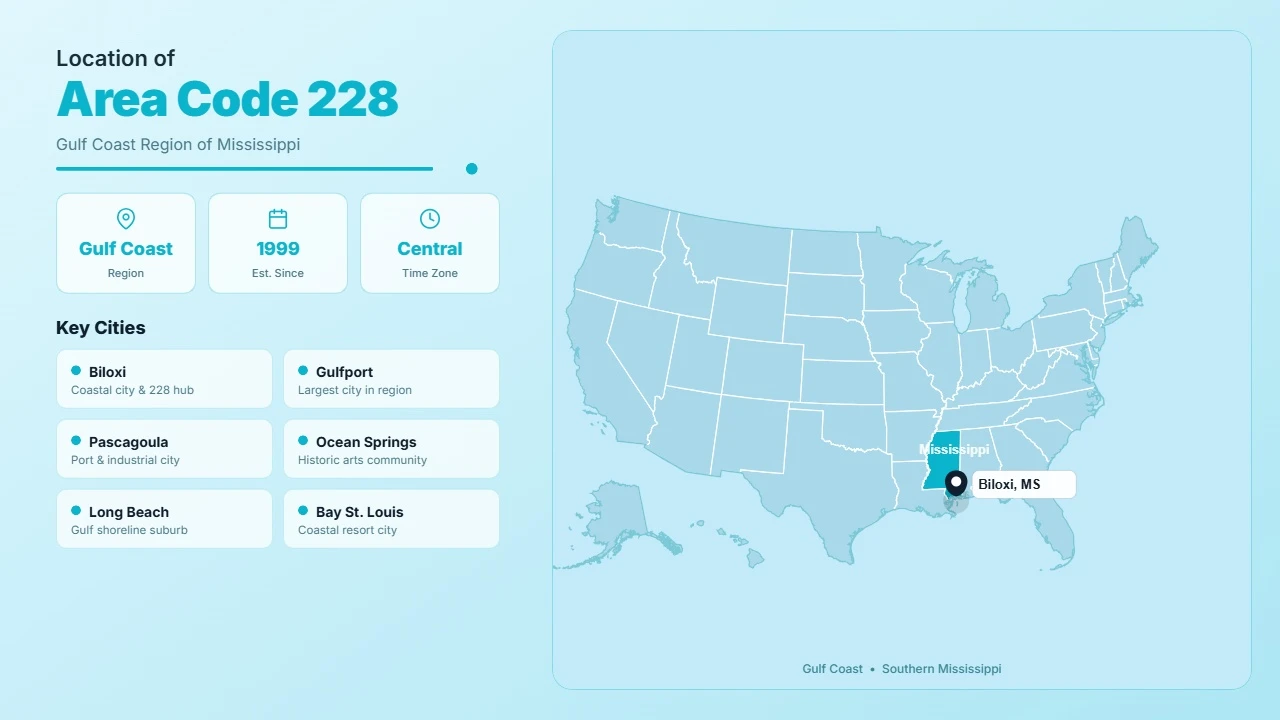
The 228 area code is the sole telephone code for Mississippi's Gulf Coast — established in 1997 when demand for phone numbers in the region's rapidly growing coastal communities outpaced the capacity of the original statewide code. It covers three counties along the state's southernmost border with the Gulf of Mexico and serves a metropolitan area of more than 420,000 people.
Unlike many urban codes that have required overlays to manage number exhaustion, 228 remains the only active code for its territory — no overlay has been introduced, and all local numbers carry the same prefix.
Quick Facts:
| Detail | Info |
|---|---|
| Area Code | 228 |
| Overlay Code | None — 228 is the only code for the region |
| State | Mississippi |
| Region | Hancock County, Harrison County, Jackson County |
| Time Zone | Central Time (CT) — UTC−6/UTC−5 |
| Dialing | Standard 10-digit |
| Established | September 15, 1997 |
| Split From | 601 (original statewide Mississippi code) |
| Adjacent Codes | 601/769 (central and northern MS), 985/504 (Louisiana) |
| Metro Population | 420,000+ (Gulfport-Biloxi-Pascagoula MSA) |
Area code 228 covers the three southernmost counties in Mississippi, running along approximately 62 miles of Gulf Coast shoreline from the Louisiana border east to the Alabama state line.
Where Does the 228 Code Cover?
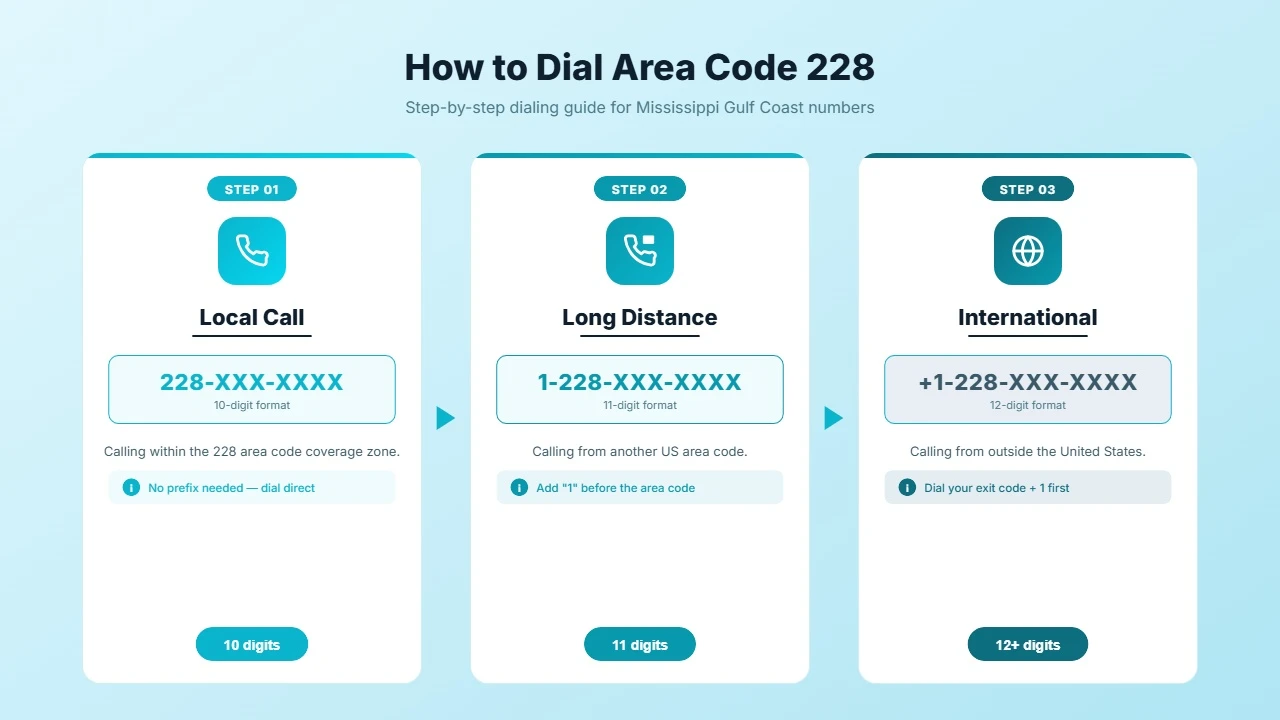
The 228 zone covers three counties along the southernmost edge of Mississippi — each with a distinct economic and community character.
Harrison County
Harrison County is the population and commercial center of the 228 zone. It contains the region's two largest cities and most of its commercial and hospitality infrastructure.
Gulfport is the largest city in the region and the seat of Harrison County. It is home to the Port of Gulfport — a federally designated strategic seaport handling millions of tons of international cargo annually, including perishable goods from Central America and the Caribbean, and one of the region's biggest employers. Gulfport also hosts the Naval Construction Battalion Center (NCBC), supporting Seabee construction and engineering operations worldwide.
Biloxi is the second-largest city and the heart of the region's gaming and hospitality economy. A dense corridor of casino resorts lines the Biloxi waterfront — a legacy of Mississippi's 1990 legalization of casino gambling, which transformed a quiet fishing town into one of the South's premier entertainment destinations. Keesler Air Force Base, located in Biloxi, trains Air Force technicians in cyber, weather, and electronic warfare.
D'Iberville, Long Beach, and Pass Christian complete Harrison County's coverage with residential and light commercial communities along the Bay of St. Louis corridor.
Jackson County
Jackson County, east of Harrison, is the industrial heartbeat of the region.
Pascagoula is the county seat and home to Ingalls Shipbuilding — the United States Navy's single largest surface combat shipbuilder. Ingalls employs approximately 11,000 workers in direct positions with an estimated 15,000 additional indirect jobs tied to its supply chain. The yard builds destroyers, amphibious assault ships, and other combat vessels under long-term US Navy contracts.
Ocean Springs sits across the Biloxi Bay from Biloxi and offers a distinct character: an arts community with a concentration of galleries, restaurants, and boutique businesses serving both local professionals and regional tourists.
Moss Point, Gautier, and Vancleave add residential and industrial depth to Jackson County's footprint.
Hancock County
Hancock County is the westernmost county in the 228 zone, bordering Louisiana.
Bay St. Louis is the county seat and a growing arts and residential community known for its historic Main Street district and its position on the Bay of St. Louis.
Waveland and Diamondhead are primarily residential communities that were significantly impacted by Hurricane Katrina in 2005 and have since undergone substantial rebuilding and investment.
Hancock County also serves as the home county of Stennis Space Center — the country's primary rocket propulsion testing facility, operated by NASA. Stennis employs over 5,000 highly skilled workers in rocket testing, propulsion research, and federal agency operations.
History of the 228 Area Code
When the North American Numbering Plan (NANP) launched in 1947, Mississippi was assigned a single area code — 601 — to cover the entire state. For five decades, every home, business, and payphone in Mississippi dialed under the same 601 prefix. As the state's population grew and the proliferation of fax machines, pagers, and early mobile phones accelerated demand for new numbers, the 601 numbering supply began approaching exhaustion.
The 1997 Split: 228 Created
Area code 228 was split from 601 on September 15, 1997, under the numbering administration framework that governs every area code split and overlay nationwide. Mississippi's Gulf Coast counties were carved out to form the new code, with the three southernmost counties — Hancock, Harrison, and Jackson — becoming 228, while the rest of the state retained 601.
Two years later, in 1999, the northern half of Mississippi was further split from 601 to create 662, giving the state three area codes aligned with its three geographic regions: northern (662), central/southern (601), and Gulf Coast (228).
No Overlay — 228 Remains Sole Code
Unlike many high-growth metro codes, the 228 area code has never required an overlay. No second code has been added to the region. This means that — unlike the 213 area code in Los Angeles, which now operates alongside 323 and 738 — every phone number on the Mississippi Gulf Coast carries the same 228 prefix. For businesses, this simplifies branding: a 228 number is unambiguously identified as a Gulf Coast Mississippi number with no competing local codes.
228 Area Code Time Zone
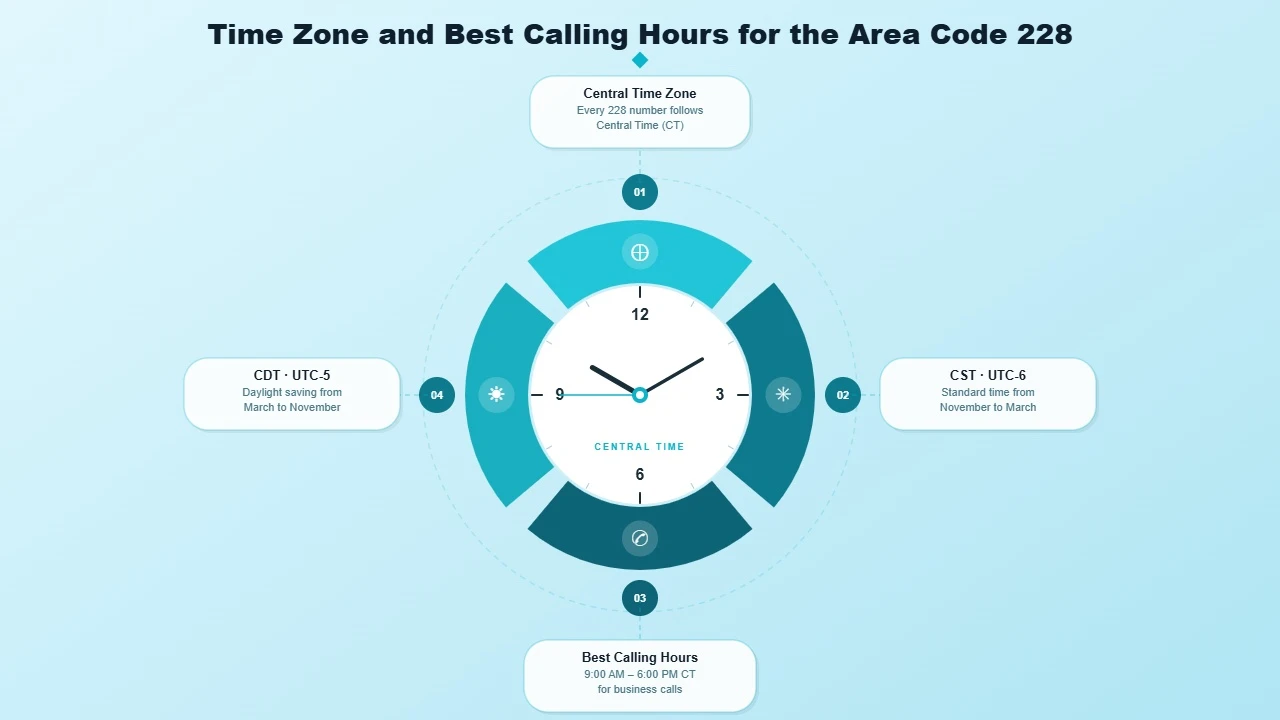
The 228 zone operates in the Central Time Zone (CT):
- Central Standard Time (CST): UTC−6 — observed from early November to mid-March
- Central Daylight Time (CDT): UTC−5 — observed from mid-March to early November
Cross-Timezone Calling Guide
To/from the East Coast (ET): Eastern Time is 1 hour ahead of Central. A Gulf Coast business calling a New York or Atlanta client at 9 AM CT reaches them at 10 AM ET — ideal overlap. East Coast clients calling the 228 zone in the late afternoon (5 PM ET) reach the Gulf Coast at 4 PM CT — still within business hours.
To/from the West Coast (PT): Pacific Time is 2 hours behind Central. Calling Los Angeles or Seattle from Gulfport at 9 AM CT reaches the recipient at 7 AM PT — too early. Best practice: wait until after 11 AM CT (9 AM PT) for first-call outreach to West Coast contacts.
To/from Mountain Time (MT): MT is 1 hour behind CT. A 10 AM CT call reaches Mountain Time at 9 AM — easy coordination. Note Arizona's no-DST exception during summer months.
International calls to 228: From the UK, dial 00 + 1 + 228 + 7-digit number. From Australia, dial 0011 + 1 + 228 + 7-digit number. On mobile: +1-228-XXX-XXXX.
The Central Time Zone positions Gulf Coast businesses comfortably between the two largest US time zones — able to reach East Coast clients in the morning and West Coast clients in the afternoon within a standard working day.
Is a 228 Call a Scam?
The 228 prefix is legitimate — it serves real residents and businesses across Mississippi's Gulf Coast. Like all US area codes, however, it is subject to caller ID spoofing by scammers who display local numbers to increase answer rates in the region.
Consumer reporting data identifies several high-frequency scam patterns on 228 numbers:
Health Insurance Robocalls
The most commonly reported scam type involves prerecorded calls claiming to offer subsidized or "government" health insurance plans. These calls target uninsured and underinsured residents — a demographic present in Mississippi at above-national-average rates — and direct victims to provide personal and financial details in exchange for quote information. Legitimate health insurance providers and ACA marketplace navigators do not cold-call offering coverage without an existing inquiry.
Auto Warranty Fraud
Auto warranty robocalls using spoofed 228 numbers claim that the recipient's vehicle warranty is expiring and require immediate payment for an extension. These calls generate a high volume of complaints across the Gulf Coast because the region has a higher-than-average rate of vehicle ownership due to limited public transit infrastructure. Genuine dealership warranty departments contact customers in writing, not by unsolicited robocall.
Medicare and Medicaid Impersonation
Given Mississippi's older coastal population and high Medicaid enrollment rate, scammers frequently spoof local numbers to impersonate CMS (Centers for Medicare & Medicaid Services) agents. They claim that a new card, an updated benefit, or a required verification must be processed immediately. Real CMS and Social Security Administration agents do not call requesting account numbers or payment.
Amazon Order and Delivery Fraud
Scammers impersonate Amazon customer service using spoofed caller IDs, claiming an unauthorized purchase was made on the recipient's account. They request account credentials or gift card payments to "resolve" the fraudulent charge. Amazon does not initiate inbound calls to customers about specific order issues.
Social Security Number Suspension
Calls claiming that the recipient's Social Security number has been "suspended" due to suspicious activity are widely reported on spoofed Gulf Coast numbers. No government agency suspends Social Security numbers, and legitimate enforcement actions are not initiated through unsolicited phone calls.
Staying Protected
- If a call from a 228 number you don't recognize offers health insurance, a warranty extension, or claims a government benefit is at risk, hang up and call the agency's published number directly to verify.
- Businesses with local Gulf Coast numbers benefit from using a STIR/SHAKEN-compliant VoIP provider — this framework verifies caller ID at the carrier level.
- Report suspicious calls at reportfraud.ftc.gov.
The 228 Economy: What Drives the Mississippi Gulf Coast
The Gulf Coast 228 zone runs on four economic pillars that make it resilient, specialized, and distinct from every other market in this area code series.
Defense and Shipbuilding
Ingalls Shipbuilding in Pascagoula is the defining employer of Jackson County and one of the most consequential defense contractors on the Gulf Coast. With 11,000 direct employees and an estimated 15,000 indirect jobs tied to its supply chain, Ingalls builds DDG-51 Arleigh Burke-class destroyers and LHA amphibious assault ships for the United States Navy under multi-billion-dollar long-term contracts.
Bollinger Shipyards, also operating in the region, has secured contracts exceeding $5 billion for the production of Polar Security Cutter icebreakers for the US Coast Guard, with projections to add 3,250 direct and indirect jobs annually through 2030.
The Naval Construction Battalion Center Gulfport and Keesler Air Force Base together contribute more than $1 billion annually to the local economy, with approximately 25,000 direct and indirect jobs tied to the military presence in Harrison and Jackson counties.
Gaming and Hospitality
Mississippi legalized dockside casino gambling in 1990, and the Gulf Coast was among the first regions to capitalize. The casino corridor along the Biloxi waterfront generates approximately $1.6 billion in annual gaming revenue, supporting over 9,000 direct jobs in gaming with an estimated 18,000 additional hospitality and service positions in the broader ecosystem. Major operators including Beau Rivage (MGM), Hard Rock Hotel & Casino, IP Casino Resort, and Golden Nugget operate large resort complexes.
Aerospace and Research
John C. Stennis Space Center in Hancock County is NASA's primary rocket propulsion testing facility. It employs more than 5,000 scientists, engineers, and federal workers across multiple agencies — including NASA, NOAA, the Navy, and the NGA — with an estimated 4,500 additional indirect jobs in the regional economy. Stennis's role in testing engines for the Artemis program ensures continued federal investment through the coming decade.
Maritime Trade and Logistics
The Port of Gulfport is a federally designated strategic military seaport and a key commercial gateway for Central American and Caribbean trade. It handles millions of tons of cargo annually and is the primary US entry point for Chiquita Brands bananas and other perishable imports. The port's strategic designation means it receives federal investment for infrastructure and security upgrades that private commercial ports do not.
Why a 228 Business Number Works on the Gulf Coast
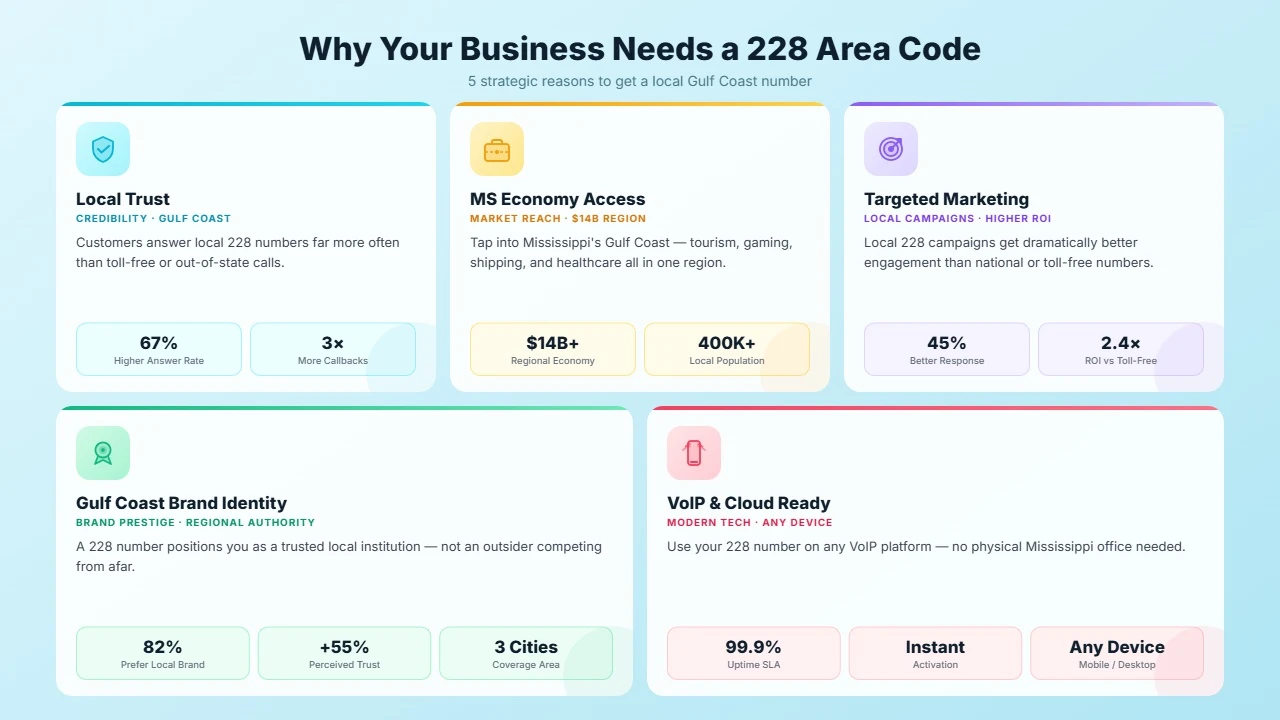
A local 228 number does specific work in the Mississippi Gulf Coast market that out-of-state or toll-free numbers cannot replicate.
Community Identity in a Loyalty-Driven Market
The Gulf Coast is a tight-knit regional market where community membership matters to purchasing decisions. A 228 number signals that your business is a local participant, not an outside vendor parachuting in for a contract. This is particularly relevant for businesses serving defense contractors, casino resort operators, healthcare systems, and maritime companies — all of whom have well-established local vendor relationships that a local area code reinforces.
Credibility with Defense and Government Procurement
The defense and government contractor community around Ingalls, Keesler, NCBC, and Stennis is relationship-intensive. Vendors who can present a local Gulf Coast number alongside a local business address position themselves as embedded in the community rather than operating remotely.
Local SEO in an Underserved Digital Market
Mississippi's Gulf Coast is significantly less competitive in local search than the major metro codes in this series. A 228 number in your Google Business Profile, local citations, and website creates NAP (Name, Address, Phone) consistency that ranks more efficiently in Gulfport, Biloxi, and Pascagoula search results than in Los Angeles or New York — making the SEO investment more immediately impactful per dollar.
No Overlay Confusion — One Clear Identity
Because 228 has no overlay, there is no ambiguity about what your number signals. A 228 prefix is unambiguously the Gulf Coast of Mississippi. There is no need to explain which code serves your area — this simplicity reinforces brand clarity in a market where many businesses still operate on traditional phone systems.
Gulf South Regional Reach
For businesses serving the broader Gulf South — from New Orleans to Mobile — a 228 number positions you at the geographic midpoint of a regional market. Combined with the Central Time Zone, a Gulf Coast business is reachable during the same core hours as clients in Houston, New Orleans, and Nashville without any time zone friction.
How to Get a Local 228 Business Number
1. Choose a VoIP or virtual number provider Select a provider with live 228 inventory. Because there is no overlay, any 228 number is unambiguously local to Mississippi's Gulf Coast — there is no need to compare prefix options between competing codes.
2. Browse available numbers Search the provider's available inventory by pattern or number type. For businesses serving the defense and maritime community, a professional and easily recalled number format supports the credibility expected in contractor environments.
3. Configure call routing Set how incoming 228 calls are handled: forward to mobile, ring a softphone app, route through an IVR menu, or connect to a call queue for teams supporting multiple client accounts across the defense, gaming, and maritime sectors.
4. Enable SMS Two-way SMS is increasingly used for service reminders, delivery confirmations, and hospitality booking confirmations in the casino and tourism economy.
5. Port an existing number if needed Local Number Portability (LNP) regulations allow you to transfer an existing 228 number from your current carrier. Coordinate with your new provider for a smooth port with no service interruption.
What to Look For in a Provider
When evaluating a provider for a local Gulf Coast business number, the region's industry mix creates specific requirements:
- Reliability — Defense contractors, casino operators, and port logistics businesses cannot afford missed calls. Rozper delivers 99.999% uptime, keeping your Gulf Coast line available around the clock.
- Call quality — Government contractor calls and high-value hospitality client communication demand clear, HD-quality audio. Tier-1 carrier connections ensure consistent quality.
- Feature depth — IVR, call forwarding, call recording, voicemail-to-email, and analytics as standard — not as paid add-ons.
- International reach — For maritime and logistics businesses in the Port of Gulfport corridor that connect with international trading partners, a provider covering 150+ countries keeps global communication on one platform.
- Human support — In a market where relationship-first business culture is the norm, a provider with accessible, human-first customer service aligns with how the Gulf Coast does business.
Rozper is one option worth considering here, maintaining 99.999% uptime and coverage in 150+ countries so a single platform can serve both your local Gulfport line and any international operations.
Common 228 Business Number Challenges and Solutions
| Challenge | Solution |
|---|---|
| Low brand recognition outside Mississippi | Pair 228 number with active local SEO strategy — lower competition means faster ranking |
| Health insurance / Medicare robocalls undermining trust | Use STIR/SHAKEN-compliant provider to authenticate outbound caller ID |
| Defense contractors requiring reliable communication | Cloud VoIP with failover routing maintains communication during facility access restrictions |
| Casino/hospitality high-volume inbound calls | Call queue + IVR with skills-based routing handles peak booking and service periods |
| Remote team needs a unified Gulf Coast presence | Call forwarding to any device; clients always see 228 on outbound |
| Port/logistics partners in international time zones | 24/7 IVR with voicemail-to-email covers off-hours contact from international shipping partners |
| Multiple client accounts across 3 counties | Per-number analytics dashboard tracks call volume by number, county, and campaign |
What's Next for the 228 Region
Shipbuilding expansion is accelerating. Ingalls Shipbuilding's hiring push and Bollinger's $5B+ Coast Guard icebreaker contracts signal sustained growth in Jackson County's industrial workforce through at least 2030. This creates demand for professional services, housing, healthcare, and communications infrastructure that benefits businesses across the zone.
Katrina recovery is now an investment story. Nearly two decades after Hurricane Katrina devastated Hancock and Harrison counties in 2005, the region has moved from recovery into a long-term investment cycle. Waveland, Bay St. Louis, and Pass Christian have rebuilt with improved infrastructure, and real estate investment interest in the coast is growing from both regional and national buyers.
Tourism diversification. The Gulf Coast tourism economy is actively diversifying beyond casino gaming — expanding Gulf Islands National Seashore visitation, culinary tourism, arts and culture programming in Ocean Springs and Bay St. Louis, and sports fishing are drawing higher-spend visitors who support a broader range of local businesses.
Artemis program at Stennis. NASA's Stennis Space Center is the primary testing site for the Space Launch System (SLS) engines powering the Artemis lunar program. Continued federal investment in Artemis testing adds workforce, contractor activity, and economic spillover to Hancock County through the decade.
Broadband infrastructure investment. Mississippi's Gulf Coast is receiving federal and state investment in broadband infrastructure that is expanding high-speed internet access to previously underserved coastal and rural communities in Hancock and Jackson counties — opening new markets for VoIP providers, tech companies, and digital service businesses.
Conclusion
The 228 area code covers one of the most strategically significant and economically specialized stretches of the American Gulf Coast — home to the Navy's largest surface shipbuilder, a billion-dollar gaming economy, a strategic seaport, and one of NASA's most critical testing facilities. It's the only telephone code for its territory, making it a clear, unambiguous signal of Mississippi Gulf Coast identity — no overlay confusion, no competing local codes.
For businesses, that clarity is an asset. A 228 number communicates local presence in a market that rewards community membership, especially in defense contracting, maritime logistics, healthcare, and hospitality. With a reliable VoIP provider and Central Time Zone positioning that reaches both East and West Coast clients within the same working day, a 228 number is a sound investment in one of the Gulf South's most resilient markets. That stability traces back to the same numbering system overseen nationwide, ensuring codes like 228 remain unambiguous as the region continues to grow.
FAQs
What cities does the 228 area code cover?
It covers all three Gulf Coast counties in Mississippi — Hancock, Harrison, and Jackson. Major cities include Gulfport, Biloxi, Pascagoula, Bay St. Louis, Ocean Springs, Long Beach, Waveland, D'Iberville, Diamondhead, Gautier, Moss Point, and Pass Christian. The region encompasses the full stretch of Mississippi's Gulf Coast shoreline.
Does the 228 code have an overlay?
No. Area code 228 has no overlay — it is the only active code serving its three-county territory. This distinguishes it from many urban codes in large metro areas that have added second or third overlay codes to manage number demand. Every Gulf Coast Mississippi number carries the same 228 prefix.
What time zone does the 228 code use?
Area code 228 is in the Central Time Zone. It observes Central Standard Time (CST, UTC−6) from early November through mid-March and Central Daylight Time (CDT, UTC−5) from mid-March through early November. The Central Time Zone positions Gulf Coast businesses one hour behind Eastern Time and two hours ahead of Pacific Time.
When was the 228 code created?
The 228 code was established on September 15, 1997, as a split from 601 — the original statewide Mississippi code that had served the entire state since 1947. A subsequent split in 1999 created 662 for northern Mississippi, giving the state its current three-code structure.
What scam types are common on 228 numbers?
The most frequently reported scam types using spoofed 228 numbers include health insurance robocalls, auto warranty fraud, Medicare and Medicaid impersonation, fake Amazon order alerts, and Social Security Number suspension threats. Scammers spoof local codes to increase answer rates — a legitimate 228 number from a STIR/SHAKEN-verified provider displays as authenticated to recipients.
Can I get a 228 number if I'm not based in Mississippi?
Yes. Virtual 228 numbers route calls to any device regardless of your physical location. A business anywhere in the country can maintain a credible Mississippi Gulf Coast presence with a 228 number, and FCC numbering administration rules on portability let you keep it even if you switch providers later — particularly valuable for defense contractors, maritime logistics companies, and hospitality vendors managing Gulf Coast client relationships remotely.
Does Rozper offer 228 business phone numbers?
Yes. Rozper provides local 228 numbers with full VoIP features — IVR, call forwarding, voicemail-to-email, call recording, SMS, and analytics. With 99.999% uptime and coverage across 150+ countries, Rozper supports both local Gulf Coast presence and broader national or international communication needs on one platform.