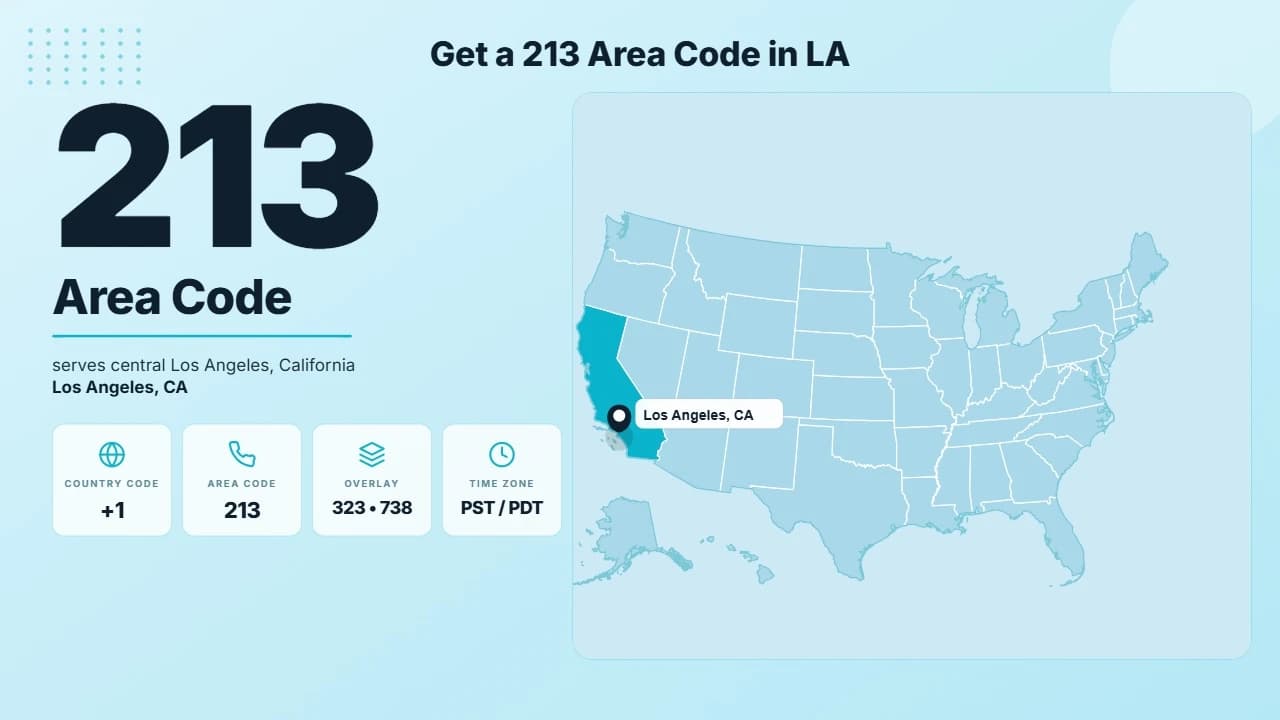
213 is the area code people picture when they think of Los Angeles. In 1947 it covered all of Southern California; after five splits it shrank to little more than Downtown LA. Then, in 2017, it was merged with its neighbor 323 into one shared region, and in 2024 a third code, 738, was added on top.
The result is that today 213, 323 and 738 are interchangeable labels for the same piece of central Los Angeles. This guide explains how that happened, exactly which areas are included, how to dial, and what to know about 213 calls and 213 business numbers.
What Is the 213 Area Code?
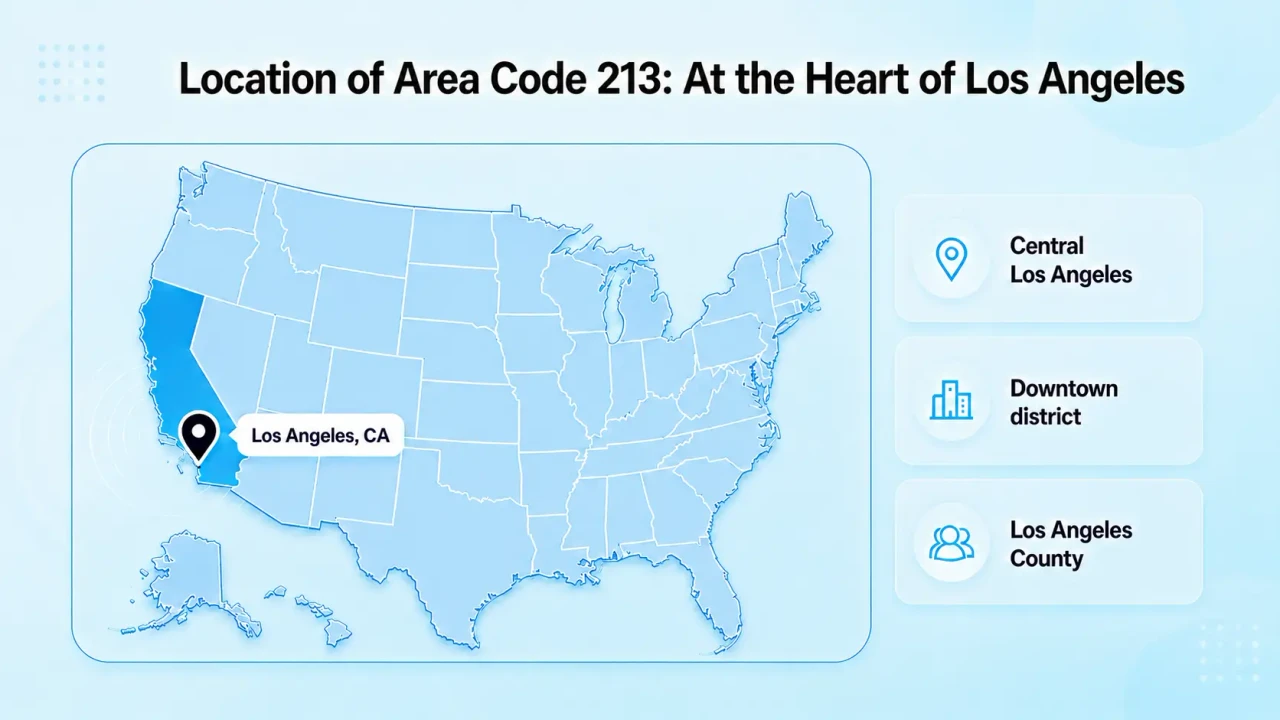
Quick facts:
| Detail | Info |
|---|---|
| Area code | 213 |
| Shares territory with | 323 (merged as an overlay in 2017), 738 (in service November 1, 2024) |
| State | California |
| Region | Downtown and central Los Angeles, Hollywood, and nearby cities in LA County |
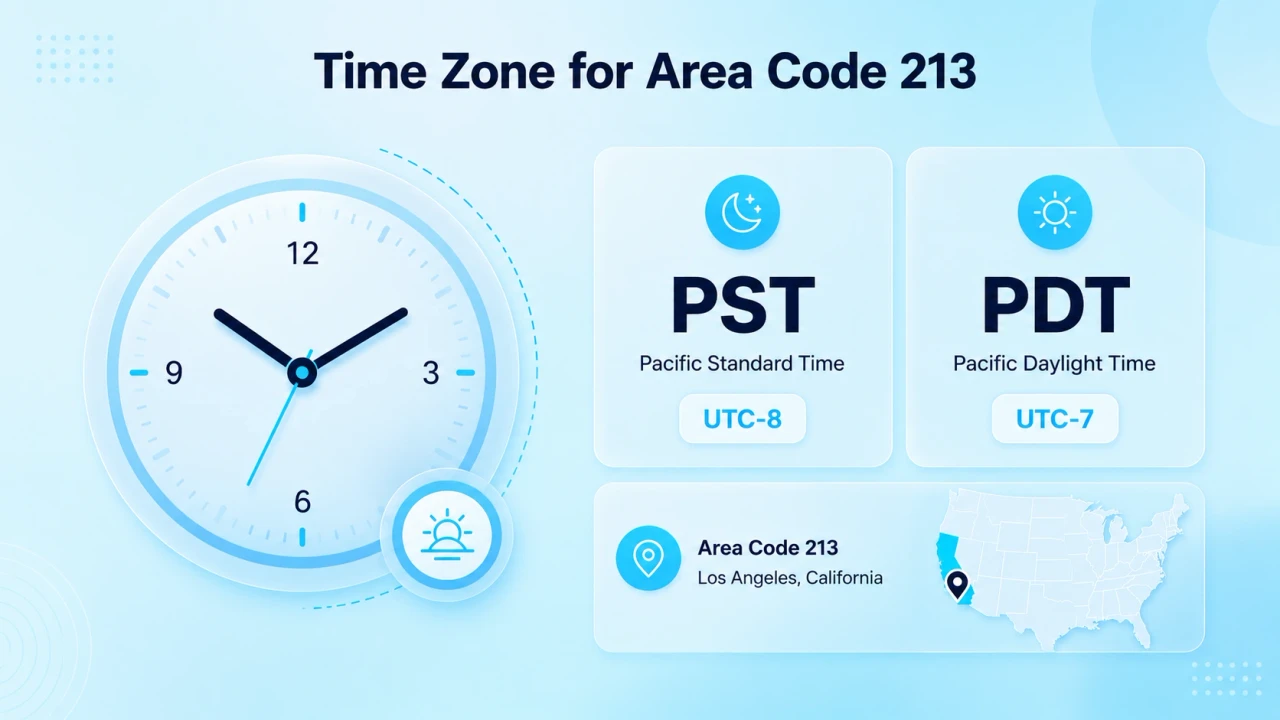
| Time zone | Pacific (PT) — UTC−8 / UTC−7 in daylight saving time |
| Local dialing | 1 + area code + number for all local calls |
| In service | 1947 (one of the original North American area codes) |
| Regulator | California Public Utilities Commission (CPUC) |
| Neighboring codes | 310/424 (Westside, South Bay), 818 (San Fernando Valley), 626 (San Gabriel Valley) |
Where Does the 213 Code Cover?
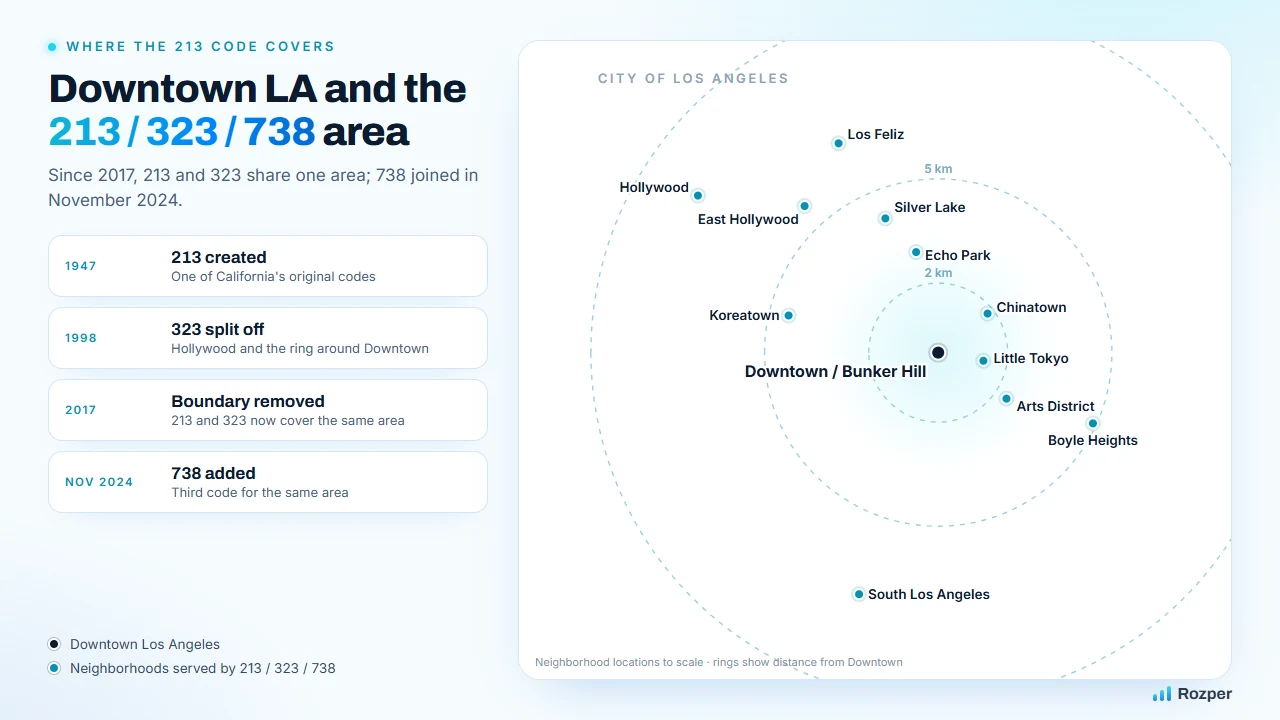
Because the 213/323 boundary was erased in 2017, "the 213 area" now means the combined territory of both codes. The CPUC describes it as serving "downtown Los Angeles, Alhambra, Bell, Bell Gardens, Beverly Hills, Commerce, Cudahy, Glendale, Hawthorne, Huntington Park, Inglewood, Lynwood, Maywood, Montebello, Monterey Park, Pasadena, Rosemead, South Gate, South Pasadena, Vernon, West Hollywood," plus unincorporated parts of LA County such as East Los Angeles (CPUC, new 738 area code). Some of those cities are only partly in the region: most of Pasadena and Alhambra, for example, use 626, with just a small portion in 213/323 (Wikipedia, area code 626).
Inside the City of Los Angeles, the region takes in:
- Downtown: Bunker Hill and the Financial District, the Civic Center around City Hall, the Historic Core, Little Tokyo, Chinatown, the Arts District, and South Park around Crypto.com Arena and the Convention Center.
- Central LA: Koreatown, Westlake and MacArthur Park, Echo Park, Silver Lake, Los Feliz.
- Hollywood: Hollywood and East Hollywood — historically 323 territory, now part of the same overlay.
- East and South LA: Boyle Heights and much of South Los Angeles.
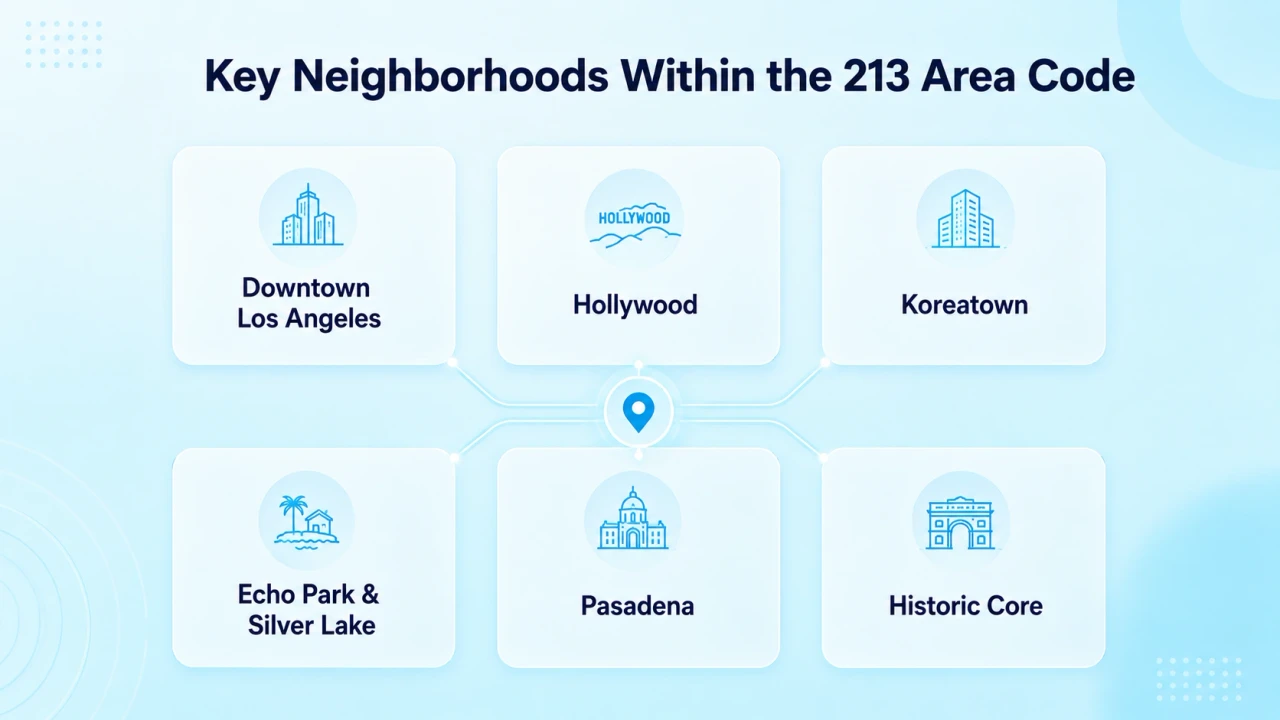
Before 2017 the split was roughly: 213 for Downtown and the neighborhoods immediately around it; 323 for the ring around that — Hollywood, East LA, South LA and the Southeast LA County cities. If you remember a business as "a 213 number" from the 2000s, it was almost certainly near Downtown. A 213 number issued today can be anywhere in the combined area.
History of the 213 Area Code
1947: one code for Southern California
When AT&T drew up the first nationwide numbering plan in 1947, California got three area codes: 213 for the southern part of the state, 415 for the central part and 916 for the north. 213 ran from the Mexican border up to the Central Coast (Wikipedia, area codes 213, 323 and 738). An earlier version of this article said 213 covered all of California; that was wrong.
Five splits, 1951–1998
| Year | New code | What left 213 |
|---|---|---|
| 1951 | 714 | San Diego and most of Orange County |
| 1957 | 805 | The northern and western portions (Central Coast) |
| 1984 | 818 | The San Fernando and San Gabriel Valleys |
| 1991 | 310 | West Los Angeles and the South Bay |
| 1998 | 323 | Everything around Downtown — split on June 13, 1998 |
After 1998, 213 was a small code wrapped around Downtown LA, surrounded on all sides by 323. The Westside's 310 later got its own overlay, the 424 area code.
2017: 213 and 323 merge
By the 2010s both codes were running low. Instead of a sixth split, the CPUC eliminated the boundary between 213 and 323, turning them into a single overlay region (CPUC, 213 and 323 area codes). The change went into full effect on July 8, 2017; from then on, numbers from either code could be assigned anywhere in the combined area, and everyone had to dial the area code for every call.
2024: 738 added
The CPUC approved a third code, 738, on March 16, 2023, with an in-service date of November 1, 2024. From that date, customers in the 213/323 region "may be assigned a number in the new 738 area code when they request new service or an additional line" (CPUC). No existing numbers changed, local calls stayed local, and the dialing rules didn't change.
Dialing and Time Zone
Dialing: The CPUC requires 1 + area code + number for all local calls in the 213/323/738 region. A seven-digit call won't connect. If you're moving an older phone system, alarm panel or CRM into this area, make sure every stored number includes the area code.
Time zone: Pacific Time — PST (UTC−8) from early November to mid-March and PDT (UTC−7) the rest of the year. LA is 3 hours behind New York and 2 behind Chicago, so a 9 a.m. call from the East Coast reaches Downtown at 6 a.m. Arizona doesn't observe daylight saving time (outside the Navajo Nation), so in summer it lines up with LA.
Calling from abroad: dial your country's exit code, then 1, 213 and the seven-digit number — for example 00 1 213 … from the UK, or +1 213 … from a mobile.
Is a 213 Call a Scam?
213 is a busy, real area code: millions of people and a large share of LA's businesses have numbers in the 213/323/738 region. A 213 call on its own is not suspicious. But caller ID is easy to fake — the FTC warns that scammers "can make any name or number show up on your caller ID" — so a 213 number is no proof the caller is in Los Angeles (FTC, Phone Scams).
Patterns worth knowing in an entertainment- and job-heavy market like LA:
- Fake job, audition or "content creator" offers that turn into a request to pay for training, equipment or a background check. Paying to get hired is the giveaway.
- "Wrong number" or chatty texts ("Hi, is this Jenny?", "Are we still on for Tuesday?") from unknown numbers that try to start a conversation and later steer toward money or crypto investing. Don't engage with a stranger's casual text.
- Government or law-enforcement impersonation — a caller says you owe money or face arrest, and insists on payment by wire transfer, gift card, cryptocurrency or payment app. The FTC lists those payment methods, and threats of arrest, as hallmarks of scams.
- Tech support calls claiming your computer or phone is infected and asking you to install remote-access software.
If in doubt, hang up and contact the organization through a number you look up yourself, and report scam calls at ReportFraud.ftc.gov.
213 vs 323 vs 738 for a Business Number
Since 2017 the three codes cover exactly the same ground, so the choice is about perception and availability, not geography:
- 213 is the code most people associate with Downtown LA, and it's the one a law firm, agency or studio near Bunker Hill or the Arts District will usually want. Because it's the oldest and most sought-after, inventory varies by provider.
- 323 has its own following — it's long been associated with Hollywood, Silver Lake, Echo Park and East LA.
- 738 is the newest and least recognized. It's perfectly local, but people may not yet recognize it as an LA number.
Practical points for a 213 business line:
- You don't need an LA office. A virtual 213 number rings wherever you route it — mobile app, desktop softphone or a call queue.
- Store every number as 1 + 10 digits. Mandatory since 2017; old seven-digit entries in IVR or CRM dial rules will fail.
- Port instead of switching numbers. Local number portability lets you move an existing 213 number to a new provider.
- Turn on SMS if your customers expect to text you; many virtual number providers support it on local numbers.
- Help customers verify you. Keep the number consistent across your website and Google Business Profile, and tell customers how you will and won't contact them.
Rozper is one option here: you can pick a 213 number, set routing, business hours, voicemail-to-email and call recording from one dashboard, and add numbers in other markets on the same account.
Common 213 Business Number Questions
| Situation | What to do |
|---|---|
| Outbound calls fail from an old PBX or CRM | Update dial rules to 1 + area code + number — required since July 2017 |
| Customers outside LA call before you open | PT is 3 hours behind ET; set after-hours IVR or voicemail-to-email |
| Can't find the exact 213 number you want | 323 and 738 cover the same area; or port an existing 213 number |
| Worried customers will think your number is spoofed | Publish one consistent number and say how you contact customers |
| Need to track LA campaigns separately | Use separate local numbers per campaign, routed to the same team |
FAQs
What cities does the 213 area code cover?
Downtown and central Los Angeles (including Koreatown, Echo Park, Silver Lake, Hollywood, Boyle Heights and much of South LA), plus — per the CPUC — Bell, Bell Gardens, Beverly Hills, Commerce, Cudahy, Hawthorne, Huntington Park, Inglewood, Lynwood, Maywood, Montebello, Monterey Park, Rosemead, South Gate, South Pasadena, Vernon, West Hollywood, unincorporated areas like East Los Angeles, and parts of Alhambra, Glendale and Pasadena.
What is the difference between 213, 323 and 738?
Today, only age. 213 dates from 1947; 323 was split off on June 13, 1998 and merged back with 213 as an overlay in 2017; 738 was added on November 1, 2024. All three are assigned anywhere in the same territory.
Was 213 ever California's only area code?
No. California started with three codes in 1947: 213 (south), 415 (central) and 916 (north). 213 covered the southern part of the state, from the Mexican border to the Central Coast.
Do I need to dial the area code for local calls in the 213 area?
Yes. Since the 213/323 overlay took full effect on July 8, 2017, the CPUC requires 1 + area code + number for all local calls in the 213/323/738 region.
Is a 213 call a scam?
Usually not — 213 is one of the most-used area codes in Los Angeles. But any number can be spoofed, so judge the call by what the caller asks for, not the area code. Pressure, threats and demands for gift cards, wire transfers or crypto are red flags.
What time zone is 213 in?
Pacific Time: UTC−8 in winter (PST) and UTC−7 during daylight saving time (PDT).
Can I get a 213 number if I'm not in Los Angeles?
Yes. A virtual 213 number can route calls to any device anywhere. Rozper provides local 213 numbers with call forwarding, IVR, voicemail-to-email, call recording, SMS and analytics.