การแนะนำ
A call comes in from 888 and a fair question follows: is this a real company or a scam? Both are possible. The 888 area code is a toll-free prefix, so it can belong to a bank, an airline, a clinic, or a stranger trying to look official. This guide answers the questions people actually search for. It explains what the prefix means, where calls come from, how to judge a call, what to do about a suspicious one, and how a business can use an 888 number the right way.
The quick answer: 888 is a toll-free code used across the United States and Canada. It is not tied to a city or state. The code itself is legitimate, and most calls from it are honest businesses. Scammers do borrow toll-free numbers because they look trustworthy, so verify before you share anything.
What the 888 Prefix Really Means
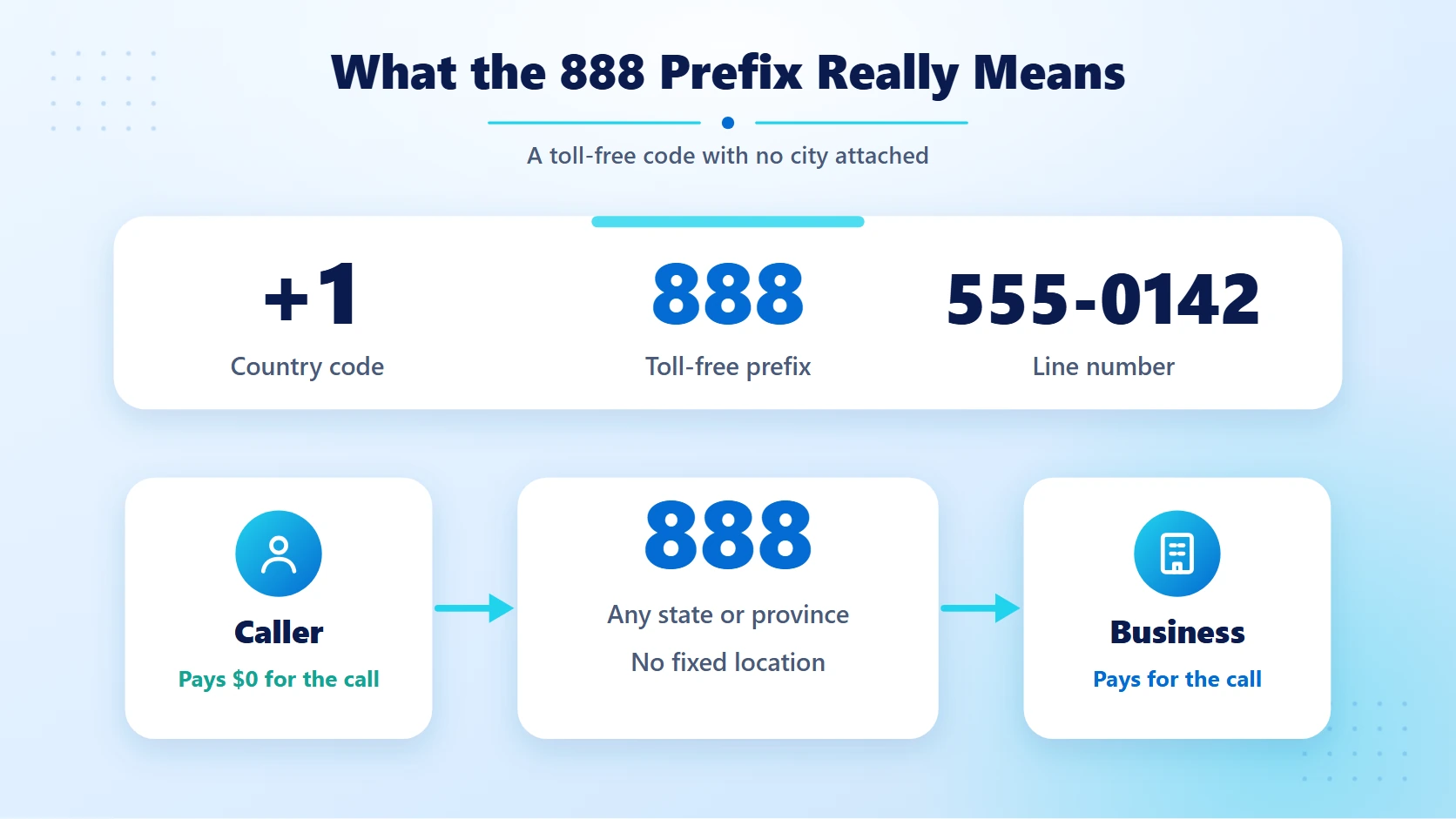
The 888 area code is a toll-free prefix inside the North American Numbering Plan, which covers the United States, Canada, and several nearby territories. Unlike a local prefix, it does not point to a place. When someone dials an 888 line, the business that owns the number pays for the call, and the caller pays nothing. That single rule is the core of toll-free service. The prefix was added in the mid-1990s because the original 800 pool was running out of good combinations.
Because no location is attached, an 888 caller can be sitting in any state or province. A support team in Florida and a billing office in Ontario can both answer the same number. If you want to see how a prefix is assigned before you call back, our free area code lookup tool is a quick place to start.
Who Uses 888 Numbers and What For
Toll-free numbers exist so that customers never hesitate to call. That is why you see 888 on so many kinds of organizations.
- Customer support lines for banks, insurers, utilities, and online stores.
- Sales and order lines where a free call removes one reason to abandon a purchase.
- Healthcare and pharmacy lines that handle appointments, refills, and billing questions.
- Nonprofits and public-facing services that want people to be able to reach them at no cost.
- Travel and delivery companies that field urgent calls from customers in other regions.
Most of the 888 calls you receive will come from one of these. The trouble is that a number being toll-free says nothing about who is actually on the line.
Are 888 Numbers Safe?
The prefix is not dangerous. Millions of legitimate calls come from 888 every day, and answering one will not hurt you. The risk lies in what the caller says and asks you to do, not in the three digits.
Scammers like toll-free numbers for three reasons. They look established and national. They are easy and cheap to obtain. And caller ID can be spoofed, which means the number on your screen may not be the number that really placed the call. So a toll-free number on your display is a reason to pay attention, not a reason to trust.
A fair rule: treat an unexpected call as unverified until you have confirmed who it is through a channel you chose yourself.
Common Scams That Use Toll-Free Numbers
Knowing the usual scripts makes them easy to spot. These are the patterns that appear most often on toll-free lines.
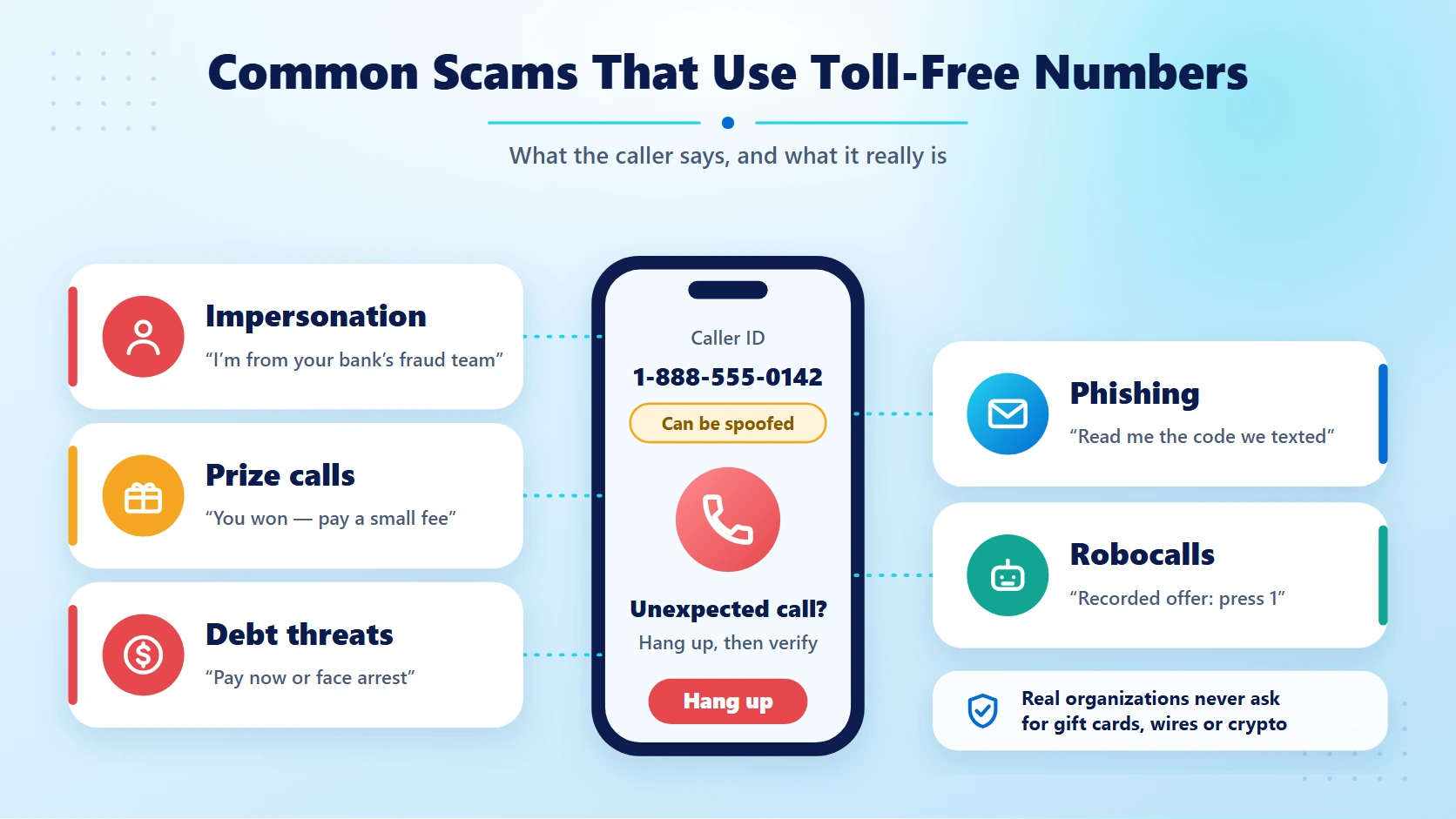
Impersonation of banks, agencies, and tech companies
The caller says they are from your bank's fraud team, a government office, or a well-known software company. They claim there is a problem with your account, a tax issue, or a virus on your computer, and they need you to act now.
Prize and lottery calls
You are told you have won a contest you never entered, but a fee or card number is needed first. Real prizes do not ask you to pay to receive them.
Debt-collection threats
An aggressive caller says you owe money and threatens legal action or arrest unless you pay by phone. Genuine collectors send written notices and do not demand instant payment over an unsolicited call.
Phishing by call and text
A call asks you to confirm a one-time code or a login, sometimes followed by a text with a link. The goal is to steal credentials, not to help you.
Robocalls
A recorded voice pushes an offer, a survey, or a warranty extension. Pressing a key to opt out often just confirms your number is active.
How to Tell Whether an 888 Call Is Legitimate
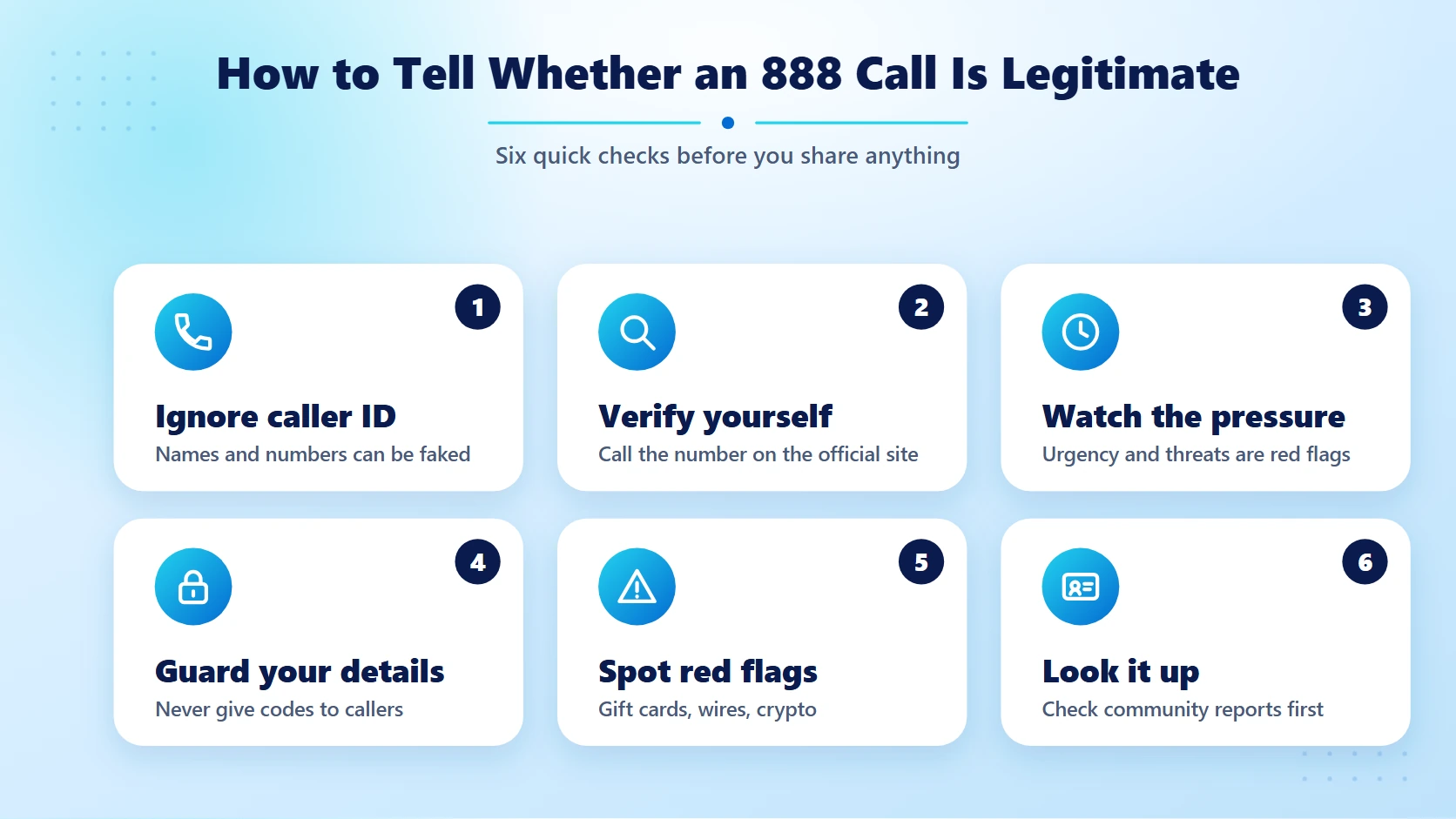
Run through these checks before you share anything or press a key.
- Do not rely on caller ID. A displayed name or number can be faked.
- Verify independently. Hang up, find the company's number on its official website or on your card or statement, and call that number yourself.
- Watch for pressure. Urgency, secrecy, and threats are tools of the trade. Honest organizations let you take time.
- Protect personal details. Do not give out your Social Security number, passwords, or one-time codes to someone who called you.
- Spot the red flags. Requests for gift cards, wire transfers, or crypto, demands for remote access to your computer, and a refusal to send anything in writing all point to fraud.
- Look the number up. Community reports on a number often show whether others have flagged it.
You can also run a suspicious number through our free reverse phone number lookup to see what is publicly known about it.
What to Do If You Get a Suspicious 888 Call
If a call feels wrong, you have simple options, and none of them cost anything.
- Hang up. You do not owe a stranger an explanation.
- Do not press keys or call back a number the caller gave you.
- Report it. In the United States, file a report with the Federal Trade Commission so it can be tracked. You can also tell your phone carrier and your state attorney general's office.
- If you shared money or details, contact your bank or card issuer immediately, change affected passwords, and consider a credit freeze.
- Block the number. Most phones can block individual numbers, and many carriers offer free spam filtering.
Should You Answer 888 Calls?
You do not have to. A sensible habit is to let unknown numbers go to voicemail. A real business will leave a message with a clear reason and a callback path. If you are expecting a call from a bank, a delivery, or a medical office, answer, but still confirm who you are speaking with before you share private details. If the call turns out to be a recording or a high-pressure pitch, hang up.
888 vs +888: Two Different Things
People often mix up the toll-free 888 prefix with the +888 country code. They are not the same. The toll-free 888 code belongs to the North American Numbering Plan and is dialed as a normal ten-digit number. The +888 country code is an international code reserved for humanitarian and relief use, and ordinary callers almost never see it. If a call shows +888 or a number you cannot place, be extra careful, because it is unusual and may be a spoofed attempt.
Where 888 Sits Among Toll-Free Codes
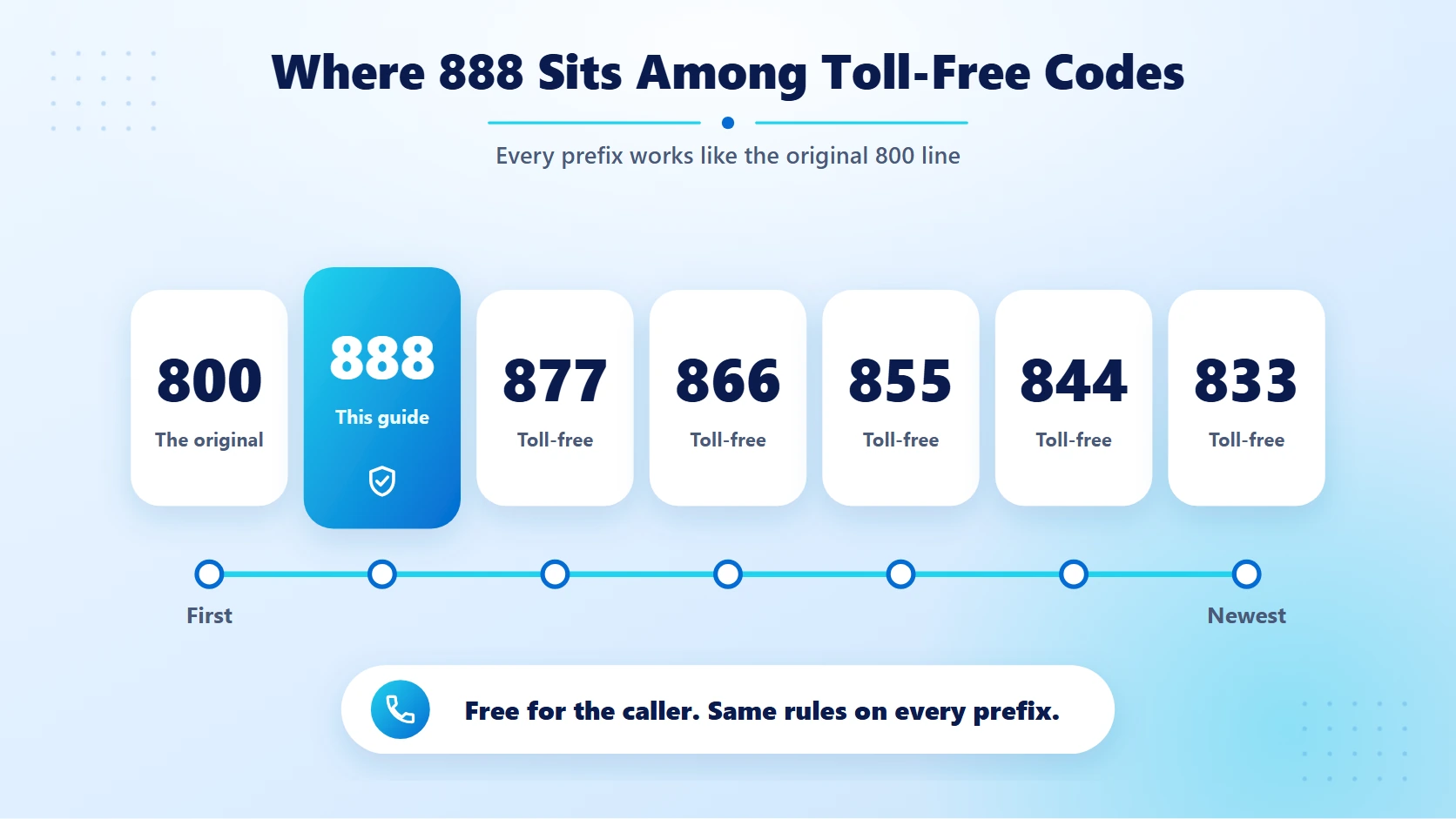
Toll-free dialing began with the original 800 line. It grew as the best combinations ran short. Our toll-free vs. local numbers guide explains how the first toll-free numbers changed customer service. The 888 prefix was the first expansion of that pool, followed by 877, 866, 855, 844, and 833. Every one of these works the same way, and each exists to open up fresh number combinations.
| Prefix | Role | Works like 800? |
|---|---|---|
| 800 | The original toll-free code | ใช่ |
| 888 | First expansion of the pool | ใช่ |
| 877 | Added next | ใช่ |
| 866 | Added next | ใช่ |
| 855 | Added later | ใช่ |
| 844 | Added later | ใช่ |
| 833 | Newest in the series | ใช่ |
The practical lesson is that an 888 area code behaves just like a classic 800 line. Your real choice comes down to which numbers are still open and how easy they are to remember. For a close look at a sibling prefix, see our breakdown of the 844 area code.
How an 888 Call Connects
An 888 number uses the standard ten-digit format: the prefix, then a seven-digit line number. There are no special codes to dial, so a caller simply enters all ten digits from anywhere in North America. Behind the scenes, the number is managed in one place and routed to whatever destination you choose, such as a desk phone, a mobile, a call center, or a cloud app. You can reroute it whenever you like, send calls to different teams by time of day, and log every inbound call. Seen this way, the 888 area code is less like a single phone line and more like an adjustable front door to your business.
What an 888 Line Costs
Toll-free pricing is usually low and predictable. Most providers charge a small monthly fee for the number plus a per-minute rate for inbound calls. The business pays so that the caller pays nothing. Vanity numbers that spell a word can carry a one-time premium, since demand for them runs high, while plain numeric lines cost less and work just as well. Many plans bundle routing, voicemail, and analytics at no extra charge, so your real cost tracks call volume more than setup. There is no equipment to buy and no install visit to book. You can compare plans on our pricing page before you decide.
Claiming or Porting an 888 Number
Getting started is quicker than most owners expect. You browse a provider's list of open numbers, pick a standard or vanity combination, and point it at the phones or apps your team already uses. No hardware is needed. If you already hold a toll-free number, you can usually port it to a new provider without losing it. You supply account details and sign off, and the move happens with little or no downtime. A vanity number that spells your brand can be easier to remember and can lift response on your ads.
Turning 888 Into a Marketing Asset
A toll-free number is also a measuring tool. Attach call tracking to your line and you can see which campaigns actually make the phone ring, then shift spend toward what works. Providers add features such as business-hour scheduling, voicemail-to-email, auto-attendants, and call recording, which lets a small team sound like a national operation. This is where a provider like Rozper fits in. With reliable service and international coverage, it can set up an 888 number that routes anywhere, with calls, texts, and analytics in one dashboard.
The Credibility an 888 Number Brings
First impressions move fast over the phone. An 888 area code signals that a company is established, has national reach, and is willing to cover the cost of a conversation. That can nudge a hesitant prospect into becoming a customer. The same number can follow your business through every move, rebrand, or growth spurt, so customers never lose touch when an office moves or a team goes remote. That mix of staying power, reach, and clear data is hard to match with an ordinary local line.
Protecting Your Own 888 Line From Spoofing
If you run an 888 number, scammers may also copy it to trick your customers. You cannot stop every attempt, but you can reduce the damage. Publish your official number clearly on your website and statements. Tell customers you will never ask for passwords, codes, or payment by gift card over an unsolicited call. Work with a provider that supports proper caller registration, and keep an easy way for customers to confirm a call was really yours. Our free phone number validator can help you check how a number is formatted and classified.
Is an 888 Number Right for You?
Not every company needs a toll-free line, but a few signs point to a clear yes. If you sell across state or national borders, a local number quietly hints that you only serve one area, and a toll-free line says the opposite. If you run ads, the tracking data tied to the line shows which channels deserve more budget. If you plan to grow, a number that scales from one line to many, with no new hardware, saves you from rebuilding your phone setup at each stage. Service firms, online stores, clinics, and support teams tend to gain the most, because each depends on how easily customers can reach a real person.
บทสรุป
The 888 area code is legitimate, but a toll-free number on your screen proves nothing about who is calling. If you are on the receiving end, verify through a channel you choose and never share codes or payments with an unsolicited caller. If you are a business, an 888 line removes the cost barrier for customers, gives your brand a national feel, and hands you data you can act on. To launch one with steady routing and real support behind it, see how Rozper handles toll-free numbers at rozper.com.
คำถามที่พบบ่อย
Is the 888 area code a scam?
No. The 888 code is a legitimate toll-free prefix used by real businesses and organizations. Scammers do sometimes use toll-free numbers or spoof them, so judge the call by what the caller asks for, not by the prefix.
Should I answer 888 numbers?
You do not have to. Letting unknown calls go to voicemail is safe, and genuine callers will leave a clear message. If you do answer, do not share personal data until you have verified the caller another way.
Can scammers use a real company's 888 number?
Yes. Caller ID spoofing lets a scammer display a real company's number. If a call claims to be from a company you use, hang up and call the number on its official website or your statement.
Can I block all 888 numbers?
Most phones cannot block an entire area code, but you can block individual numbers. Many carriers and call-filtering apps also offer free spam screening. Blocking every 888 number would also cut off real businesses.
Is the 888 area code free to call?
Yes. Calls to an 888 number are free for the person dialing from the United States, Canada, and other North American Numbering Plan regions. The business that owns the line covers the cost. Calls from outside that region may differ, so check with your carrier.
Where is the 888 area code located?
Nowhere specific. It is a toll-free prefix, not a geographic marker. A number using it can be answered in any state or province.
What is the difference between 888 and 800?
In practice there is none. Both are toll-free and free to the caller. The 888 prefix was added to expand supply when the first pool filled up.
Can I move my current toll-free number to a new provider?
Usually, yes. Most providers let you port a toll-free line, including an 888 number, to a new platform. You supply authorization and account details, and the transfer typically finishes with little or no downtime.
How do I report a scam call from an 888 number?
In the United States, report it to the FTC and tell your phone carrier. If you lost money, contact your bank right away and consider reporting to the FBI's Internet Crime Complaint Center.
Does an 888 number help with marketing?
Yes. Beyond free calls, an 888 line supports call tracking and analytics that reveal which ads, pages, or campaigns drive real phone calls.