Introduction
The phone rings during lunch. Nobody's at the front desk. It goes to voicemail, and the caller hangs up without leaving a message — because most callers do. For a small business, that's a lead that just called your competitor instead.
This is the gap an AI receptionist is built to close: something answering every call, at every hour, without a second employee on payroll to do it. This guide covers what an AI receptionist actually is, how it works, what it costs, and how to tell if your business is a good fit before you buy one.
Key Takeaways
- What it is: Software that answers phone calls, holds a real conversation, and takes action — not a phone tree with numbered menu options.
- How it works: Answer → converse naturally → qualify the caller → book an appointment or route the call → log everything to your CRM, usually in under a few seconds per step.
- Who it's for: Any business where a missed call is a missed dollar — dental and medical practices, home services, real estate, and professional services see the clearest return.
- What it costs: Far less than a second front-desk hire, and increasingly bundled into the phone system itself rather than sold as a standalone add-on.
- The real test: Whether callers can tell it's not a person — and whether the business behind it can prove that with real numbers, not a demo video.
What Is an AI Receptionist?
An AI receptionist is a voice AI agent that answers incoming business calls and handles the conversation the way a trained front-desk employee would — greeting the caller, understanding what they need, and taking the right next step: booking an appointment, answering a common question, or transferring to a person.
That's meaningfully different from the IVR ("press 1 for sales, press 2 for support") systems most people associate with automated phone answering. An IVR forces the caller to navigate a fixed menu tree with a keypad. An AI receptionist has an actual conversation — it understands intent from what was said, not which button was pressed. That's why IVRs are widely disliked and a well-built AI receptionist usually isn't: one makes the caller do the work, the other does it for them.
How an AI Receptionist Actually Works
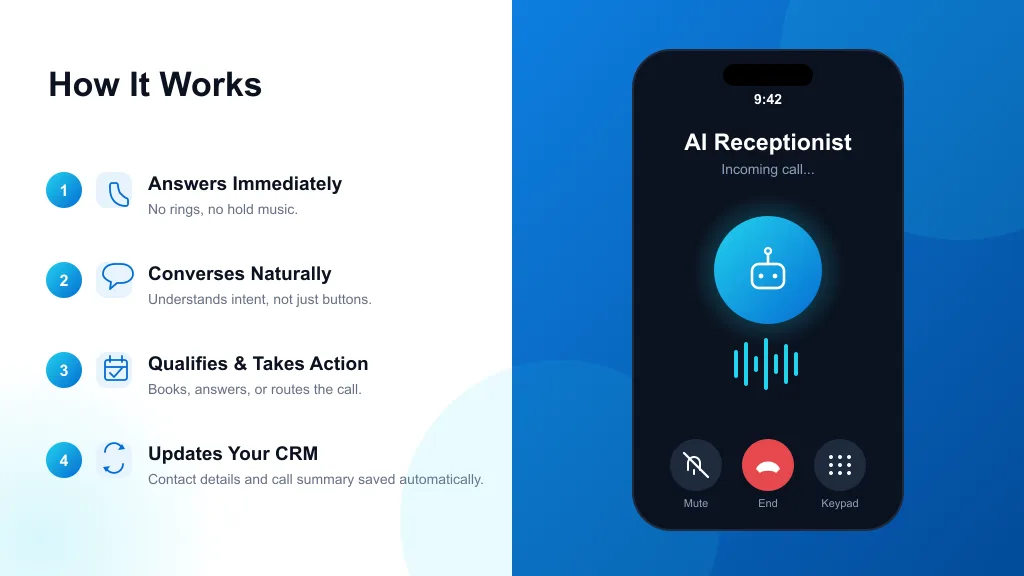
Strip away the marketing language and the flow behind a real AI receptionist call looks like this:
- The call is answered immediately — no ring cycles, no hold music, at any hour.
- The AI greets the caller in natural language — an actual sentence that invites the caller to say what they need, not a scripted menu.
- It qualifies the caller — department, urgency, topic — from what they actually say.
- It takes the appropriate action — books an appointment with a confirmation sent by SMS or email, answers a common question, or transfers to a live person.
- It updates your CRM — contact details and a call summary land in your system automatically.
The step that matters most for call quality is #2 and #3 together: how naturally it holds the conversation, and how accurately it captures what the caller needs before deciding what to do next. A system that mishears "reschedule" as "cancel" doesn't just annoy a caller — it creates real work undoing the mistake later.
Key Features Worth Evaluating
Not every AI receptionist on the market does all of this well. When comparing options, these are the features that separate a genuinely useful system from a gimmick:
- 24/7 availability. A call at 9pm gets answered the same way a call at 9am does — no after-hours voicemail that just loses the caller.
- Natural-language conversation, not a menu tree. If it still asks callers to press numbers, it's an IVR with a new coat of paint.
- Direct calendar booking with confirmation. Taking a message and promising a callback solves half the problem. Booking the appointment on the call, with an instant confirmation, solves the whole thing.
- CRM sync without manual entry. Contact data and a call summary should land in your CRM automatically — that's the difference between an AI receptionist and a sophisticated voicemail box.
- Multi-language support. A system that only answers in one language turns away business your competitors might not.
- Configurable call flows per number or department. A dental practice's qualifying questions look nothing like a real estate office's.
- A real path to a human. A distressed or complex caller should reach a person, not get stuck with a bot that can't escalate.
Rozper's AI Receptionist covers all seven directly: sub-2-second pickup, natural-language greetings with no IVR tree, direct calendar booking with instant confirmation, automatic CRM pre-population, 40+ languages, and per-number custom call flows with live-agent handoff built in.
AI Receptionist vs. a Human Receptionist or Answering Service
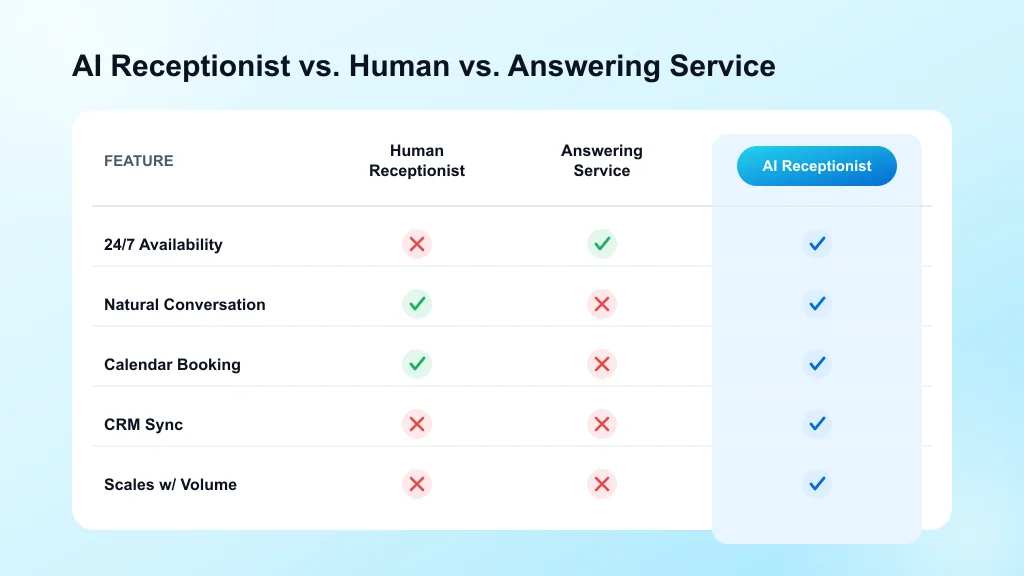
The honest comparison isn't "AI vs. human" as a philosophical question — it's what each option actually covers for the money.
| Human receptionist | Answering service | AI receptionist | |
|---|---|---|---|
| Coverage | Business hours only (typically) | 24/7, but scripted | 24/7, conversational |
| Cost | Full-time salary + benefits | Per-minute or per-call fees that scale with volume | Flat or usage-based, often bundled into the phone system |
| Consistency | Varies by person, day, mood | Scripted, so consistent but rigid | Consistent every call, adapts within the conversation |
| Calendar booking | Yes, manual | Usually message-taking only | Yes, automatic, with confirmation |
| CRM logging | Manual, if it happens at all | Rarely | Automatic |
| Scales with call volume | No — a busy day means longer hold times | Costs rise directly with volume | Yes, at no marginal staffing cost |
A human receptionist is still the right call for a business that needs someone physically present — greeting walk-ins, managing a front office. A traditional answering service solves the after-hours gap but usually can't do more than take a message. An AI receptionist sits between them: it can't greet a walk-in, but for phone-based coverage specifically, it typically outperforms both on availability and consistency, at a fraction of the cost.
Is an AI Receptionist Right for Your Small Business?
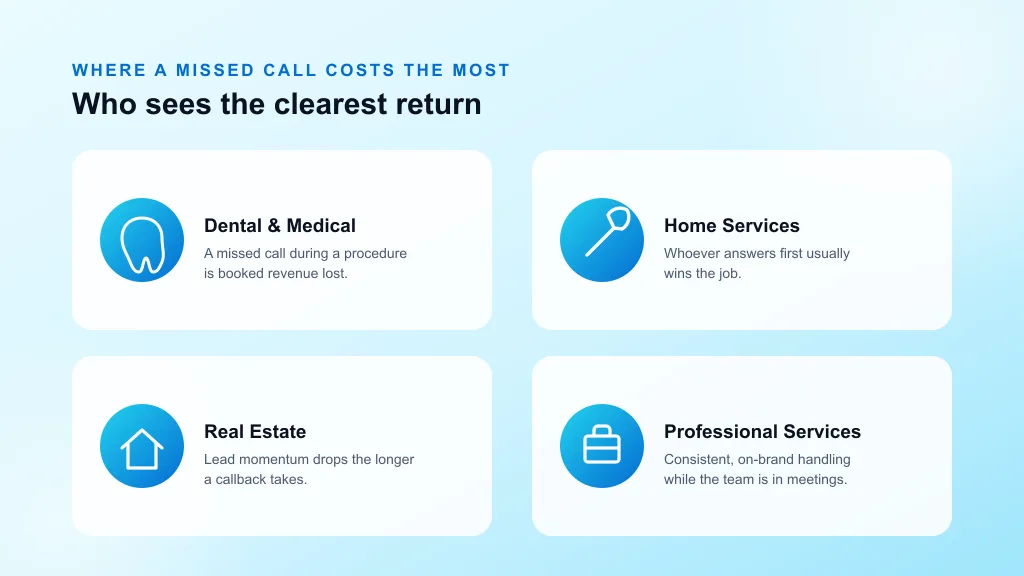
The businesses that see the clearest return share one thing in common: every missed call has a real, calculable cost attached to it.
- Dental and medical practices lose booked revenue every time a call during a procedure or lunch hour goes to voicemail instead of getting an appointment on the calendar.
- Home services (plumbing, HVAC, electrical) compete on who picks up first — a caller with a burst pipe calls the next name the moment the first one doesn't answer.
- Real estate agents lose lead momentum the longer a prospective buyer or renter waits for a callback.
- Professional services (law firms, accounting, consulting) get consistent, on-brand call handling even when the whole team is in back-to-back meetings.
If your business rarely gets inbound calls, or those calls can genuinely wait for a callback, the return is smaller. But where a ringing phone represents real, immediate revenue, the math favors answering every single one.
What Does an AI Receptionist Cost?
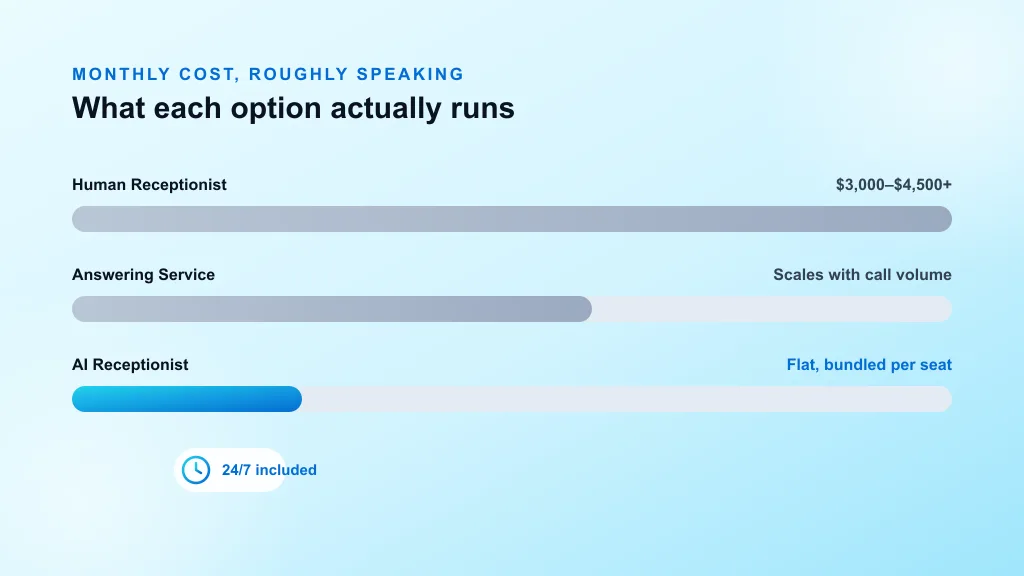
Pricing in this category has shifted over the past couple of years. Early AI receptionist products were sold as a standalone add-on, often billed per conversation or per minute — so the cost scaled with your busiest, most valuable days, exactly when you least wanted a bill to spike.
The more buyer-friendly model now shows up bundled directly into a business phone platform. Rozper's AI Receptionist, for example, is included on every seat rather than metered as an extra line item — adopting it isn't a second buying decision on top of your phone system, it's part of the one you already made.
Either way, run the comparison against what you're replacing: a part-time front-desk hire costs several thousand dollars a month with payroll taxes and benefits, and still only covers business hours. An answering service's per-minute fees add up fast on a busy month. Measured against either, most AI receptionist pricing is the cheaper option — before you even account for after-hours coverage a human role doesn't provide at all.
How to Choose an AI Receptionist Provider
Once you've decided the category makes sense, the providers themselves aren't interchangeable. Evaluate on:
- Pickup speed. Ask for the actual number, not "instantly." A 2-second pickup and a 15-second pickup are a very different caller experience.
- How it sounds on a real call, not a demo. Demos are rehearsed. Call the number yourself, interrupt it mid-conversation, ask an off-script question, and see how it recovers.
- Language coverage, if your callers need it — and whether that's automatic or requires separate setup per language.
- Whether booking and CRM sync are truly automatic, or whether "integration" really means a CSV export you still have to import.
- How live-agent handoff actually works — does a caller who needs a person get transferred cleanly, or hit a dead end?
- Whether pricing is bundled or metered, and if metered, what a worst-case monthly bill looks like at your call volume.
Conclusion
An AI receptionist isn't a replacement for every front-desk function a small business needs — it's a fix for one specific, expensive problem: the phone ringing and nobody, or nothing, picking it up well. For businesses where a missed call is a missed customer, that fix pays for itself quickly. The providers worth evaluating are the ones that can prove pickup speed, booking automation, and CRM sync with a real number and a real call — not just a script.
FAQs
Can callers tell they're talking to an AI receptionist instead of a person?
With a well-built system, often not right away — the difference shows up if you deliberately try to confuse it (an off-script question, an interruption) rather than in normal conversation. That's the real test to run before buying, not a scripted demo.
Does an AI receptionist replace a front-desk employee entirely?
For phone coverage specifically, often yes. For in-person duties — greeting walk-ins, managing a physical office — no. Most small businesses that adopt one are replacing an answering service or unanswered calls, not a full-time front-desk role.
What happens if a caller needs something the AI can't handle?
A properly configured AI receptionist recognizes when a call needs a human and transfers it — the goal isn't to handle every call alone, it's to make sure every call gets a fast, useful response, whether that's the AI resolving it or routing it correctly.
Is an AI receptionist worth it for a very small business with low call volume?
It depends on what each call is worth. A business with few calls but high value per call (e.g. a single-location medical or legal practice) often sees a clear return even at low volume, because the cost of one missed high-value call outweighs months of the service.
How long does it take to set up an AI receptionist?
With a bundled solution like Rozper's, where it's included on the phone platform rather than a separate integration, setup is typically a matter of configuring the greeting, qualifying questions, and routing rules — not a multi-week implementation project.