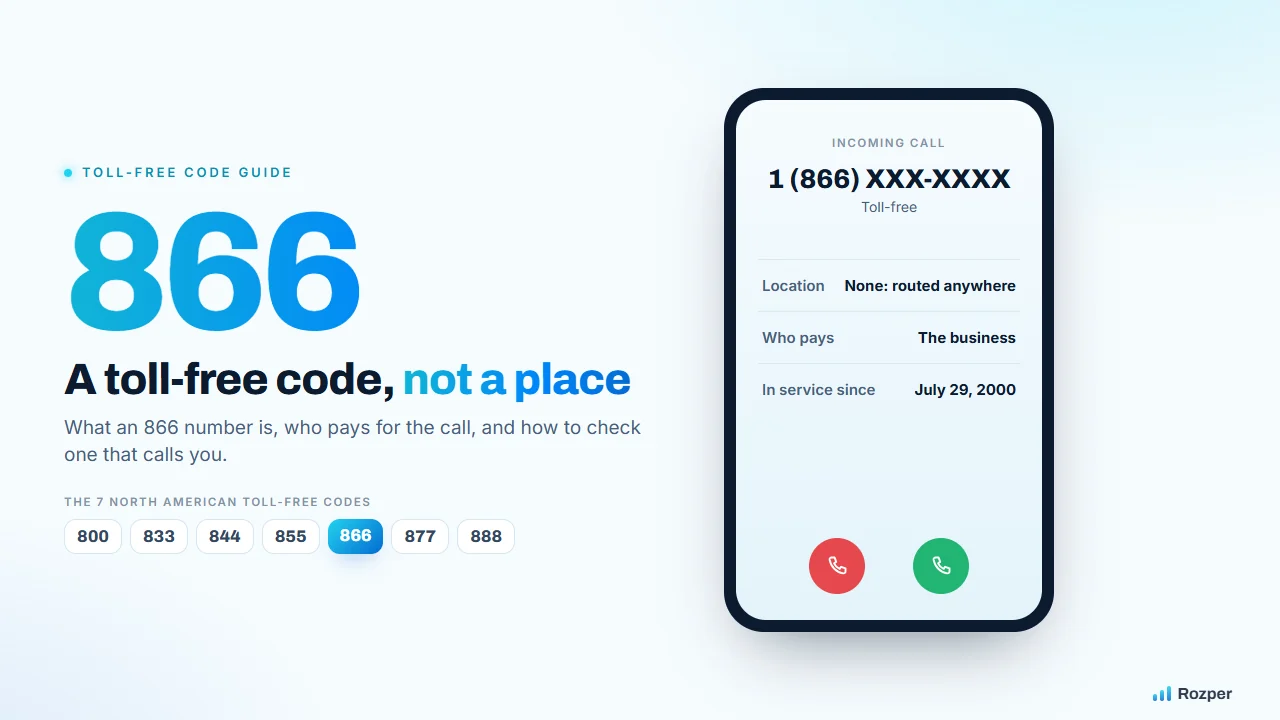
If you're looking up "866 area code" because a number called you, here's the short answer: 866 isn't tied to any city, state or country. It's one of the toll-free codes of the North American Numbering Plan, so an 866 number could be answered anywhere — by a bank's call center, a software company's help desk, or someone you'd rather not talk to. The area code alone tells you nothing about where the caller is.
This guide explains what 866 is, when it appeared, how toll-free numbers are handed out and moved between providers, and how to judge an incoming 866 call.
What an 866 Number Actually Is
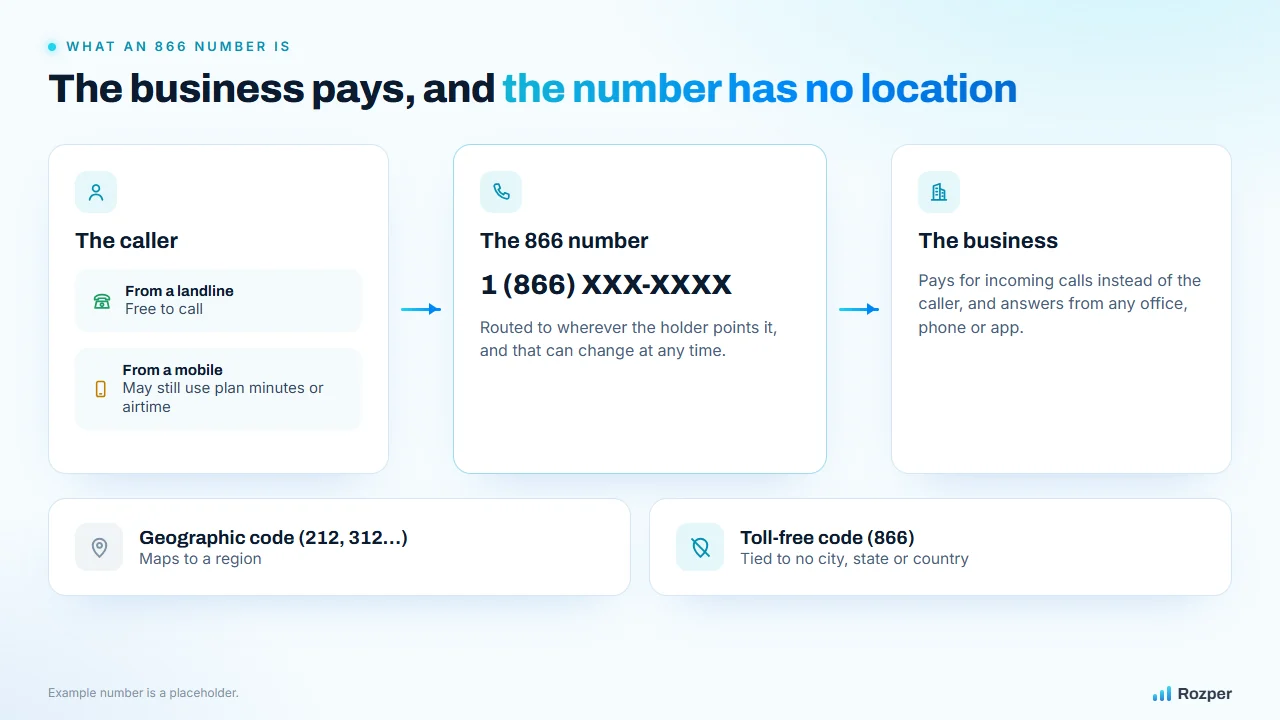
North American toll-free numbers use one of seven area codes: 800, 833, 844, 855, 866, 877 and 888 (Wikipedia). They all behave the same way: the business that holds the number pays for incoming calls instead of the caller.
Two details that often get left out:
- "Free" means free on landlines. Toll-free calls are free to the caller from a landline, but a mobile call to a toll-free number may still use your plan's minutes or airtime.
- There's no location behind the code. A geographic area code like 212 or 312 maps to a region. An 866 number is routed to wherever the holder points it, and that can change at any time.
When 866 Arrived — and Why
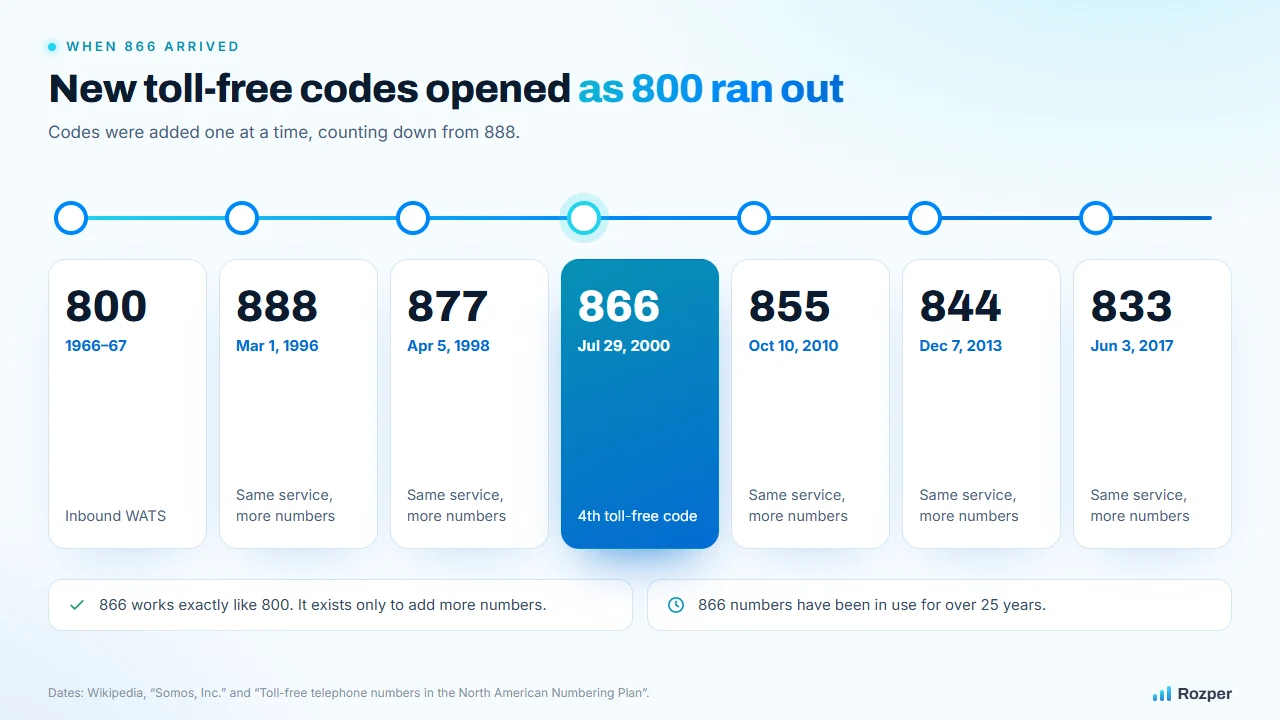
Automated toll-free service started with 800 in the late 1960s, created as inbound WATS service — 1966 for calls within a state and 1967 for interstate calls. As 800 numbers ran out, new toll-free codes were opened one at a time, counting down from 888:
| Code | Opened |
|---|---|
| 800 | 1966–67 |
| 888 | March 1, 1996 |
| 877 | April 5, 1998 |
| 866 | July 29, 2000 |
| 855 | October 10, 2010 |
| 844 | December 7, 2013 |
| 833 | June 3, 2017 |
(Dates: Wikipedia, Somos, Inc. and toll-free numbers in the NANP.)
So 866 is the fourth toll-free code, and 866 numbers have been in circulation for over 25 years. There's nothing functionally different about it from 800 — it exists purely to add more numbers. For the original code, see our 800 area code guide; for a newer one, see the 855 area code guide.
Who Hands Out 866 Numbers
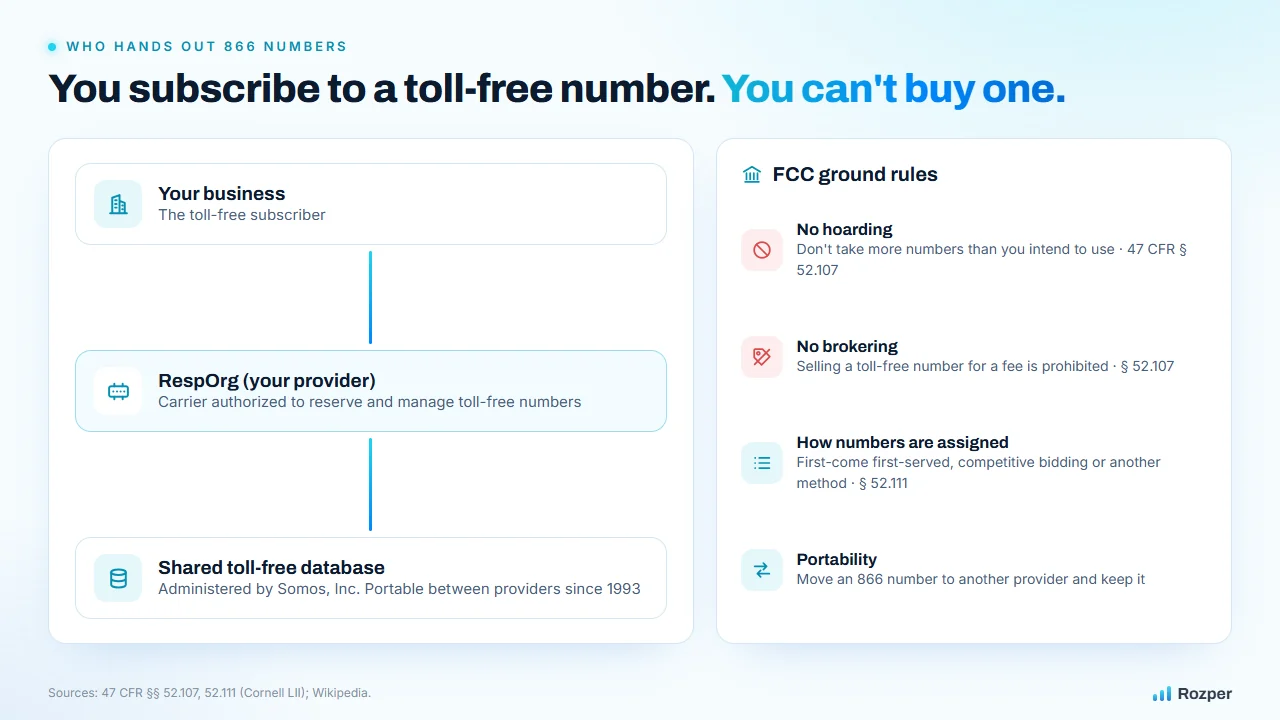
Toll-free numbers aren't sold by the phone company the way local numbers are. They're reserved through Responsible Organizations ("RespOrgs") — carriers and providers authorized to manage numbers in the shared toll-free database. That system was set up in 1993 to make toll-free numbers portable between rival carriers. The database is administered by Somos, Inc.
The FCC sets the ground rules:
- No hoarding or brokering. Under 47 CFR § 52.107, a subscriber may not acquire "more toll free numbers than the toll free subscriber intends to use," and selling a toll-free number for a fee is prohibited (47 CFR § 52.107). That's why legitimate providers won't "sell" you a toll-free number outright — you subscribe to it.
- How numbers are assigned. The FCC may assign toll-free numbers "by competitive bidding, on a first-come, first-served basis, by an alternative assignment methodology, or by a combination" (47 CFR § 52.111).
- Portability. Because the database is shared, you can move an 866 number from one RespOrg or provider to another and keep the number.
Is an 866 Call Legitimate?
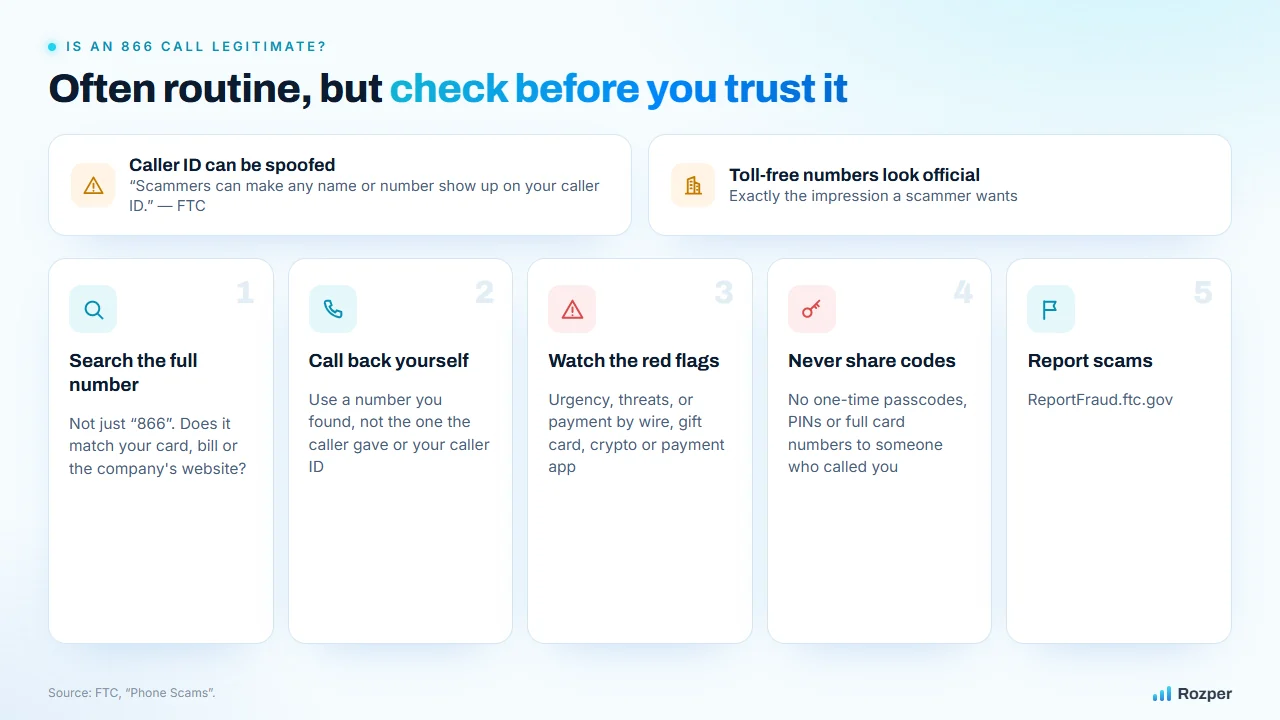
Many large companies use 866 numbers for customer service, billing and appointment reminders, so an 866 call can be perfectly routine. But two things make toll-free numbers easy to misuse:
- Caller ID can be spoofed. The FTC warns that scammers "can make any name or number show up on your caller ID" (FTC, Phone Scams). A call showing a real company's 866 number may not be from that company.
- Toll-free numbers look official. People associate them with big, established businesses, which is exactly the impression a scammer wants.
How to check an 866 call:
- Search the full number, not just "866." If it matches the number printed on your card, bill or the company's official website, that's a good sign — but still verify before sharing anything.
- Call back through a number you found yourself, not the one the caller gave you or the one on your caller ID.
- Watch the classic red flags: urgency, threats of arrest or account closure, and demands to pay by wire transfer, gift card, cryptocurrency or payment app.
- Never read out one-time passcodes, PINs or full card numbers to someone who called you.
- Report scam calls at ReportFraud.ftc.gov.
Getting an 866 Number for a Business
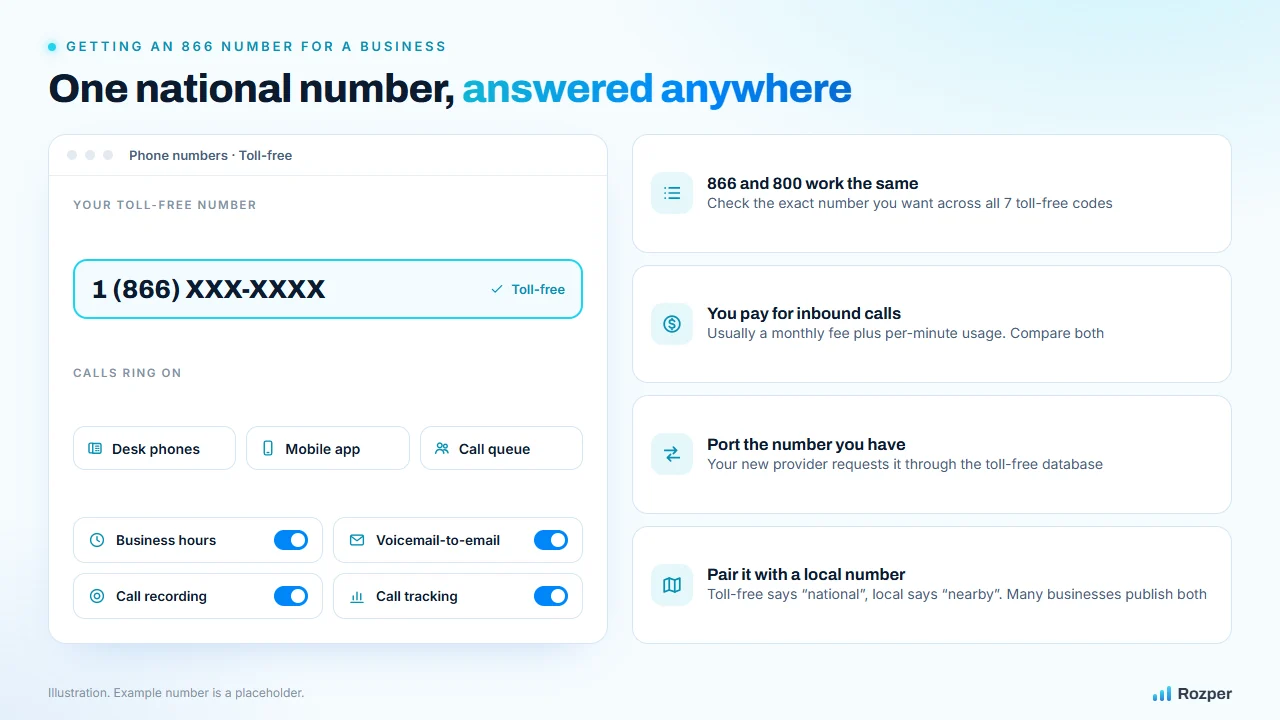
A toll-free number makes sense when your callers are spread across the country and you don't want any of them to feel they're calling long distance. What to know before you set one up:
- 866 vs 800: they work identically. 800 is the oldest and most recognizable code, and it has been handing out numbers the longest, so a specific memorable sequence may already be taken there but free in a newer code. Check the exact number you want across 800, 888, 877, 866, 855, 844 and 833.
- Vanity numbers: a number that spells a word on the keypad can be easier to remember in ads, but it's subject to the same no-brokering rules — be wary of anyone offering to sell you a toll-free number.
- Costs: you pay for inbound minutes instead of your callers. Providers typically charge a monthly fee for the number plus per-minute usage; compare both, because a busy line's usage will outweigh the monthly fee.
- Porting: if you already have a toll-free number, you can move it to a new provider instead of reprinting everything. Your new provider submits the request through the toll-free database.
- Pair it with a local number when it helps. A toll-free number signals "national"; a local number signals "nearby." Many businesses publish both.
Rozper can set up an 866 number (or move an existing one) and route it to desk phones, mobile apps or call queues, with business-hours rules, voicemail-to-email, call recording and per-campaign call tracking in the same dashboard.
Is an 866 Number Right for You?
A toll-free line tends to fit if you sell across state lines, run a central support or sales team, or advertise nationally and want one number in every ad. It's less useful if nearly all your customers are in one metro area, where a local number usually feels more personal. And because the number isn't tied to a place, you can keep it through office moves, remote work and provider changes.
FAQs
Where is the 866 area code located?
Nowhere specific. 866 is a toll-free code, not a geographic one, so an 866 number can be answered anywhere. The area code gives no clue to the caller's location.
Is it free to call an 866 number?
From a landline, yes — the number's holder pays for the call. From a mobile phone, the call may still count against your plan's minutes or airtime.
When did the 866 area code start?
The 866 toll-free code was opened on July 29, 2000, after 800, 888 and 877. It was followed by 855 (2010), 844 (2013) and 833 (2017).
Is an 866 call a scam?
Not necessarily — many legitimate companies use 866 numbers. But caller ID can be faked, so don't trust the number alone. Verify by calling the company on a number you look up yourself, and be suspicious of urgency or requests for payment by gift card, wire transfer or crypto.
What's the difference between 866 and 800?
None in how they work. Both are toll-free and reach the same kinds of businesses. 866 was opened in 2000 because 800 numbers (and then 888 and 877) were running out.
Can I move my toll-free number to a new provider?
Yes. Toll-free numbers have been portable since the RespOrg system was introduced in 1993. Your new provider requests the transfer through the shared toll-free database.
Can I buy a specific 866 number from someone?
No. FCC rules prohibit hoarding toll-free numbers and selling them for a fee (brokering). You get a toll-free number by subscribing through a provider, not by buying it from another person.