Introduction
The 641 area code covers a broad band of central Iowa, wrapping around the Des Moines metro without actually including it. Most guides describe the 641 area code as simply another rural prefix, missing both its unusual ring shape and the strange chapter that once made its exchanges among the most-dialed in the country. This guide maps the cities it reaches, explains the 2000 split that created it, sets out the dialing rules, and tells the story of how rural Iowa numbers briefly became genuinely valuable. A code defined by what it surrounds behaves differently from one built around a city.
Key Takeaways:
- The 641 area code forms a ring across central Iowa around the Des Moines metro.
- It was created in July 2000, the first area code split in Iowa since 1947.
- Seven-digit local dialing still works because no overlay was ever added.
- Its rural exchanges played a central role in the access stimulation era.
A Code Shaped Like A Ring
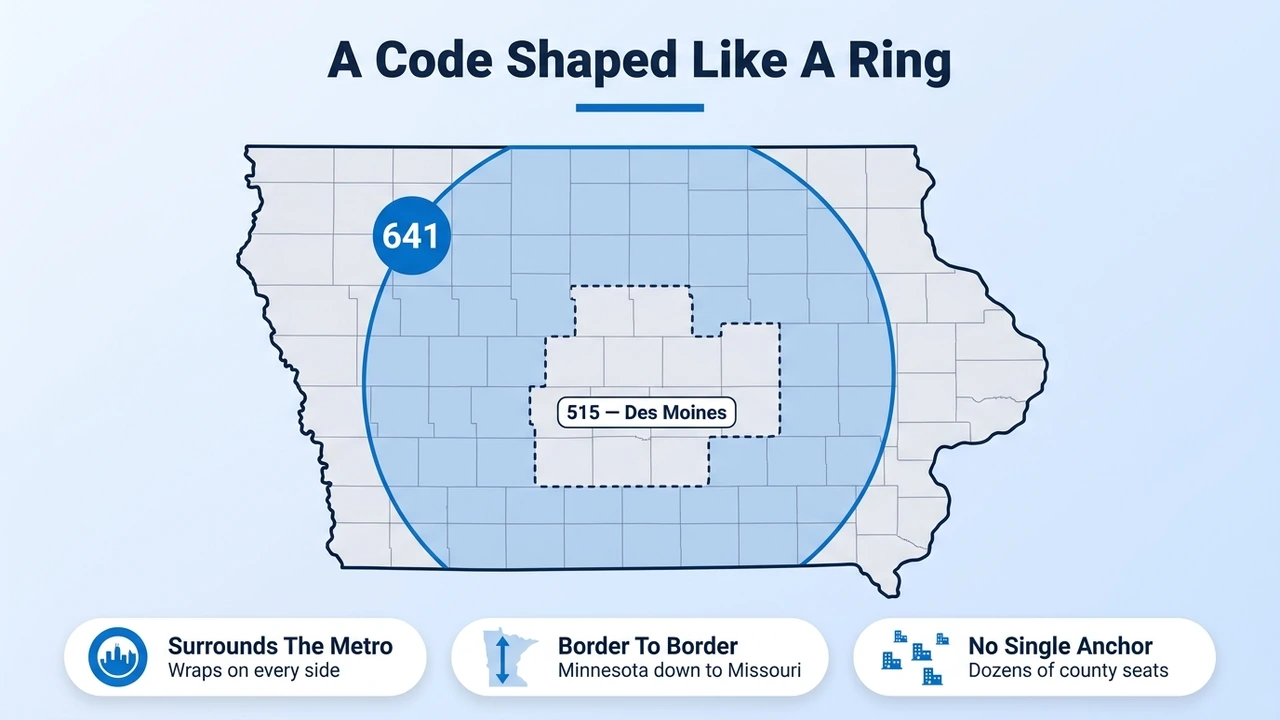
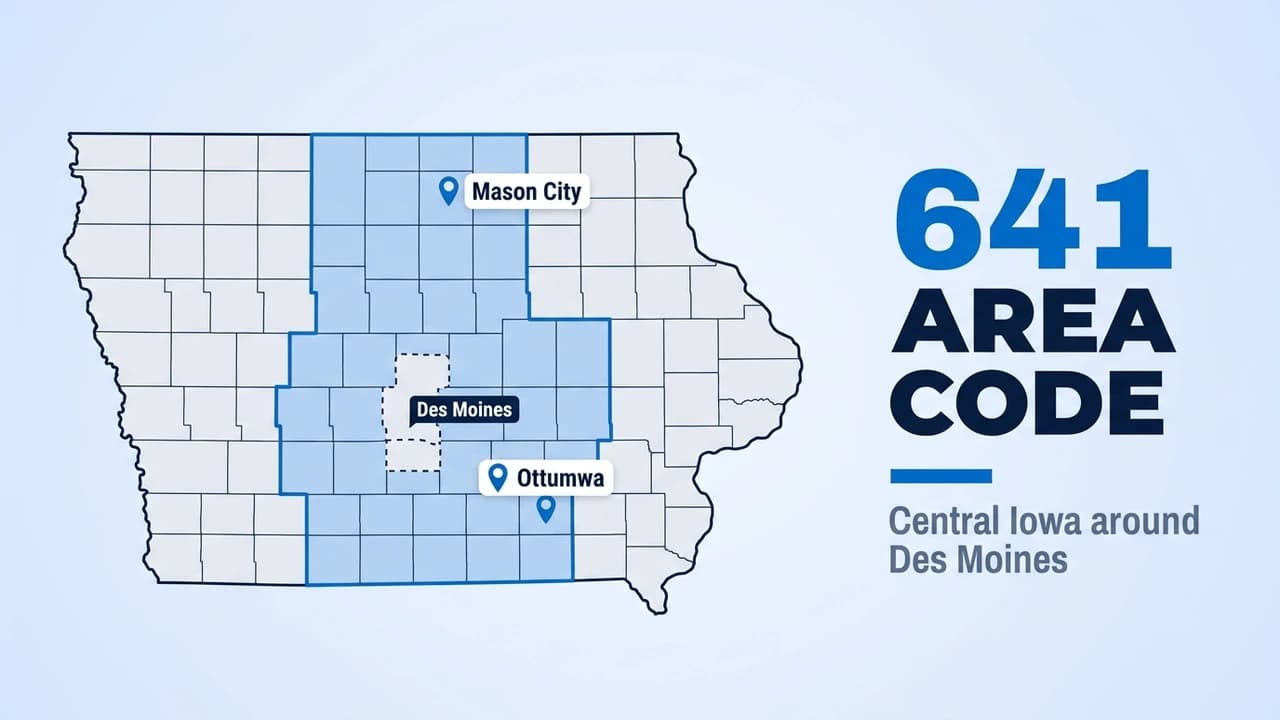
Most area codes are defined by the city sitting at their centre. The 641 area code is defined instead by the city it deliberately leaves out, which produces a shape unlike almost any other numbering plan in the Midwest. Picture a wide band of countryside with a hole punched neatly through the middle of it.
- The territory wraps north, east, south, and west around the capital region.
- Des Moines and its immediate suburbs sit inside, under a different prefix.
- Coverage reaches from the Minnesota border down to the Missouri line.
- No single dominant city anchors the region the way a metro normally would.
- The 641 area code spreads instead across dozens of small county seats.
That structure is the direct result of how the region was created. The 515 area code kept the metro core and its northern corridor, while everything surrounding it became area code 641. One code got the density, the other got the distance.
Iowa's First Split Since 1947
Iowa spent more than five decades with exactly three area codes, an unusually long run of stability by national standards. That ended in the summer of 2000, and the arrival of the 641 area code carried more significance than a simple boundary redraw. It was the moment Iowa joined the rest of the country in running out of numbers.
Fifty-three years without a change
The original three codes were drawn in 1947 and survived the entire postwar period completely untouched, through decades of population shifts and industrial change. Mobile phones, fax machines, pagers, and second household lines eventually consumed what remained of the available prefixes, and central Iowa reached its limit before the rest of the state did. On 9 July 2000 the territory finally divided, marking the first split Iowa had ever needed in fifty-three years of the numbering system.
Why a split rather than an overlay
Regulators could have layered a second code across the whole region, but that approach forces ten-digit dialing on absolutely everyone inside it. A geographic split kept dialing simple for both sides, at the cost of changing numbers for one of them. Businesses outside the metro bore that cost, reprinting signage and stationery through the changeover period. Eastern Iowa faced precisely the same choice a year later, and the 563 area code was created the same way for the same reason.
When Rural Iowa Numbers Became Valuable
Here is the chapter almost no guide to this region ever mentions. In the mid-2000s, a handful of tiny exchanges scattered across rural Iowa briefly handled call volumes wildly out of proportion to their populations, and the 641 area code sat right at the centre of it. Towns of a few hundred people were suddenly receiving millions of minutes of traffic.
- Rural carriers could charge higher fees to connect incoming long-distance calls.
- Some partnered with conference and chat services to attract enormous call volumes.
- Services advertised free conference calling and free international calling.
- The numbers routed to small Iowa towns with only a few hundred residents.
- Long-distance carriers ultimately passed those inflated costs to all customers.
Regulators called the practice access stimulation, or traffic pumping, and Wikipedia explains how those arrangements worked and why they were eventually curtailed. Rules adopted in later years shifted the financial responsibility onto the carriers benefiting from the arrangement, which largely ended the model. It remains a genuine piece of telecom history attached to these three digits, and a useful reminder that the economics behind a rural prefix have never been quite the same as those behind an urban one.
Mason City Down To Ottumwa
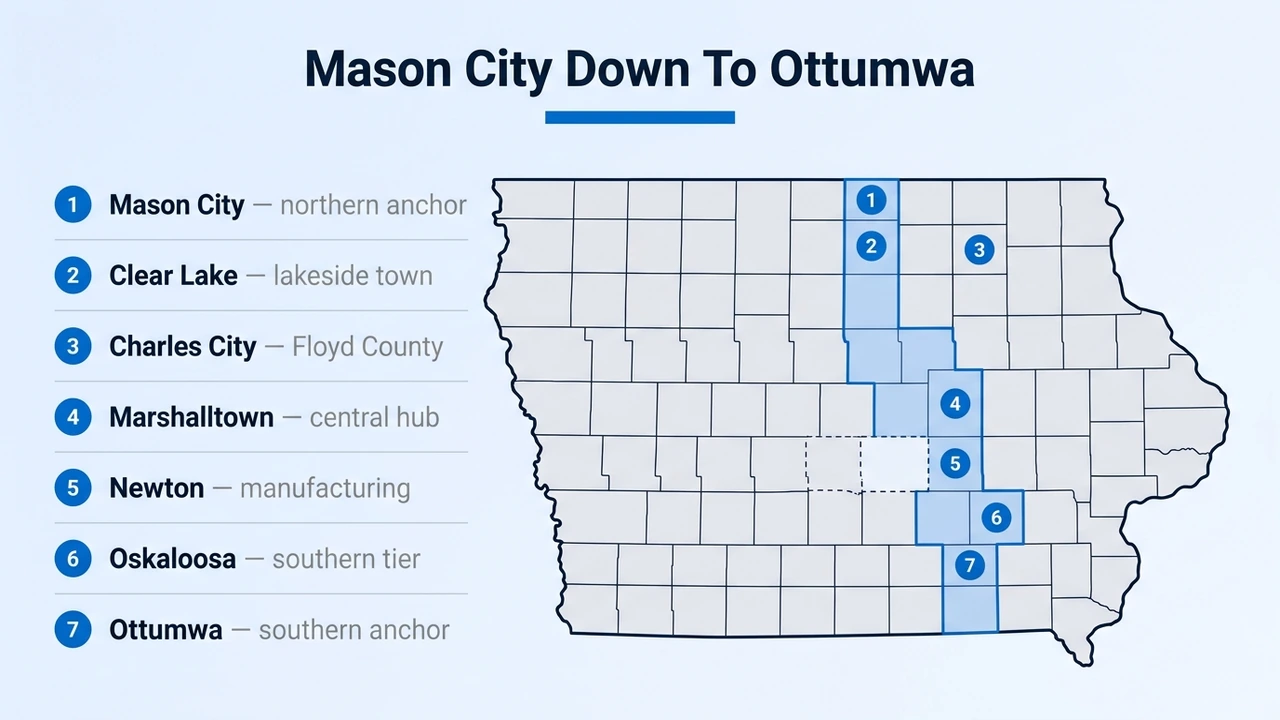
Coverage spans a wide band of central Iowa, taking in dozens of county seats and small manufacturing towns. Without a dominant metro to pull everything inward, activity across the 641 area code distributes among many modest centres rather than concentrating in a single place.
The northern band
Mason City and Clear Lake anchor the north near the Minnesota border, with Charles City, Hampton, and Iowa Falls spread across the surrounding farmland. This stretch leans heavily on agriculture, grain handling, and food processing, and its call patterns follow the seasons more closely than most regions do.
The central and southern band
Marshalltown, Newton, Grinnell, Pella, and Oskaloosa form the middle tier, several of them carrying long manufacturing histories and small private colleges. Further south, Ottumwa, Fairfield, Centerville, Chariton, and Creston cover the approach toward the Missouri line, where the towns thin out and the distances between them grow noticeably longer.
How To Dial A 641 Number
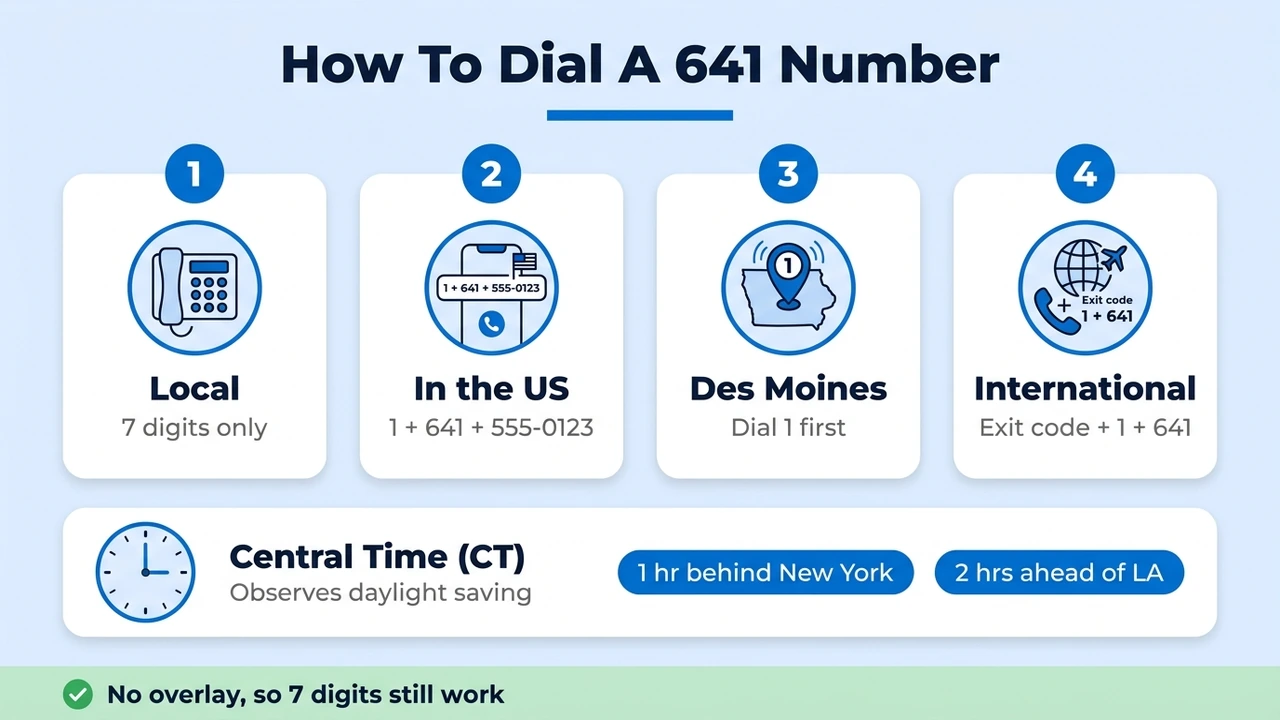
Central Iowa sits in the Central Time zone and observes daylight saving, one hour behind New York and two hours ahead of Los Angeles. Because no second code was ever layered over the 641 area code, the dialing rules here stayed straightforward while many comparable regions grew steadily more complicated.
- Calling locally inside central Iowa: seven digits alone will still complete the call.
- Calling from elsewhere in the US: dial 1, then 641, then the seven-digit number.
- Calling into Des Moines: dial 1 plus that code, since the metro is a separate region.
- Calling from abroad: dial your exit code, then country code 1, then 641, then the number.
This region was also not among the areas required to change when 988 became the national crisis lifeline, unlike some neighbouring Iowa codes. Cloud platforms such as Rozper normalize stored numbers automatically, so a contact saved in either format still connects on the first attempt.
One Number, Dozens Of Towns
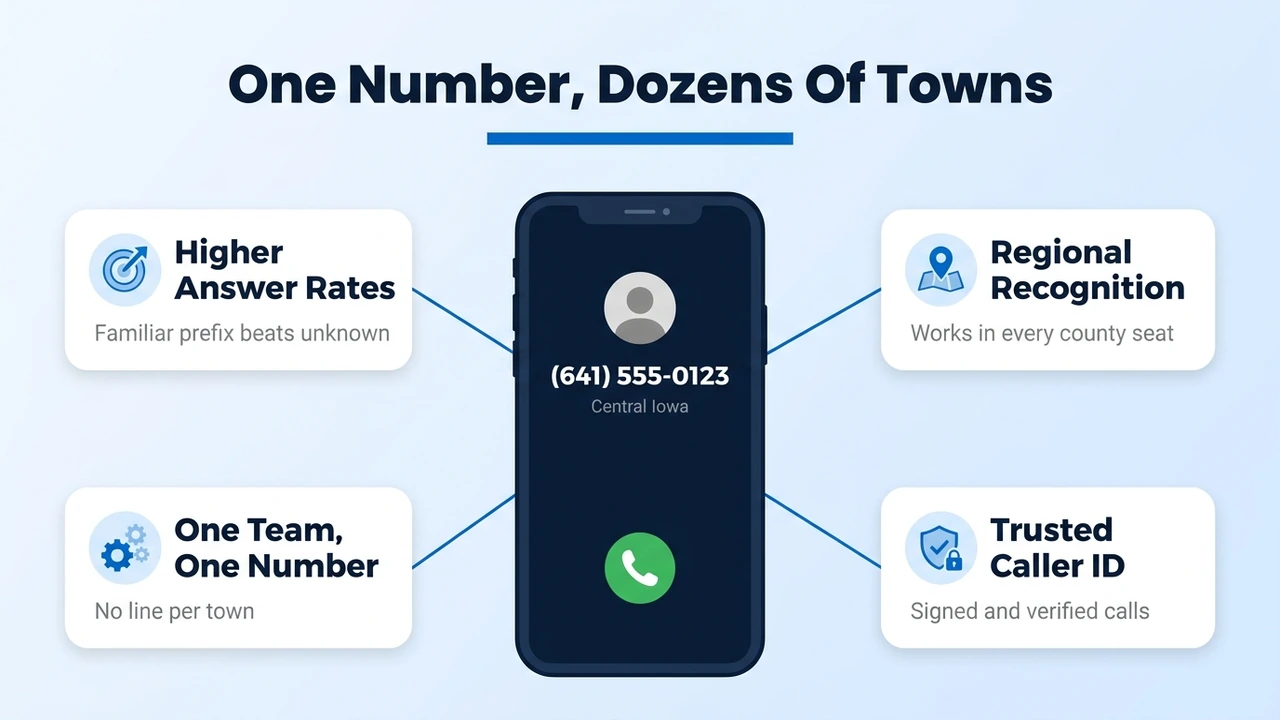
Selling into this region presents a problem that metro-focused businesses rarely have to think about. There is no single city where a local presence covers most of your market, because that market is spread across dozens of towns often separated by an hour or more of driving. A number that reads as local in Mason City means nothing in Ottumwa, two hundred miles to the south, unless the prefix is one both towns already recognise.
One number, many communities
Maintaining separate lines for every county seat fragments your identity and quietly confuses returning callers who cannot recall which number they used last time. A single prefix covering the whole ring keeps the arrangement simple for customers and staff alike, and it reads as genuinely regional rather than tied to one particular town. Rozper lets a distributed team share one central Iowa identity on every outbound call they place, wherever the person dialing happens to be sitting.
Why recognition matters more here
Small communities notice unfamiliar numbers quickly, and screening is common. A consistent, verifiable number across area code 641 Iowa signals a business that has been around rather than a call centre working a list. Rozper signs outbound traffic with carrier-level authentication so genuine calls stay trusted across the network.
Conclusion
The 641 area code covers a wide ring of central Iowa, surrounding the Des Moines metro without including it, from the Minnesota border down to the Missouri line. It was created on 9 July 2000 in Iowa's first area code split since the numbering system began in 1947. No overlay has ever been added, which is why seven-digit local dialing still works throughout area code 641 Iowa today. Add the access stimulation era and these three digits carry more history than their quiet county seats suggest.
Central Iowa will keep supporting agriculture, food processing, and small-scale manufacturing across dozens of communities for years to come. Businesses serving that spread should secure a recognizable regional number before their next round of outreach. Whether you work the northern farmland near Mason City or the southern towns around Ottumwa, the right calling setup makes a scattered market feel close. Rozper can have that presence running well before your next campaign begins.
FAQs
Where is the 641 area code located?
It covers a broad ring of central Iowa surrounding the Des Moines metro. Mason City, Marshalltown, and Ottumwa are among its largest cities.
Why does 641 surround Des Moines instead of including it?
The capital region kept the older prefix when the territory split in 2000. Everything around it became the new code.
What time zone does area code 641 use?
Central Iowa observes Central Time and follows daylight saving each year. That is one hour behind New York and two hours ahead of Los Angeles.
Can you still dial seven digits here?
Yes. No overlay was ever added to the region, so local calls still complete on seven digits alone.
When was the 641 area code created?
It was created on 9 July 2000 in a split of the older central Iowa code. That was Iowa's first split since 1947.
Which cities use this code?
Mason City, Marshalltown, Ottumwa, Newton, and Grinnell are among the largest. Pella, Oskaloosa, Fairfield, and Clear Lake round out the region.
Why were 641 numbers linked to free conference calls?
Rural carriers could charge higher fees to connect incoming calls, so some partnered with free calling services. Regulators later curtailed the practice.
Can a 641 number be spoofed by scammers?
Yes. Neighbor spoofing fakes a local caller ID, so verify unexpected callers by hanging up and dialing back on a number you looked up.