परिचय
The global VoIP market is expected to grow from $167.27 billion in 2025 to $185.34 billion in 2026 — a 10.8% jump in a single year. Behind much of that growth sits an industry most end-users never see: wholesale VoIP. Carriers, resellers, call centers, and fast-scaling businesses all rely on wholesale VoIP services to move enormous volumes of voice traffic across the internet at a fraction of traditional telephony costs. This guide covers the four services themselves — what's included, what they cost, and how to choose a provider. For the carrier-interconnection mechanics underneath them, see our guide to थोक वीओआईपी.
This guide walks through what wholesale VoIP services are, how they work behind the scenes, the measurable advantages they deliver,
and the criteria that separate a dependable provider from a risky one.
Whether you resell voice services or simply run high call volumes, understanding the wholesale layer of telecommunications puts you in a stronger position to negotiate,
scale, and compete.
Key Takeaways
- Bulk economics: Wholesale VoIP services let businesses buy voice termination, origination, and SIP capacity in volume, driving per-minute rates well below retail pricing.
- Internet-native infrastructure: Calls travel over IP networks instead of legacy circuits, removing the hardware and geographic limits of traditional phone lines.
- Built for growth: Capacity scales up or down with demand, so seasonal spikes or rapid expansion never require new physical infrastructure.
- Carrier-grade quality: Modern wholesale platforms use intelligent routing and quality monitoring to keep latency, jitter, and packet loss in check.
- Global by default: A single wholesale relationship can open calling routes to markets worldwide — Rozper, for example, offers wholesale voice, SIP trunking, and numbers from one platform.
Understanding Wholesale VoIP Services
Before evaluating providers or pricing, it helps to understand exactly what wholesale VoIP services are and how they fit into the broader telecom ecosystem.
What Are Wholesale VoIP Services?
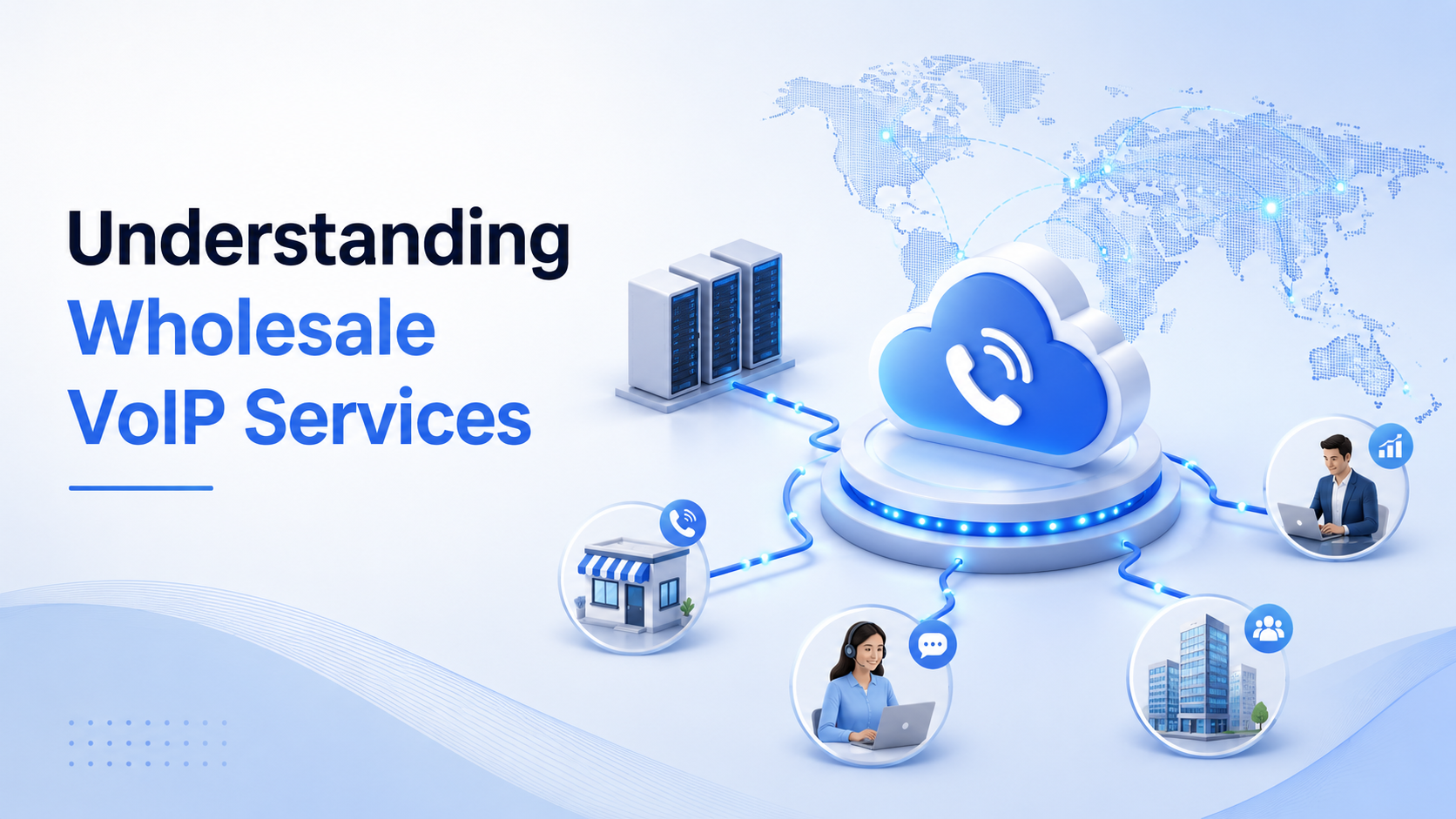
Wholesale VoIP refers to the bulk purchase and sale of voice communication services delivered over IP networks. Rather than serving individual end-users, wholesale providers supply large blocks of capacity — call minutes, SIP trunks, and phone numbers (DIDs) — to carriers, internet telephony service providers (ITSPs), resellers, BPOs, and enterprises with heavy calling needs.
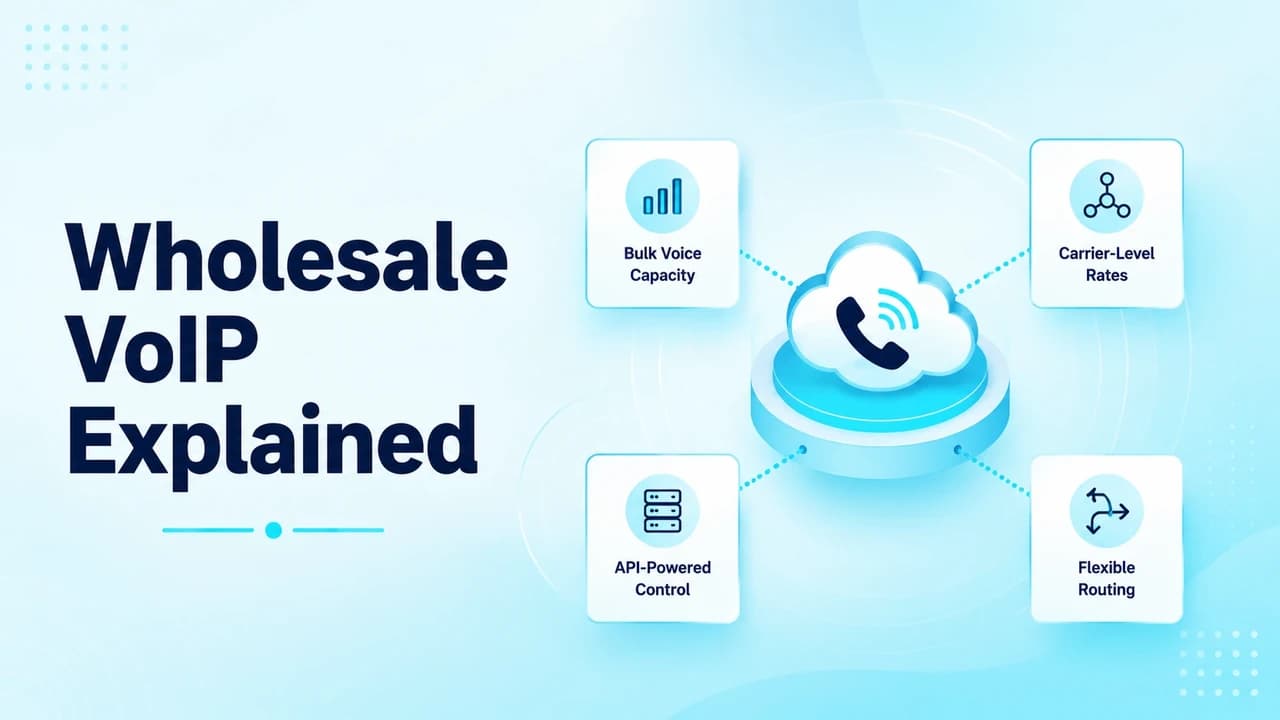
The model rests on four core service components. Voice termination carries outbound calls from an IP network to their destination worldwide, while voice origination handles inbound traffic from the PSTN into a VoIP environment.
SIP trunking connects a business PBX directly to the PSTN over the internet using SIP. Toll-free and DID number services round out the portfolio,
giving businesses local and free-to-call presence in the markets they serve.
How Wholesale VoIP Services Work
When a call is placed, the voice signal is digitized, compressed into data packets, and routed across IP networks toward its destination. A wholesale provider's switching platform examines each call and selects a route based on cost, quality metrics, and destination — a process refined continuously through least cost routing (LCR) and real-time quality scoring. For the fundamentals behind this infrastructure layer, see our guide to थोक वीओआईपी.
The wholesale layer is what makes this invisible to end-users. A reseller's customer in Chicago dials a number in Singapore; the reseller hands the call to its wholesale partner,
whose carrier interconnects complete it across one or more networks.
The entire transaction settles in fractions of a second, billed by the second or minute at wholesale rates.
Who Uses Wholesale VoIP?
The buyer landscape is broader than many assume. Telecom carriers use wholesale partners to fill coverage gaps without building new interconnects. Resellers and ITSPs build entire branded phone services on top of wholesale infrastructure. Call centers and BPOs depend on wholesale termination to keep the cost of millions of monthly minutes sustainable. And growing enterprises increasingly buy wholesale directly once their call volumes justify it. For a broader look at the service categories involved, see our guide to wholesale voice services.
Benefits of Wholesale VoIP Services
Dramatic Cost Reduction
Volume is the engine of wholesale pricing. Because providers aggregate traffic from many customers, they negotiate carrier rates no single business could reach alone — and pass much of that saving on.
Businesses moving from retail telephony to wholesale VoIP routinely cut per-minute costs significantly, especially on international routes. There is no copper to lease,
no on-site switching hardware to maintain, and no separate network to run for voice.
Elastic Scalability
Adding capacity on a wholesale VoIP platform is a configuration change, not a construction project. A business expecting a seasonal surge can provision hundreds of additional channels in hours and release them when demand subsides.
This elasticity is decisive for call centers, political campaigns, e-commerce operations, and any business whose call volume moves with the calendar.
Carrier-Grade Call Quality
Wholesale providers compete on quality metrics: answer-seizure ratio (ASR), average call duration (ACD), post-dial delay, and mean opinion score (MOS).
Serious platforms monitor these continuously and reroute traffic automatically when a route degrades. The result is voice quality that meets or exceeds legacy telephony — with far more transparency,
since buyers can see the numbers themselves.
Global Market Access
A single wholesale agreement can unlock calling to virtually every country. Instead of negotiating with dozens of regional carriers, a business plugs into one platform with established global interconnects. This is where provider footprint matters: Rozper's wholesale platform, for instance, is built to let businesses enter new markets without building new infrastructure.
Redundancy and Reliability
Mature wholesale networks are built with multiple redundant routes to every destination. If a carrier path fails, traffic shifts automatically. For businesses where a dropped sales call is lost revenue, this multi-route resilience is one of the strongest yet least discussed arguments for the wholesale model.
Key Features to Look For
Not all wholesale VoIP platforms are built the same — the right feature set determines whether a provider can actually support your traffic, scale, and compliance requirements.
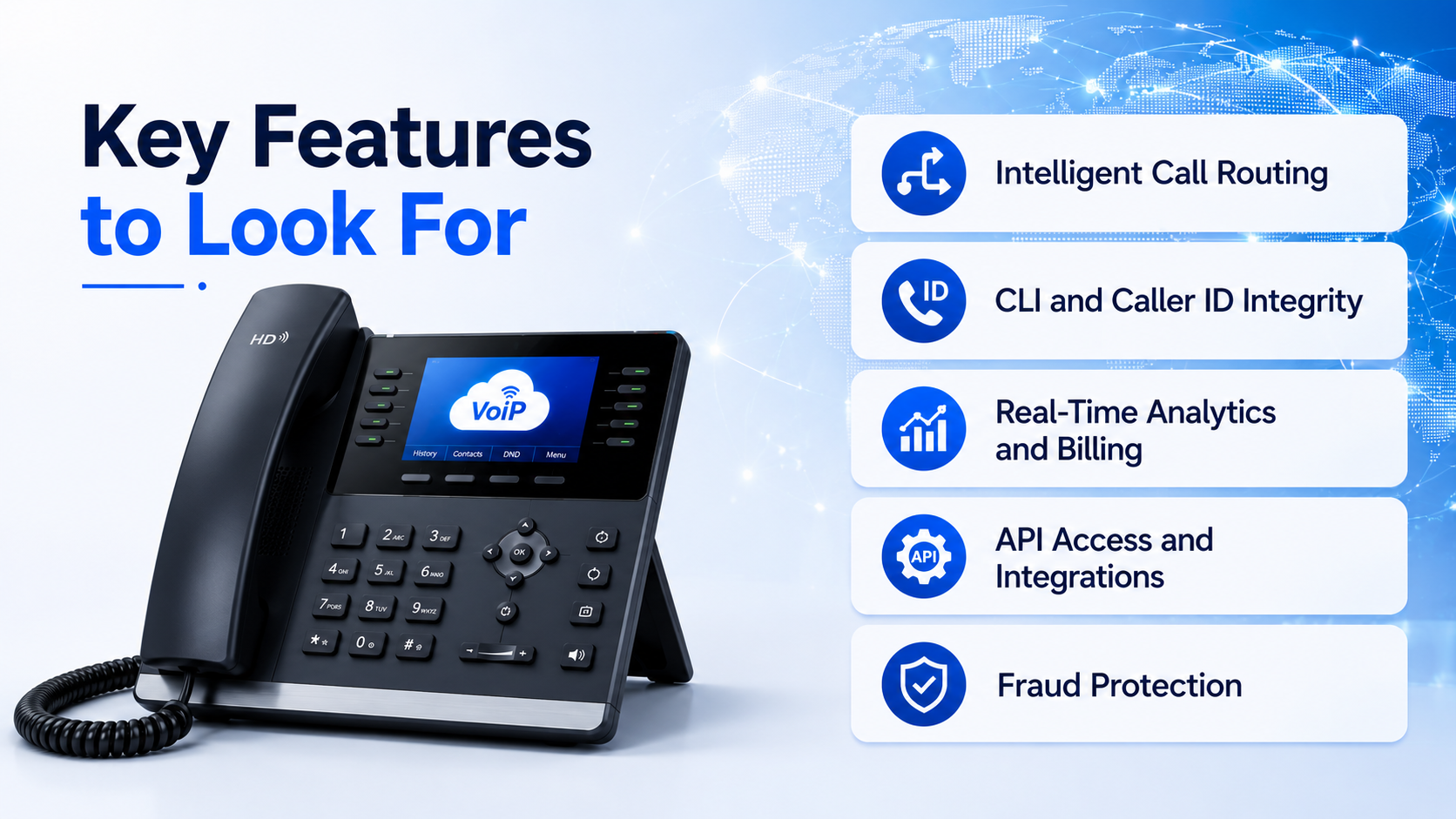
Intelligent Call Routing
Look for platforms offering both least cost routing and quality-based routing, with the ability to set rules per destination. Real-time route updates matter: international rates and route quality change daily, and static routing tables leak money and quality.
CLI and Caller ID Integrity
Reliable CLI (calling line identification) routes ensure your business number displays correctly at the destination — essential for answer rates and regulatory compliance. Ask providers directly about their CLI route guarantees; this is a frequent weak point with low-cost operators.
Real-Time Analytics and Billing
A serious wholesale platform exposes live dashboards for traffic volume, ASR, ACD, and spend, with billing increments clearly stated. Per-second billing on international routes can meaningfully reduce costs versus per-minute rounding.
API Access and Integrations
Wholesale buyers increasingly automate provisioning, number ordering, and route management through APIs. If you plan to resell or to integrate voice into your own software, API depth should be a primary evaluation criterion, not an afterthought.
Fraud Protection
Toll fraud costs the telecom industry billions annually. Look for velocity limits, destination blocking, real-time spend alerts, and anomaly detection built into the platform rather than bolted on.
How to Choose a Wholesale VoIP Provider
The right wholesale VoIP partner is a long-term infrastructure decision — use these five criteria to evaluate every provider before you commit. For a reusable scoring sheet you can hand to every candidate, see our wholesale VoIP provider checklist: 25 questions and a weighted scorecard.
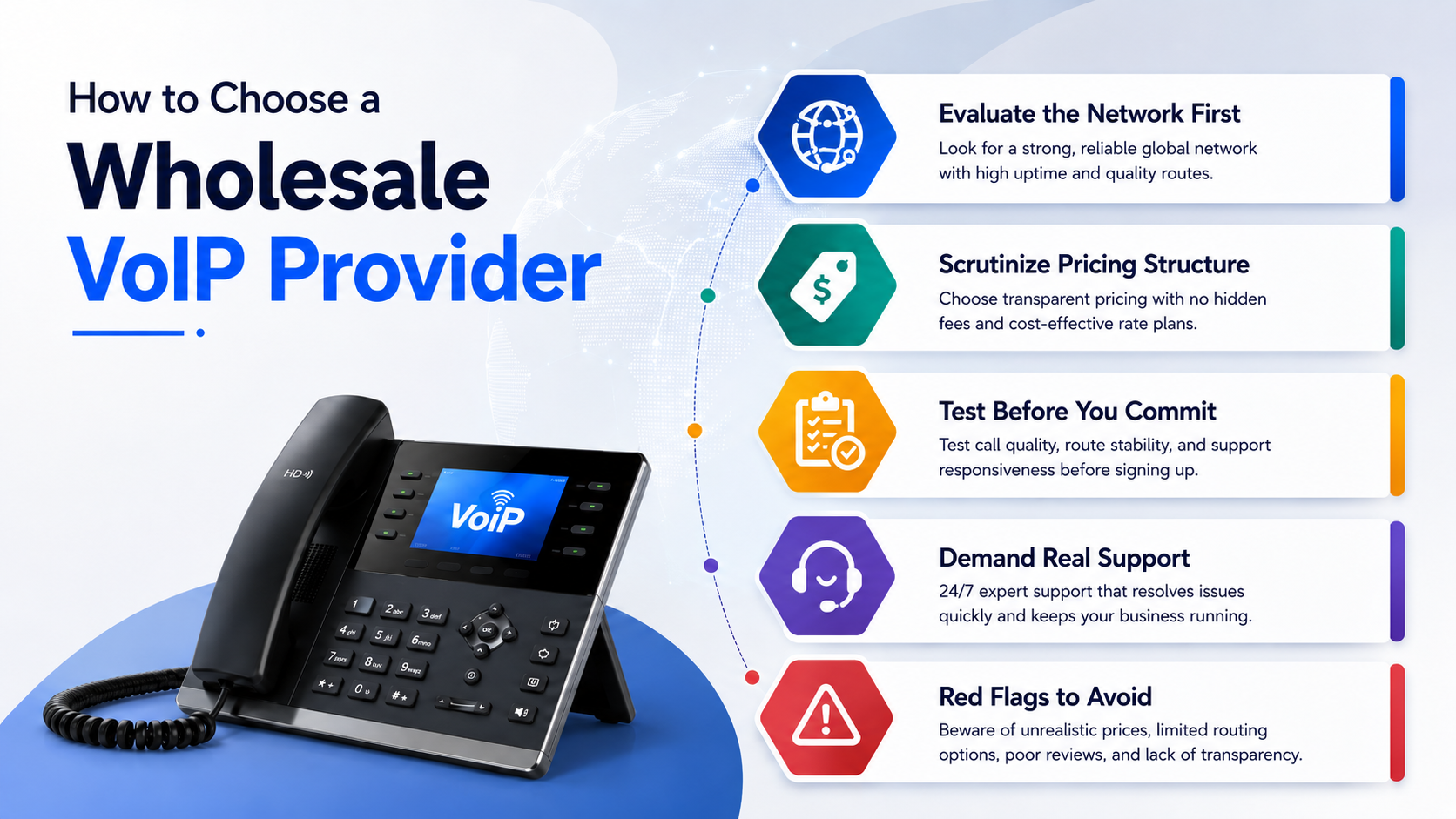
Evaluate the Network First
Request the provider's coverage map, interconnect list, and uptime history. A provider claiming global reach should be able to show direct routes — not just resold capacity — on your key destinations. Verify redundancy: how many routes exist to your top ten calling destinations?
Scrutinize Pricing Structure
Compare rate decks line by line on the destinations that matter to you, not headline rates. Confirm billing increments, minimum commitments, and what happens to your rate when volumes change. Transparent providers publish or share full rate decks willingly; hesitation here is a warning sign.
Test Before You Commit
Run a proof of concept with real traffic. Measure ASR, ACD, post-dial delay, and CLI delivery on your actual routes for at least two weeks. The gap between a sales deck and live performance is where wholesale relationships succeed or fail.
Demand Real Support
Voice problems happen at 2 a.m. Confirm that support is 24/7, staffed by engineers who can read SIP traces, and bound by a written SLA with response times — then ask each candidate provider who actually answers when a route fails.
Rozper is one option worth considering here, with a single platform that can serve both your local operations and your international reach.
Red Flags to Avoid
Be cautious with providers showing rates dramatically below market (often grey routes that damage CLI and answer rates), vague answers about interconnects, no test account option, or contracts with aggressive minimums before any live traffic. A provider unwilling to be measured is telling you something.
Wholesale VoIP Trends Shaping 2026
The wholesale voice landscape is shifting fast — here are the four forces defining competitive advantage in 2026.

AI-Driven Routing and Analytics
Machine learning now selects routes based on predicted quality, not just historical averages. Nearly 58% of VoIP providers have integrated AI-driven analytics into their platforms, using it for fraud detection, traffic forecasting, and automated quality management.
STIR/SHAKEN and Caller Trust
Regulatory pressure on call authentication continues to tighten globally, with the STIR/SHAKEN rules setting the baseline in the US market. Wholesale providers that handle attestation properly protect their customers' answer rates; those that don't are increasingly filtered as spam. Ask any prospective provider how they handle call authentication on your key routes.
The Wholesale Voice Market Keeps Growing
The wholesale voice carrier market is projected at roughly $44.5 billion in 2026, on track to reach $73.6 billion by 2031 at a 10.58% CAGR. Growth is concentrated among providers offering bundled services — voice plus messaging, numbers, and APIs — rather than minutes alone.
Convergence with CPaaS
The line between wholesale voice and communications-platform-as-a-service is blurring. Buyers increasingly expect one provider to deliver termination, SIP trunking, DIDs, and programmable APIs under one contract and one dashboard.
Wholesale vs. Retail VoIP: Which Do You Need?
Retail VoIP serves end-users with standardized plans, simple pricing, and limited customization — the right fit for small teams with modest call volumes. Wholesale VoIP serves businesses that need volume economics, route control, custom configurations, and API access.
The practical threshold: if your business spends enough on voice that per-minute rates materially affect your margins, or if you resell communication services in any form, you belong in the wholesale conversation. If voice is a minor utility cost, retail simplicity wins.
Pricing Models and Cost Optimization
Wholesale VoIP pricing typically follows one of four models. Per-minute (or per-second) pricing bills actual usage and suits variable traffic. Tiered pricing lowers rates as volume rises. Flat-rate channel pricing fixes monthly cost per concurrent call path, which suits predictable, heavy traffic. Custom contracts blend these for large or unusual traffic profiles.
To optimize spend: consolidate traffic with fewer providers to hit volume tiers faster, insist on per-second billing for international routes, review your destination mix quarterly against current rate decks, and monitor short-duration calls — they often signal quality or fraud issues inflating your bill.
निष्कर्ष
Wholesale VoIP services have become the invisible backbone of modern business communication — the layer that determines what calls cost, how they sound, and how far a business can reach. The fundamentals are clear: volume pricing that retail can't touch, elasticity that physical infrastructure can't match, and global coverage through a single relationship.
The differentiator is no longer whether to use wholesale VoIP, but which partner to trust with your traffic. Measure providers on network evidence, pricing transparency, live test results, and the quality of their human support. Get those four things right and voice shifts from a cost center to a competitive lever.
See how Rozper handles wholesale voice traffic at rozper.com/wholesale-voip.
पूछे जाने वाले प्रश्न
How is wholesale VoIP different from a regular business phone plan?
A business phone plan is a retail product: fixed features, per-user pricing, and no route control. Wholesale VoIP sells raw capacity — minutes,
trunks, and numbers — in bulk at rates tied to volume.
It gives you control over routing, billing increments, and configuration that retail plans never expose, in exchange for managing more of the setup yourself or through a reseller.
What volume do I need before wholesale VoIP makes sense?
There's no universal threshold, but businesses typically benefit once voice spend reaches a level where per-minute rates affect margins — commonly tens of thousands of minutes per month. Resellers and call centers benefit at almost any scale because wholesale rates are the foundation of their unit economics.
Can I resell wholesale VoIP services under my own brand?
Yes — this is one of the most common wholesale use cases. Providers supply white-label termination, origination, DIDs, and often billing tools, while you own the customer relationship and set your own pricing. Margins depend on the wholesale rates you negotiate and the value-added services you bundle on top.
What quality metrics should I track on a wholesale route?
The four core metrics are ASR (answer-seizure ratio, the percentage of attempts that connect), ACD (average call duration), PDD (post-dial delay), and MOS (mean opinion score for audio quality). A healthy route typically shows ASR above 50–60% on good destinations, ACD over 3 minutes, and PDD under 5 seconds.
How do wholesale providers keep international rates so low?
Scale and routing intelligence. Providers aggregate traffic from hundreds of customers, negotiate direct interconnects with destination carriers, and use least cost routing to select the cheapest acceptable-quality path for every call in real time. The savings come from volume leverage, not corner-cutting — though with low-quality providers, corner-cutting is exactly the risk to watch for.
Is wholesale VoIP secure enough for regulated industries?
Reputable wholesale platforms support TLS/SRTP encryption for signaling and media, fraud monitoring, and compliance frameworks relevant to voice traffic. Regulated businesses should confirm encryption support, data handling policies, and call authentication (STIR/SHAKEN) practices during provider evaluation rather than assuming them. Our guide to wholesale VoIP termination covers these controls in more detail.
What happens to my service if a wholesale route goes down?
On a well-architected platform, nothing visible: traffic fails over automatically to redundant routes. This is why route redundancy and uptime history matter so much in provider selection — a provider with a single carrier path to a destination has a single point of failure, whatever their advertised uptime.