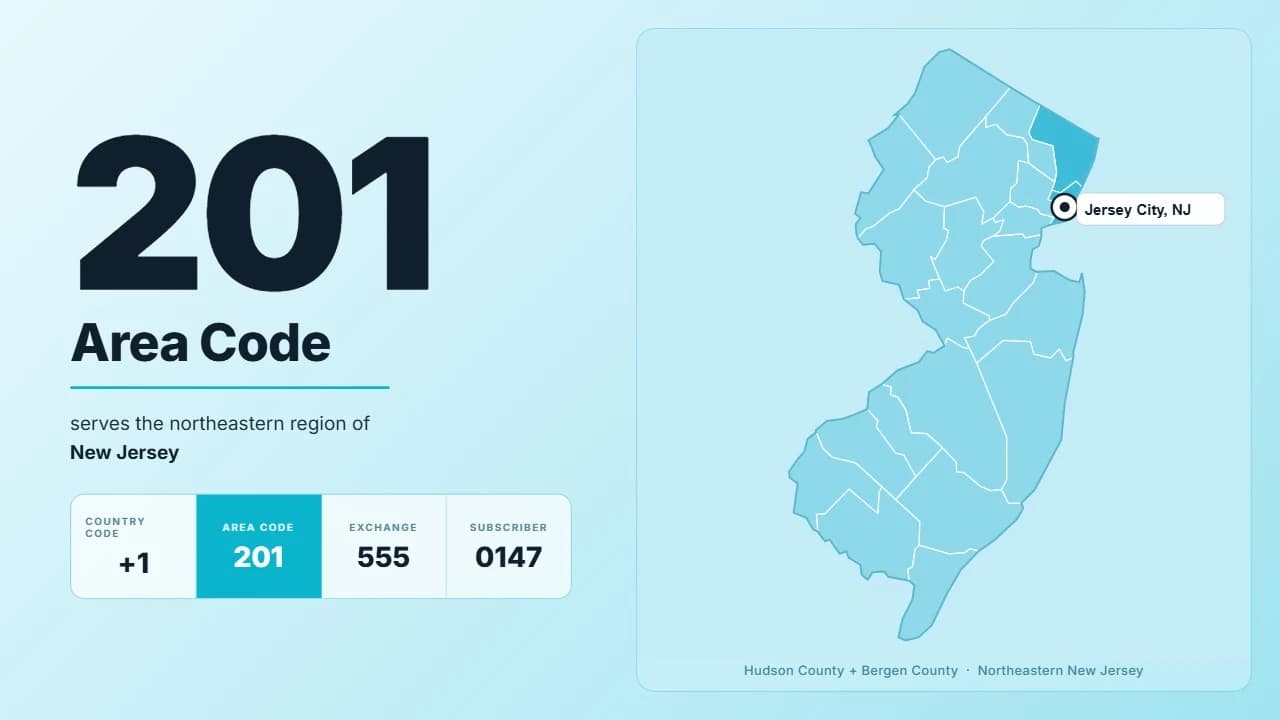
Introduzione
Immaginate una società di servizi finanziari di Jersey City che chiama un cliente di Manhattan. L'ID chiamante mostra un prefisso locale del New Jersey e, prima ancora che venga pronunciata una parola, il cliente sa già che l'attività è locale: qualcuno che capisce il mercato perché lavora alla sua ombra.
Questo è ciò che Prefisso 201 fa per le aziende nel nord-est del New Jersey: segnala vicinanza, credibilità e comunità prima ancora che la chiamata venga effettuata.
Dato che solo il fiume Hudson separa questa regione da alcune delle relazioni commerciali più preziose del mondo, un prefisso locale è una dichiarazione di posizionamento,
non solo un dettaglio telefonico.
Questa guida copre la copertura geografica del prefisso 201, l'overlay 551 che ne ha ampliato la capacità (una soluzione adottata dal New Jersey in modo molto simile all'approccio overlay dietro il prefisso 315 nel centro di New York),
i requisiti di composizione, la consapevolezza delle truffe, l'economia regionale e come ottenere un numero aziendale 201 che apre le porte nel nord-est del New Jersey.
Qual è il prefisso 201?
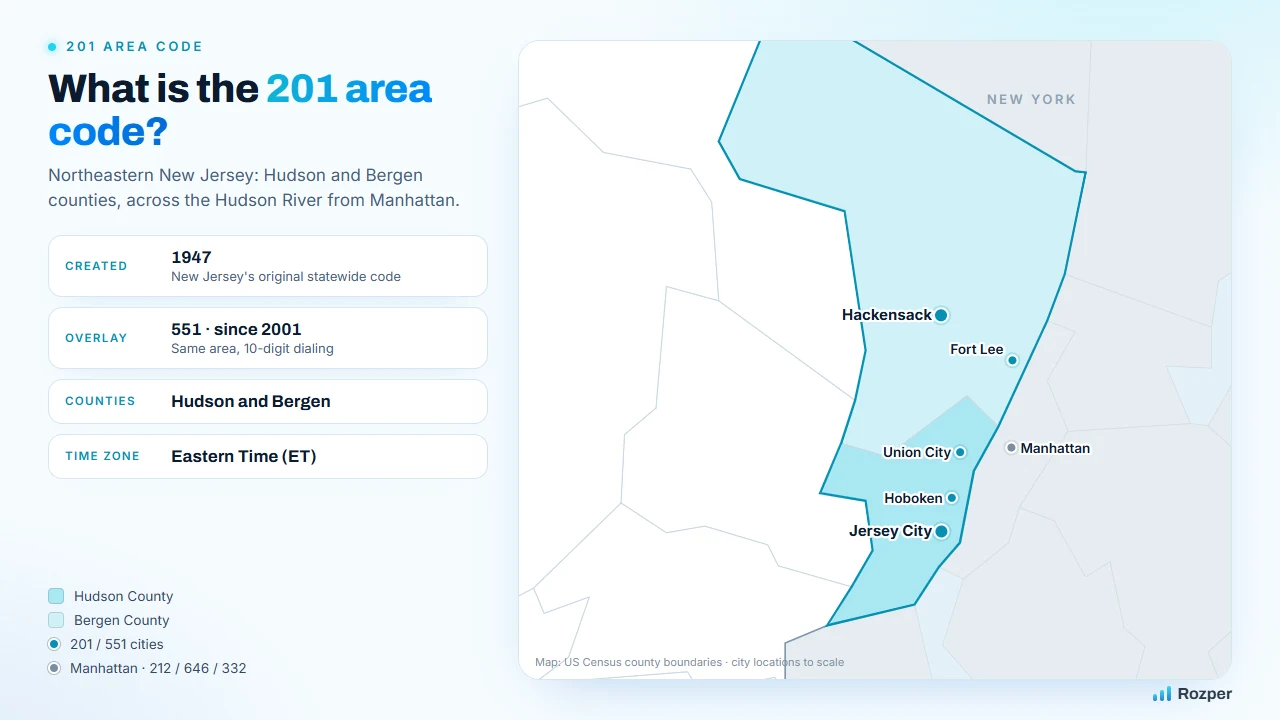
IL Prefisso 201 è uno dei codici telefonici storicamente più significativi negli Stati Uniti. Era il prefisso originale dell'intero stato del New Jersey, stabilito nel 1947 quando fu introdotto per la prima volta il Piano di numerazione nordamericano (NANP).
Dopo decenni di divisioni e riallineamenti, ora serve la punta nord-orientale dello stato: la contea di Hudson e la maggior parte della contea di Bergen,
al confine con New York City direttamente attraverso il fiume Hudson.
Fatti in breve:
| Dettaglio | Informazioni |
|---|---|
| Prefissi USA | 201 |
| Codice di sovrapposizione | 551 (aggiunto il 1 dicembre 2001) |
| Stato | New Jersey |
| Regione | Contea di Hudson, contea di Bergen (NE New Jersey) |
| Fuso orario | Ora di New York (ET) — UTC−5/UTC−4 |
| Composizione | Obbligatorio 10 cifre (da dicembre 2001) |
| Stabilito | 1947 (codice originale in tutto lo stato del New Jersey) |
| Divisioni chiave | 908 (1991), 973 (1997) |
| Codici adiacenti | 973 (Essex/Passaic), Prefisso 732 (NJ centrale), 212/646 (Manhattan) |
Il prefisso 201 copre le comunità più direttamente collegate a Manhattan - con accesso al treno PATH e chiare linee di vista dello skyline di New York - conferendogli un'identità commerciale distinta tra i prefissi del New Jersey.
Dove copre il codice 201?
Il codice 201 copre l'angolo nord-orientale del New Jersey, comprendendo l'intera contea di Hudson e gran parte della contea di Bergen, due delle contee economicamente più attive dello stato.
Contea di Hudson
La contea di Hudson è il cuore economico della regione 201. Contiene alcuni degli immobili commerciali e residenziali in più rapido sviluppo dell'intero Nordest, grazie in gran parte al suo accesso diretto a Manhattan.
Jersey City è la città più grande della zona 201 e uno dei centri finanziari e tecnologici in più rapida crescita del paese.
Il suo quartiere sul lungomare, Wall Street West, ospita importanti operazioni per Goldman Sachs, JPMorgan Chase e Citigroup. Il settore tecnologico sta crescendo a un tasso previsto del 25%,
con la domanda di sviluppatori e analisti di dati che supera l’offerta locale.
Hoboken si trova direttamente di fronte all'Hudson da Midtown Manhattan ed è accessibile tramite il treno PATH in meno di 10 minuti.
Ospita lo Stevens Institute of Technology e l’acceleratore fintech NJ FAST, un programma sostenuto dallo stato che ha formato gruppi di startup fintech e IA,
raccogliendo collettivamente decine di milioni di capitale di rischio.
Bayona completa la copertura 201 della contea di Hudson con un'economia industriale e logistica in crescita, sostenuta dalla sua vicinanza a Port Newark e Port Elizabeth, il complesso portuale più trafficato della costa orientale.
Secaucus ospita un importante centro di vendita al dettaglio e distribuzione, compreso uno dei più grandi complessi di outlet nel nord-est, nonché importanti operazioni di magazzinaggio e logistica.
Weehawken, New York occidentale e Union City estendere l'impronta 201 lungo il litorale dell'Hudson con una fitta attività residenziale e commerciale.
Contea di Bergen
La contea di Bergen è la contea più popolosa del New Jersey e una delle contee più ricche della costa orientale. Il codice 201 copre la maggior parte delle sue comunità.
Hackensack è la sede e il centro commerciale della contea di Bergen. Ospita importanti studi legali, strutture sanitarie, uffici governativi della contea e un mercato in crescita degli uffici aziendali.
Englewood è una comunità diversificata e commercialmente attiva con forti settori della sanità, della vendita al dettaglio e dei servizi professionali.
Forte Lee si trova ai piedi del George Washington Bridge - il ponte più trafficato del mondo per volume di traffico - rendendolo una delle comunità commerciali più strategicamente posizionate dell'intera regione.
Paramus è il centro commerciale della contea di Bergen, sede di una delle più alte concentrazioni di grandi centri commerciali per miglio quadrato negli Stati Uniti.
Teaneck, Fair Lawn, Garfield, Lodi e Saddle Brook aggiungere profondità residenziale e commerciale leggero all'impronta della contea di Bergen, servendo grandi popolazioni professionali che si spostano a Manhattan o lavorano localmente nel settore finanziario, sanitario e dell'istruzione.
Storia del prefisso 201
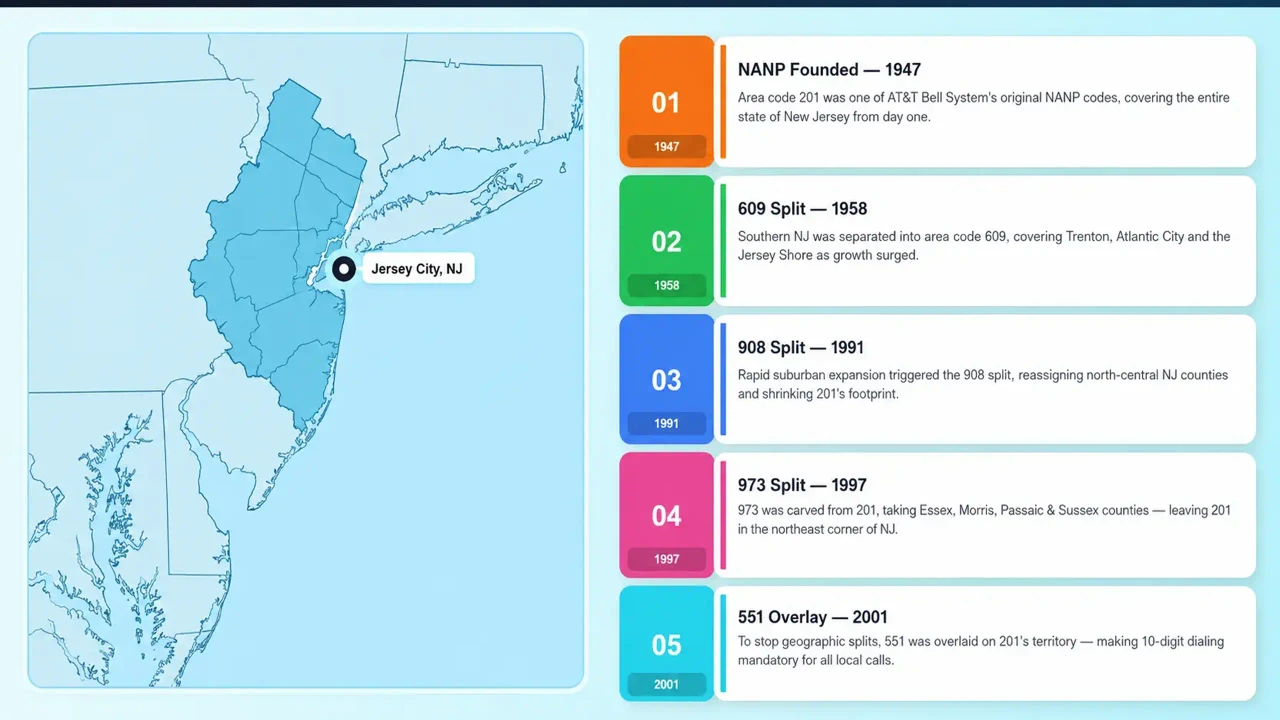
IL Prefisso 201 detiene una distinzione unica: è stato il primo prefisso assegnato al New Jersey, e ha servito lo stato in qualche modo da quando il NANP è stato lanciato nel 1947. A quel tempo, il codice 201 copriva l’intero stato: ogni città, sobborgo e comunità rurale del New Jersey.
Per decenni, il prefisso 201 ha servito tutto il New Jersey prima di essere progressivamente perfezionato attraverso una serie di suddivisioni man mano che la popolazione e la domanda telefonica aumentavano.
All’inizio degli anni 2000, la proliferazione dei dispositivi mobili e la crescita di nuove linee di business stavano spingendo l’offerta rimanente verso l’esaurimento.
Ognuna di queste divisioni e sovrapposizioni è stata eseguita sotto il amministrazione della numerazione quadro che regola il modo in cui i prefissi vengono assegnati a livello nazionale.
La scissione del 1991: 908 creati
SU 8 giugno 1991, le regioni meridionali e centrali dello stato furono ritagliate per formare il Prefisso 908, lasciando il 201 per coprire il New Jersey settentrionale.
La scissione del 1997: 973 creati
SU 1 giugno 1997, la contea di Essex (sede di Newark) e le contee di Passaic, Morris e Sussex furono riassegnate al nuovo Prefisso 973, riducendo 201 alla sua impronta attuale nelle contee di Hudson e Bergen.
2001: La sovrapposizione 551
Verso la fine degli anni ’90, la crescita combinata di dispositivi mobili, fax e nuove linee di business stava esaurendo il restante pool di 201 numeri. Piuttosto che dividere il territorio, in modo simile all'approccio di sovrapposizione utilizzato da Prefisso 315 nel centro di New York - Verizon ha invece fatto pressioni per una sovrapposizione.
IL Prefisso 551 è stato introdotto il 1 dicembre 2001, come la prima sovrapposizione nella storia del New Jersey. Sia 201 che 551 servono lo stesso territorio geografico delle contee di Hudson e Bergen. I 201 abbonati esistenti hanno mantenuto il proprio numero; i nuovi abbonati entrati nel mercato hanno ricevuto 551 numerazioni.
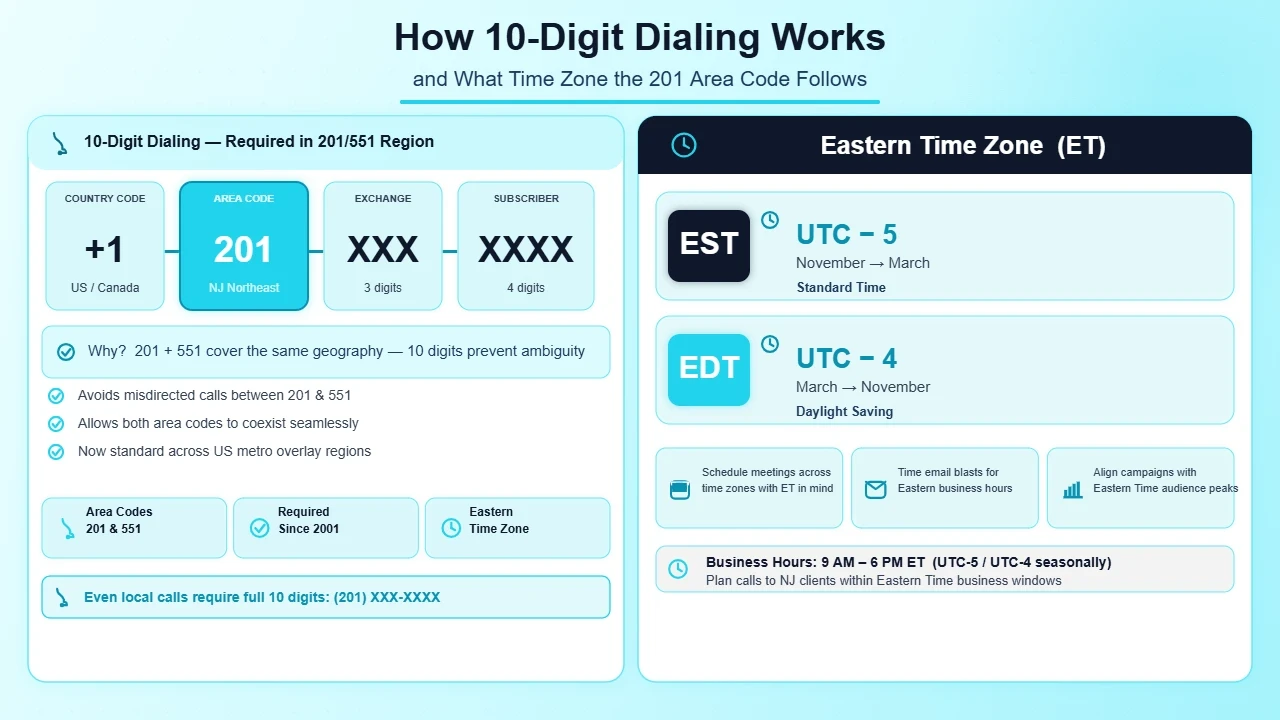
Una conseguenza chiave: composizione obbligatoria a 10 cifre per tutte le chiamate locali. Comporre solo un numero di 7 cifre non collega più: ogni chiamata, comprese quelle a un vicino nell'isolato successivo, richiede il prefisso completo del prefisso.
201 Fuso orario prefisso
Questa regione opera nel Fuso orario orientale (ET) — lo stesso fuso orario di New York City:
- Orario standard orientale (EST): UTC−5: osservato da inizio novembre a metà marzo
- Ora legale orientale (EDT): UTC−4: osservato da metà marzo a inizio novembre
Guida alle chiamate tra fusi orari
Da/per la costa occidentale (PT): L'orario del Pacifico è 3 ore indietro rispetto all'orario orientale. Una chiamata alle 9:00 ET raggiunge un contatto di Los Angeles alle 6:00 PT: troppo presto per gli affari. Pianifica le chiamate della costa occidentale per la zona 201 dopo mezzogiorno ET (9:00 PT) per gli orari lavorativi reciproci.
Da/per il Midwest (CT): L'orario centrale è 1 ora indietro rispetto all'orario orientale. Una chiamata alle 10:00 CT raggiunge la zona 201 alle 11:00 ET: coordinamento facile.
Da/per il fuso orario della montagna (MT): Nella maggior parte dei casi MT è 2 ore indietro rispetto a ET. Tieni presente che l'Arizona (esclusa la Navajo Nation) non osserva l'ora legale, che può creare un intervallo di 3 ore durante i periodi di ora legale.
Chiamate internazionali al 201: Dal Regno Unito, comporre 00 + 1 + 201 + numero a 7 cifre. Dall'Australia comporre 0011 + 1 + 201 + numero a 7 cifre. Su dispositivi mobili in tutto il mondo: +1-201-XXX-XXXX.
Poiché 201 condivide il fuso orario orientale con Manhattan, le aziende che gestiscono rapporti con clienti nell'intero Hudson non devono affrontare modifiche del fuso orario. Un numero 201 si integra perfettamente con il flusso di lavoro aziendale di New York City.
Una chiamata 201 è una truffa?
Il prefisso 201 è del tutto legittimo: serve residenti e aziende reali nelle contee di Hudson e Bergen. Tuttavia, l’elevato riconoscimento del codice in uno dei corridoi economicamente più attivi della costa orientale lo rende un obiettivo attraente per spoofing dell'ID chiamante, dove i truffatori falsificano il numero visualizzato per farlo apparire locale.
Due modelli di truffa sono particolarmente ben documentati nella regione 201:
Truffe sulla conformità OSHA
Questo è uno dei tipi di truffa più segnalati contro le aziende del New Jersey. I chiamanti che utilizzano nomi come "Kevin Adams" lasciano messaggi vocali urgenti in cui affermano che un'azienda non è conforme all'OSHA,
falsificando i numeri locali ma indirizzando le richiamate altrove.
Una volta coinvolti, promuovono corsi di formazione sulla sicurezza o servizi di consulenza non necessari senza alcuna legittimazione normativa.
La vera applicazione dell'OSHA contatta le aziende per iscritto, non per telefono.
Frode nel cambio di società di servizi pubblici
Questa truffa prende di mira specificamente i consumatori e le aziende del New Jersey spacciandosi per PSE&G (servizio pubblico di elettricità e gas) o Elizabethtown Gas.
I chiamanti affermano di dover "rivedere le spese di fornitura" e chiedere al destinatario di avere la fattura pronta. Una volta che il chiamante ottiene il numero di conto,
cambia il fornitore di energia del cliente con un fornitore terzo con tariffe notevolmente più elevate, senza il consenso informato del cliente.
Spoofing del vicino
I truffatori utilizzano anche il neighbor spoofing, ovvero la visualizzazione di un numero 201 che condivide il tuo stesso prefisso, per aumentare la probabilità di una risposta. Se una chiamata da un numero locale sconosciuto non lascia alcun messaggio vocale e corrisponde molto fedelmente al tuo prefisso, è probabile che si tratti di spoofing.
Come rimanere protetti
- Riattacca qualsiasi chiamante che lamenta violazioni urgenti dell'OSHA o della conformità senza preavviso scritto.
- Non fornire numeri di conto a chiunque affermi di essere il tuo fornitore di servizi durante una chiamata non richiesta.
- Utilizza una ricerca inversa del telefono per controllare i numeri sconosciuti prima di rispondere alle chiamate.
- Ne beneficiano le aziende che gestiscono le linee 201 legittime Compatibile con AGITARE/AGITARE Provider VoIP: questo framework verifica i dati dell'ID chiamante a livello di operatore e riduce l'efficacia dello spoofing.
L'economia del 201: cosa guida il nord-est del New Jersey
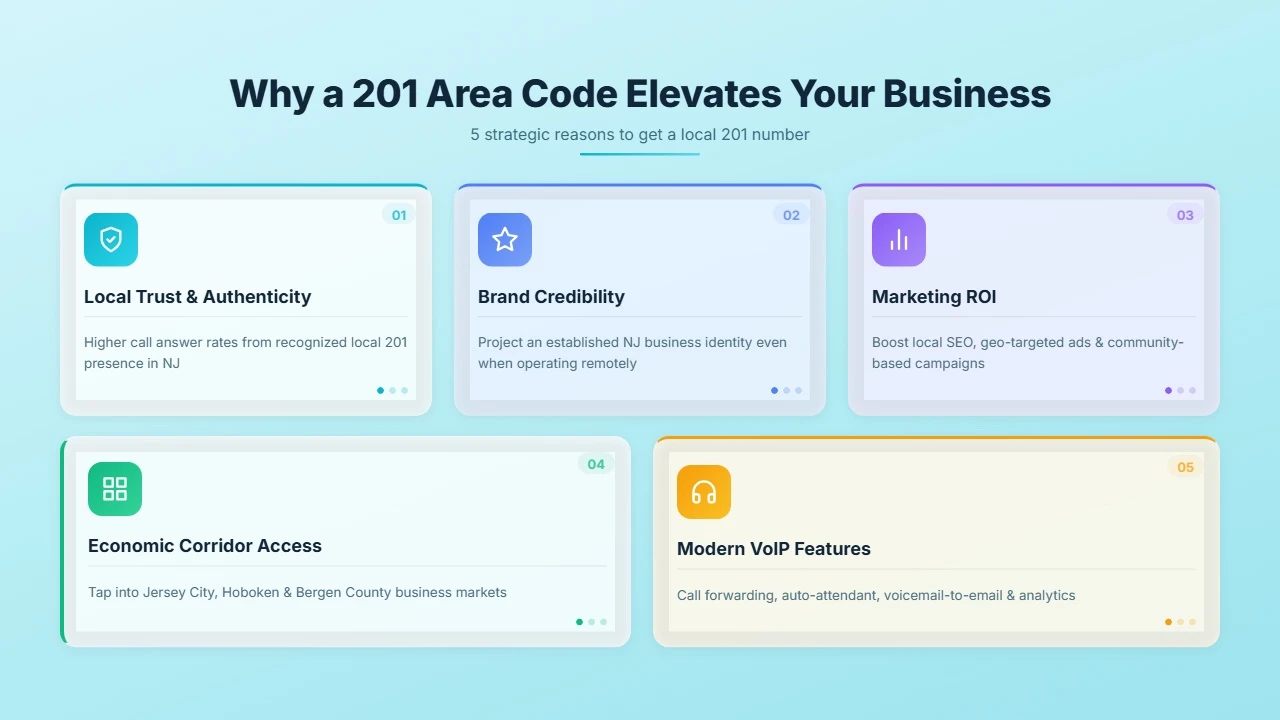
La zona 201 si trova in una delle zone economiche più strategicamente posizionate sulla costa orientale: abbastanza vicina a Manhattan per beneficiare della sua densità industriale, ma abbastanza indipendente da offrire costi operativi significativamente più bassi.
Wall Street West: Servizi finanziari
Il quartiere finanziario sul lungomare di Jersey City si è guadagnato il soprannome di "Wall Street West" per una buona ragione. Goldman Sachs mantiene lì uno dei suoi più grandi uffici statunitensi al di fuori di New York. JP Morgan Chase E Citigroup entrambi gestiscono operazioni significative a Jersey City, attratte dalla vicinanza a Manhattan a una frazione del costo immobiliare. Il settore FIRE (finanza, assicurazioni e settore immobiliare) a Jersey City è cresciuto di oltre 500% dal 1993.
Tecnologia e Fintech
Il settore tecnologico di Jersey City sta crescendo secondo le previsioni Tasso del 25%., con i ruoli di sviluppo software e analisi dei dati che registrano la domanda più forte. Quello di Hoboken Programma NJ VELOCE - L'acceleratore fintech del New Jersey, sostenuto dallo stato e con sede presso lo Stevens Institute of Technology, ha prodotto numerosi gruppi di startup fintech, IA e sicurezza informatica che hanno raccolto collettivamente decine di milioni in finanziamenti di rischio.
Logistica e commercio
Bayonne e le comunità meridionali della contea di Hudson si trovano adiacenti al Terminal marittimo del porto di Newark-Elizabeth — il più grande complesso portuale della costa orientale per volume di container.
I settori della logistica, dello stoccaggio e della gestione della catena di fornitura in tutta la zona meridionale 201 beneficiano direttamente di questa vicinanza.
Commercio al dettaglio e di consumo
La striscia di Paramus della contea di Bergen è uno dei corridoi di vendita al dettaglio più attivi dal punto di vista commerciale negli Stati Uniti.
L'elevato reddito familiare medio della regione e la densità di lavoratori professionisti ne fanno un mercato di consumo premium per le attività di vendita al dettaglio di lusso,
assistenza sanitaria e specialità.
Sanità e istruzione
I principali sistemi sanitari, tra cui Hackensack Meridian Health, operano in tutta la regione 201. Lo Stevens Institute of Technology di Hoboken e la Fairleigh Dickinson University di Teaneck sostengono il settore educativo.
Perché un numero aziendale 201 rafforza la tua posizione sul mercato
Un numero 201 funziona per le aziende nel nord-est del New Jersey in un modo che nessun numero verde o fuori dallo stato può replicare.
Credibilità adiacente a Manhattan
Per i clienti a New York City, un numero 201 segnala che non sei un venditore remoto: sei un peer locale. L'associazione di prossimità è immediata: Jersey City,
Hoboken e Fort Lee sono note comunità adiacenti a Manhattan.
Un numero 201 posiziona la tua attività come parte del più ampio ecosistema metropolitano di New York senza richiedere un indirizzo di Manhattan o spese generali a livello di Manhattan.
Fiducia locale in un mercato professionale denso
Le contee di Hudson e Bergen hanno una delle più alte concentrazioni pro capite di professionisti della finanza, del diritto,
della sanità e della tecnologia sulla costa orientale.
Questi sono decisori che rispondono ai numeri locali. Un numero 201 segnala la presenza della comunità e riceve la chiamata a tariffe che i numeri verdi non possono eguagliare.
SEO locale per ricerche specifiche del New Jersey
Un numero 201 coerente nel profilo dell'attività su Google, nel sito web e nelle citazioni locali rafforza la pertinenza geografica per le ricerche nella contea di Hudson e nella contea di Bergen.
La coerenza NAP (nome, indirizzo, telefono) è un fattore fondamentale di ranking SEO locale: un numero 201 allineato con i contenuti specifici del New Jersey migliora la visibilità per "vicino a me" e query specifiche per città in uno dei corridoi metropolitani più attivi nella ricerca nel paese.
Presenza remota senza costi per gli uffici del New Jersey
Non è necessario che un ufficio di Jersey City abbia un prefisso di Jersey City. I numeri virtuali 201 instradano le chiamate a qualsiasi dispositivo (mobile,
softphone o app desktop) da qualsiasi luogo.
Le aziende nazionali e i team remoti possono proiettare una presenza credibile nel nord-est del New Jersey senza le spese generali degli immobili commerciali della contea di Bergen o della contea di Hudson.
Attribuzione della campagna
L'assegnazione di numeri 201 dedicati ai singoli canali di marketing (stampa locale, pubblicità sui trasporti pubblici, campagne digitali, pagine di destinazione) fornisce dati chiari sulle chiamate in entrata per canale per il mercato del New Jersey. Questa attribuzione porta a decisioni di budget più mirate per le campagne destinate alla zona 201.
Come ottenere un numero aziendale 201 locale
1. Scegli un VoIP o un provider di numeri virtuali Seleziona un fornitore con inventario 201 attivo. Tieni presente che sia 201 che 551 servono lo stesso territorio: conferma che il fornitore ha in stock 201 specificamente se quel prefisso fa parte della strategia del tuo marchio.
2. Sfoglia e seleziona il tuo numero La maggior parte delle piattaforme ti consente di cercare i 201 numeri disponibili in base allo schema. Alcuni offrono opzioni di numeri vanity per la memorabilità nel mercato del New Jersey.
3. Confermare la conformità alla composizione a 10 cifre Da quando la sovrapposizione 551 è entrata in vigore nel dicembre 2001,
tutte le chiamate all'interno della zona 201/551 richiedono la composizione a 10 cifre.
Assicurati che il tuo IVR, le configurazioni delle chiamate in uscita del CRM e le regole di instradamento delle chiamate includano il prefisso completo su ogni formato numerico memorizzato.
4. Configurare l'instradamento delle chiamate Imposta la modalità di gestione delle chiamate 201 in entrata: inoltrarle al cellulare, instradarle tramite un menu IVR, far suonare un'app softphone o connettersi a una coda di chiamate.
5. Abilita gli SMS L'attivazione degli SMS bidirezionali sul tuo numero 201 aggiunge un canale pratico per promemoria di appuntamenti, follow-up dei clienti e supporto oltre alla voce.
6. Trasferisci un numero esistente, se necessario Le normative sulla portabilità del numero locale (LNP) ti consentono di trasferire un numero 201 esistente dal tuo attuale fornitore. Collabora con il tuo nuovo fornitore per programmare il trasferimento e verificare che non vi siano lacune nel servizio durante la transizione.
Cosa cercare in un fornitore
Quando selezioni un fornitore per un numero NJ locale, valuta:
- Affidabilità in termini di operatività — Rozper è progettato per garantire affidabilità, mantenendo la tua linea NJ attiva e disponibile per ogni chiamata in entrata, anche durante i periodi di forte richiesta.
- Qualità della chiamata — Le connessioni dell'operatore di livello 1 e il supporto del codec HD Voice garantiscono un audio chiaro per le chiamate di clienti e potenziali clienti.
- Profondità delle funzionalità — IVR, inoltro di chiamata, registrazione delle chiamate, voicemail-to-e-mail, analisi e SMS dovrebbero essere funzionalità standard.
- Portata internazionale - Se la tua attività nel nord-est del New Jersey si collega ai mercati globali, un fornitore che copre molti paesi mantiene tutto su un'unica piattaforma.
- Prezzi trasparenti — Richiedi per iscritto i prezzi e i termini contrattuali prima di impegnarti.
Rozper è un'opzione che vale la pena considerare qui, mantenendo un servizio affidabile e una copertura internazionale in modo che un'unica piattaforma possa servire sia la linea locale di Jersey City che qualsiasi operazione internazionale.
Sfide e soluzioni comuni relative ai numeri aziendali 201
| SFIDA | TIPOLOGIA DI AZIENDA INTERESSATA | SOLUZIONE | PRIORITÀ |
|---|---|---|---|
| Sistemi legacy che utilizzano la composizione locale a 7 cifre | Tutte le aziende con chiamate in uscita PBX o CRM | Aggiorna tutte le configurazioni delle chiamate in uscita e IVR al formato a 10 cifre (obbligatorio da dicembre 2001) | Alto |
| Chiamate fuori orario perse da clienti di New York | Società finanziarie, legali, immobiliari | Configura l'IVR fuori orario con la segreteria telefonica-e-mail: i clienti di New York spesso chiamano tardi | Alto |
| La truffa OSHA/utility mette in pericolo la fiducia del marchio | PMI e servizi professionali | Utilizza un provider conforme a STIR/SHAKEN + comunica i protocolli di contatto ai clienti | Alto |
| Team remoto che necessita di un numero NJ unificato | Team distribuiti e remoti | Inoltro di chiamata + instradamenti tramite softphone da qualsiasi luogo; i clienti vedono un singolo numero 201 | Medio |
| Monitoraggio di più numeri di campagna | Team di marketing e vendite | Il dashboard di analisi centralizzata mostra i dati sulle chiamate per numero in tempo reale | Medio |
| Scarsa qualità delle chiamate VoIP verso Manhattan | Finanziario, legale, sanitario | Passa all'operatore di livello 1 con HD Voice e QoS: essenziale per le chiamate tra Hudson | Alto |
| Overhead del CRM per un volume in entrata elevato | Imprese aziendali e di fascia media | Integra VoIP con CRM per la registrazione automatica delle chiamate e la visualizzazione dello schermo | Medio |
Qual è il futuro della Regione 201
La traiettoria di crescita di Jersey City sta accelerando. Poiché i costi degli immobili commerciali a Manhattan rimangono proibitivi per le aziende di medie dimensioni,
il distretto di Wall Street West continua ad attrarre istituzioni finanziarie e aziende tecnologiche che cercano infrastrutture di qualità nel New Jersey a costi inferiori.
Le ricadute economiche per le imprese dell’area 201 sono significative e continue.
L'ecosistema fintech di Hoboken sta maturando. Il continuo successo dell’acceleratore NJ FAST presso lo Stevens Institute sta producendo una pipeline di startup fintech che stanno mettendo radici nella zona 201, creando una crescente domanda B2B di servizi professionali, comunicazioni e infrastrutture per uffici.
L’adozione di UCaaS sta accelerando in tutto il settore finanziario. Le istituzioni finanziarie concentrate a Jersey City si stanno rapidamente spostando dai sistemi PBX legacy alle piattaforme di comunicazione unificata che integrano voce, video e gestione delle chiamate assistita dall'intelligenza artificiale, alzando il livello di qualità e affidabilità della comunicazione nell'intero mercato 201.
La gestione delle chiamate basata sull’intelligenza artificiale sta diventando mainstream. La trascrizione in tempo reale, l'analisi del sentiment e il routing intelligente stanno diventando aspettative standard tra i clienti di livello professionale nella zona 201, creando nuovi criteri di selezione per i provider VoIP.
Conclusione
IL Prefisso 201 è qui che ha avuto inizio l'identità delle telecomunicazioni del New Jersey (serviva l'intero stato nel 1947) e oggi concentra alcune delle comunità commercialmente più significative del Nordest.
Da Wall Street West di Jersey City agli acceleratori fintech di Hoboken, al potere commerciale della contea di Bergen e alla connettività attraverso l'Hudson che dista pochi minuti da Manhattan,
la zona 201 colpisce ben al di sopra del suo peso geografico.
Per le aziende, un numero 201 è uno degli investimenti più efficienti disponibili nella credibilità del mercato del Nordest del New Jersey.
Segnala la presenza locale, aumenta i tassi di risposta alle chiamate con una base di clienti altamente professionale, supporta il SEO locale e consente ai team distribuiti di proiettare la stessa identità comunitaria delle aziende con un indirizzo fisico nella contea di Hudson.
Ogni sovrapposizione e suddivisione che ha plasmato il territorio 201 nel corso dei decenni è stata effettuata sotto la stessa supervisione dell'amministrazione della numerazione che regola il modo in cui oggi i nuovi prefissi vengono assegnati a livello nazionale.
Domande frequenti
Quali città sono coperte dal prefisso 201?
Copre la contea di Hudson e gran parte della contea di Bergen nel New Jersey nord-orientale. Le città principali includono Jersey City, Hoboken, Bayonne, Secaucus, Weehawken, Hackensack, Englewood, Fort Lee, Paramus, Teaneck e Fair Lawn. Confina con New York City direttamente attraverso il fiume Hudson.
Qual è il prefisso 551 e come si collega al 201?
Il codice 551 è una sovrapposizione per lo stesso territorio geografico del 201: contee di Hudson e Bergen. È stato introdotto il 1 dicembre 2001,
quando la fornitura del numero 201 stava per esaurirsi, nell'ambito del quadro amministrativo della numerazione della FCC che regola quando e come vengono aggiunti nuovi prefissi.
Entrambi i codici sono ugualmente locali; 551 non è una zona periferica o secondaria. Una conseguenza fondamentale della sovrapposizione è la composizione obbligatoria di 10 cifre per tutte le chiamate all'interno della regione 201/551.
Devo comporre il prefisso per le chiamate locali nella regione 201?
Sì, da quando l'overlay 551 è entrato in vigore nel dicembre 2001, la composizione a 10 cifre (prefisso teleselettivo + numero a 7 cifre) è obbligatoria per tutte le chiamate all'interno della zona 201/551. Componendo solo un numero di 7 cifre non si collegherà, nemmeno per le chiamate all'interno della stessa città.
Quale fuso orario utilizza il codice 201?
Il prefisso 201 si trova nel fuso orario orientale (ET). Osserva l'ora solare orientale (EST, UTC−5) da inizio novembre a metà marzo e l'ora legale orientale (EDT,
UTC−4) da metà marzo a inizio novembre.
Poiché il 201 condivide il fuso orario orientale con New York City, non vi è alcuna differenza oraria per le chiamate aziendali tra Hudson.
Quali tipi di truffe prendono di mira il prefisso 201?
Le tipologie di truffe specifiche del New Jersey includono le frodi sulla conformità OSHA (chiamanti che si spacciano per ispettori della sicurezza per vendere materiali di conformità non necessari alle aziende) e le frodi sul cambio di servizio,
in cui i chiamanti si spacciano per PSE&G o Elizabethtown Gas per ottenere numeri di conto e trasferire i clienti a fornitori di energia di terze parti più costosi.
Anche lo spoofing dei vicini è ampiamente segnalato. Le legittime società di pubblica utilità e applicazione dell'OSHA non avviano contatti in questo modo.
Posso ottenere un numero 201 senza trovarmi fisicamente nel New Jersey?
SÌ. I numeri virtuali 201 instradano le chiamate a qualsiasi dispositivo (mobile, softphone o app desktop) indipendentemente dalla tua posizione fisica. Ciò consente alle aziende al di fuori del New Jersey di stabilire una presenza credibile nel nord-est del New Jersey e di raggiungere i clienti della contea di Hudson e Bergen come azienda locale.
Rozper offre 201 numeri aziendali?
SÌ. Rozper fornisce numeri 201 locali con funzionalità VoIP complete: inoltro di chiamata, IVR, registrazione delle chiamate, trasmissione da posta vocale a e-mail, analisi e SMS. Con un servizio affidabile e una copertura internazionale, Rozper supporta sia la presenza locale nel New Jersey che le esigenze di comunicazione globale da un'unica piattaforma.