소개
Imagine your sales team places 400 outbound calls in a morning. Sixty of them never connect, a dozen connect with garbled audio,
and on half the rest your company's caller ID shows up as an unknown number.
Nothing is wrong with your phones, your agents, or your scripts — the problem lives in a layer of the network you've probably never examined: call termination.
Wholesale VoIP termination is the machinery that carries a call from your network to the person who answers it, anywhere in the world. It determines whether calls connect,
how they sound, what they cost, and whether your number is trusted or flagged.
This guide explains how termination actually works, the difference between route types, what separates a dependable termination partner from a cheap one, and where the market is heading in 2026.
What Is Wholesale VoIP Termination?
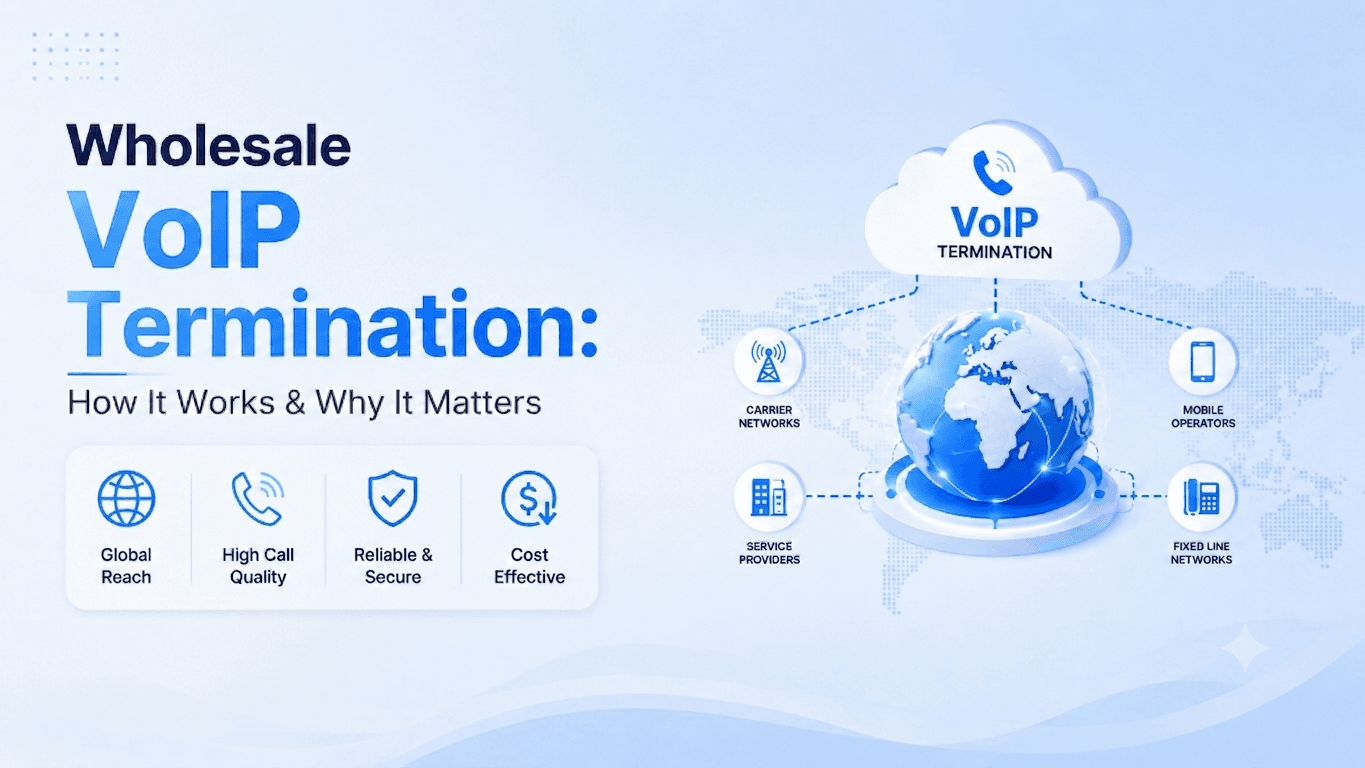
Wholesale VoIP termination is the bulk routing of outbound voice calls from an IP network to their final destination — whether that's a mobile phone in London,
a landline in São Paulo, or another VoIP endpoint.
"Termination" refers to the final leg of a call's journey: the handoff that completes ("terminates") the call on the recipient's network. Wholesale providers sell this completion capacity in volume to carriers,
resellers, call centers, and enterprises, at per-minute rates far below retail.
This guide focuses on the SIP-based termination stack specifically — session control, route-legality tiers, and the MOS/ASR/PDD metrics that define route quality. If you're weighing termination against other pricing models before committing to SIP,
our wholesale voice termination guide covers the protocol-agnostic fundamentals and pricing structures first.
Why Termination Is the Layer That Matters Most
Every other part of your voice stack — PBX, softphones, dialers, CRM integrations — only matters if the call actually completes well. Termination quality controls your answer-seizure ratio,
audio clarity, caller ID display, and cost per conversation.
In a wholesale voice market valued at roughly $44.5 billion in 2026 and projected to reach $73.6 billion by 2031, termination is where providers genuinely differentiate — and where buyers either capture value or leak it.
Key Takeaways
- Termination is the final leg: It's the handoff that completes your outbound calls on the recipient's network, and it determines connection rates, audio quality, and caller ID integrity.
- Route type defines quality: Direct, compliant "white" routes preserve CLI and deliver high answer rates; grey routes look cheaper but degrade quality and create compliance risk.
- Cost is more than the rate: Billing increments, short-call surcharges, and failed-call ratios shape your real cost per connected conversation.
- Metrics don't lie: ASR, ACD, PDD, and MOS reveal route quality objectively — test before you commit traffic.
- Authentication is now mandatory: STIR/SHAKEN and global anti-spoofing rules mean non-compliant termination increasingly gets blocked or labeled spam.
Understanding Wholesale VoIP Termination
Before optimizing for cost or quality, it's worth understanding exactly what happens — technically and commercially — when a call terminates on someone else's network.
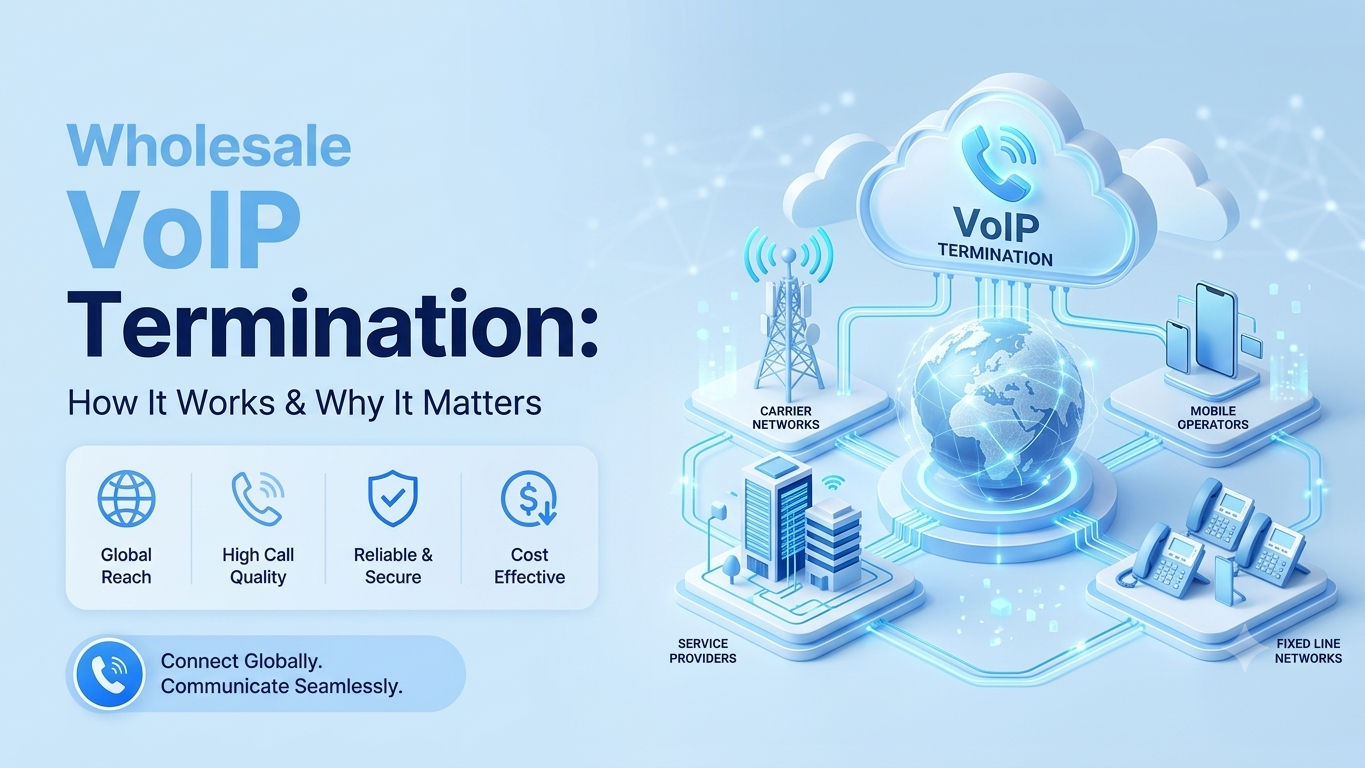
How a Call Gets Terminated
When a call leaves your network, your termination provider's switch reads the destination number and selects a route from its interconnect portfolio.
The call may pass through one or several carrier networks before reaching the destination operator, which completes it to the end device.
Each hop adds potential latency and cost, which is why providers with direct interconnects to destination carriers deliver both better quality and better economics than providers reselling someone else's routes.
Our guide to wholesale voice termination covers the carrier-agnostic fundamentals of this same process.
Termination vs. Origination
The two halves of wholesale voice are easy to confuse. Termination handles your outbound calls — traffic leaving your network for the world. Origination handles inbound — calls from the public network arriving at your VoIP system,
typically via DIDs.
Most businesses need both, but they're priced, routed, and evaluated differently. A provider can be excellent at one and mediocre at the other, so evaluate each on its own evidence.
White, Grey, and Black Routes
Termination routes fall into three categories. White routes are fully licensed interconnects that pay all regulatory fees and preserve caller ID end to end.
Grey routes exploit arbitrage — SIM boxes disguising international traffic as local calls are the classic example — delivering lower prices with degraded CLI,
poor answer rates, and regulatory exposure.
Black routes are outright fraudulent. These price gaps explain most "too good to be true" quotes: US white-route termination runs around $0.003–$0.004 per minute,
and anything far below market almost always signals a route-quality compromise.
Benefits of Wholesale VoIP Termination
Lower Cost per Connected Call
Wholesale termination rates sit dramatically below retail calling prices because providers aggregate traffic across hundreds of customers and negotiate carrier interconnects at scale.
But the real economic win is subtler: high-quality routes convert more attempts into conversations. A route that's 20% cheaper but connects 30% fewer calls costs you more per actual conversation — the metric that matters.
Higher Answer Rates Through CLI Integrity
When termination preserves your caller ID correctly, recipients see a recognizable local or business number and answer more often. Quality termination providers maintain CLI-guaranteed routes precisely because answer rate is revenue for their customers — every percentage point of ASR improvement multiplies across thousands of dial attempts.
Global Reach Without Carrier Sprawl
Building direct relationships with carriers in every destination country is impractical for all but the largest operators. A wholesale termination partner consolidates that complexity into one interconnection: one contract, one rate deck, one support channel — with completion capability across the globe.
Capacity That Scales With Demand
Termination capacity is provisioned in software, not hardware. Campaign-driven businesses can scale from hundreds to thousands of concurrent calls in hours, then scale back down, paying only for traffic sent. No legacy telephony arrangement matches this elasticity.
The Metrics That Define Termination Quality
ASR — Answer-Seizure Ratio
ASR measures the percentage of call attempts that result in an answered call. Healthy conversational traffic on good routes typically shows ASR in the 40–60% range depending on destination. Persistently low ASR on a route signals congestion, poor interconnects, or CLI problems suppressing answer rates.
ACD — Average Call Duration
ACD reflects how long answered calls last. Routes with degraded audio show shortened ACD because people abandon calls they can't hear properly. Providers also watch your ACD: very short average durations suggest dialer traffic, which is priced and routed differently.
PDD — Post-Dial Delay
PDD is the silence between dialing and ringback. Beyond about five seconds, callers start abandoning attempts and called parties grow suspicious. Long PDD usually means a call is hopping through too many intermediate carriers — a hallmark of resold or grey routing.
MOS — Mean Opinion Score
MOS scores audio quality from 1 to 5; above 4.0 is the benchmark for business-grade voice. Modern platforms compute MOS continuously from network telemetry, so a serious provider can show you live quality data per route rather than assurances.
Choosing a Wholesale VoIP Termination Provider
Verify the Route Portfolio
Ask which of your key destinations are served by direct interconnects versus third-party routes, and how many redundant paths exist to each — any credible provider should be willing to share these specifics.
Rozper is one option worth considering here, with a single termination partner that can support both domestic and international routes.
Run a Live Traffic Test
Route quality can't be evaluated from a rate deck. Send two weeks of real traffic to your actual destinations and measure ASR, ACD, PDD, and CLI display against your current provider. Providers confident in their network welcome testing; resistance to a trial is itself a data point.
Audit the Commercial Terms
Check billing increments (per-second billing materially reduces costs on short calls), short-duration surcharges, minimum commitments, and rate-change notice periods. Termination rate decks change frequently — you want contractual transparency about when and how.
Confirm Compliance and Fraud Controls
Verify STIR/SHAKEN attestation practices for US traffic, E911 handling where relevant, and built-in fraud protections like destination blocking and real-time spend alerts. Toll fraud costs the industry billions annually, and your termination provider is your first line of defense — see our broader wholesale VoIP guide for how this fits into your overall infrastructure strategy.
Evaluate the Humans
When a route to a key market degrades at midnight before your biggest campaign, the question is who picks up and whether they can read a SIP trace.
Ask prospective providers how escalations actually work — who answers, how fast, and with what authority to reroute traffic. This human layer is where Rozper deliberately competes,
offering direct access to engineers rather than ticket queues.
Termination Trends Shaping 2026
AI-Optimized Routing
Machine learning now predicts route quality before sending calls, scoring carriers on live telemetry and rerouting traffic the moment quality dips.
Nearly 58% of VoIP providers have integrated AI-driven analytics, and the gap between AI-routed and statically-routed networks is widening — in both quality and cost,
with industry forecasts pointing to 5–10% rate declines as routing efficiency improves.
Authentication Becomes Table Stakes
STIR/SHAKEN in the US and parallel frameworks elsewhere are making call authentication a condition of completion, not a nice-to-have. Unauthenticated or poorly attested traffic increasingly gets labeled "Spam Likely" or blocked outright. Termination providers that handle attestation properly now directly protect their customers' answer rates.
The Squeeze on Grey Routes
Carrier filtering, SIM-box detection, and regulatory enforcement are shrinking the grey-route arbitrage that once undercut compliant termination. Expect the price gap between compliant and non-compliant routes to persist, but the usability of cheap grey routes to keep collapsing — making white-route termination the only durable strategy.
Termination Bundled into Platforms
Buyers increasingly want termination, origination, DIDs, SMS, and APIs from one platform with unified billing and analytics. Standalone minute-selling is giving way to integrated wholesale platforms where termination is the anchor service.
Wholesale Termination Cost Optimization
Getting termination spend under control rarely means chasing lower headline rates. Start by measuring cost per connected conversation rather than cost per minute — it exposes routes that are cheap but underperforming.
Insist on per-second billing for international traffic, review your destination mix quarterly against current rate decks, and watch short-duration call ratios, which can signal quality problems or fraud inflating your bill.
Consolidate traffic enough to reach meaningful volume tiers with one or two primary providers, while keeping a tested backup route for resilience.
결론
Wholesale VoIP termination is the invisible layer that decides whether your outbound calls become conversations. The fundamentals reward diligence: understand the route types beneath the rates,
measure quality with ASR, ACD, PDD, and MOS rather than promises, and price your traffic by what a connected call actually costs.
In a market consolidating around compliant, AI-routed, platform-based termination, the businesses that thrive will be the ones that partnered for quality early.
See how Rozper terminates traffic at rozper.com/wholesale-voip.
자주 묻는 질문
What does "termination" actually mean in VoIP?
Termination is the final leg of a call's journey — the handoff that completes your outbound call on the recipient's network, whether that's a mobile carrier, landline operator, or another VoIP network. A wholesale termination provider sells this completion capability in bulk, routing your calls through its carrier interconnects to destinations worldwide.
How is wholesale VoIP termination different from SIP trunking?
SIP trunking is the connection method — the virtual phone lines linking your PBX to the outside world. Termination is the service that completes the calls those trunks carry.
In practice, a SIP trunk delivers your traffic to a provider, and the provider's termination network finishes the job. Many providers bundle both, but they're distinct layers worth evaluating separately — our wholesale VoIP services guide covers how they typically come packaged together.
What ASR should I expect on a good termination route?
It varies by destination and traffic type, but conversational business traffic on quality routes typically shows ASR between 40% and 60%.
Comparing the same traffic across two providers is more meaningful than absolute numbers: if a new route shows materially lower ASR on identical campaigns,
the route — not your dialing — is usually the problem.
Why was my caller ID showing incorrectly on some calls?
That's the signature symptom of grey-route termination. When calls travel through arbitrage paths like SIM boxes, the original caller ID is stripped or replaced, so recipients see unknown or local random numbers. Beyond hurting answer rates, this can violate caller ID regulations. The fix is moving traffic to CLI-guaranteed white routes.
Can one provider handle both my US and international termination?
Yes, and consolidation usually improves your volume pricing — but verify coverage destination by destination. A provider can have excellent direct routes in North America and weak, resold routes in the markets you call most. Request route-type disclosure and test live traffic on your top international destinations before consolidating.
How do termination providers prevent fraud on my account?
Mature platforms enforce destination whitelists or blocks, velocity limits on unusual calling spikes, real-time spend alerts, and machine-learning anomaly detection that flags traffic patterns consistent with compromised systems.
Ask any prospective provider to walk through exactly what happens in the first five minutes after your PBX starts blasting calls to a premium-rate destination at 3 a.m.
Is the cheapest termination rate ever the right choice?
Occasionally — for traffic where answer rates and caller ID don't matter, such as some notification use cases. For any revenue-generating calling, cost per connected conversation beats cost per minute as the deciding metric, and quality routes win that comparison far more often than rate decks suggest.